She Gave Them $15,000 for a Truck — Then Fought Them for the Kids
Doris was blowing the foam off a cup of coffee at the breakfast table when the doorbell went off — not the polite chime you get from a neighbor, but the hard, flat ring that comes with a government vehicle.
Two airmen stood on the porch, caps in hand, and she knew before they opened their mouths.
"Ma'am, we regret to inform you…"
Jack, her only child, was gone. A training flight out of Tucson. Engine failure at low altitude. They found the wreckage six miles from the runway.
The next few weeks came at her like a fever dream. Tessa, her daughter-in-law, drove up from North Carolina with the three kids in a minivan that wheezed every time it climbed a grade. The funeral. The folded flag. The twenty-one gun salute that made Jacob, the oldest, flinch so hard he bit his lip.
And then… nothing. Just the empty side of the bed in the guest room and the sound of her granddaughter Lily asking, "Is Daddy on the moon now?"
—
Doris had been alone on the farm outside St. Johnsbury, Vermont, for eleven years since her husband passed. What she had now was four acres of stony hillside pasture, a dozen laying hens, a pig named Albert she was too soft to slaughter, and a dairy herd she leased to the neighbor. The house smelled of wood smoke and the faint sourness of cow feed that seeped in every time the wind shifted.
When Tessa announced she was taking the kids to live with her in town, Doris didn't argue. She just put an extra blanket on the bed and cleared out the junk drawer in the kitchen so Emily could keep her art supplies.
That was the first spring after the crash. It was also the week Doris walked into the Passumpsic Savings Bank and wired fifteen thousand dollars — most of what was left of Jack's life insurance payout — into Tessa's account. Tessa's minivan had died for good on Route 91, and a nursing job meant nothing without a way to get to it.
"You don't have to pay this back," Doris had told her over the phone. "Buy something reliable. A truck, if you want. Something that'll get the kids to school in the snow."
Tessa cried so hard she couldn't finish the sentence "thank you." Two weeks later she pulled into Doris's driveway in a used gray Silverado with a hundred thousand miles on it and hugged her so tight Doris's back popped.
By summer Tessa was worn thin anyway. Her nursing license had lapsed when she moved, and the closest hospital was an hour's drive. She sat on the back steps a lot, staring at the broken porch swing that Doris and Jack had meant to fix in '09 but never did.
One night at supper — meatloaf and instant mashed potatoes — Tessa set down her fork and said, "I got a job offer. Up in Montreal."
Doris pushed a green bean across her plate. "That's not a commute you can make."
"No. I'd have to live there. A private clinic, good pay. They're desperate for bilingual nurses, and my French is fine." Tessa took a breath. "The kids would stay here. Just for six months or so, until I'm on my feet. I'll send for them the second I'm settled."
Lily, who was six then, didn't understand. Jacob, fourteen, didn't look up from his phone. Emily, ten, drew a circle in her ketchup with one finger and said nothing.
Doris said, "Fine."
—
Six months came and went. Tessa called every Sunday, always with a reason the timing wasn't right yet — the apartment search, then the licensing paperwork, then a slow season at the clinic. Doris didn't push. She told herself grief moved at its own speed, and that a woman who'd buried her husband at twenty-nine deserved room to breathe before anyone asked her to explain herself.
The packages started arriving every three weeks. A shipping box with Canadian stamps. Maple cookies, powdered milk, a snowsuit for Lily, a Canadian twenty-dollar bill tucked inside a birthday card for Jacob. Then a money transfer — two hundred and fifty dollars one month, four hundred the next.
Doris used the money to put a new water heater in the basement. The kids were good. They were real good. Jacob took over feeding the chickens. Emily learned to drive the old Ford tractor in low gear so she could pull a cart of firewood up from the shed. Lily still cried at night sometimes, but she'd crawl into Doris's bed and press her cold toes against her shins, and Doris would hum a hymn until they both fell asleep.
One year became a season, and the season became another Christmas. It wasn't perfect, but it worked, and Doris stopped counting the months out loud, even to herself.
The trouble started the second winter, just before the holidays, at the feed store.
"I hear your daughter-in-law's engaged," said Patty, who ran the register and knew everything because her brother-in-law worked at the border crossing. "Some bigwig from the clinic. Gerard something."
Doris fumbled with the credit card machine. "You heard wrong, Patty."
"She posted pictures all over Facebook. You should get one of them smartphones."
Doris paid for her laying pellets and drove home without the radio on.
That night, after the kids were asleep, she sat at the kitchen table with Emily's tablet. She typed in Tessa's name. It took her three tries because she couldn't remember whether you used the 's' or not.
The profile was public.
Tessa at a restaurant with candles on the table. Tessa on a boat — the St. Lawrence River, the caption said. Tessa with a man in a navy blazer, his hand on her waist, her smile almost cutting the screen in half. Gerard.
Doris counted the photos. Seventeen. In five months.
She shut the tablet so hard the case cracked.
—
Tessa called two days later, voice bright in that rehearsed way you use with children.
"I wanted you to hear it from me. I'm getting married. Gerard's wonderful. He has a house in Westmount — big enough for all of us. I want to bring the kids up after New Year's."
Doris was sitting on the edge of her bed, the cordless phone hot against her ear. Outside the window, the wind had picked up and was rattling the loose screen.
"Bring them where, exactly?" she asked.
"To Montreal. They'll go to school there. Gerard's kids are grown, his ex-wife is in Toronto. He wants a family again. And Jacob — he'll be fifteen in March. The way things are in the world, I don't want him anywhere near a military recruiter when he turns eighteen. I don't want to lose another one, Doris."
That last line landed like a fist.
"You said six months," Doris said quietly. "It's been almost two years. I've been paying for their school clothes and their dentist and their Christmas out of your husband's life insurance, and you're calling me now, after the fact, to tell me it's decided."
"I know I let it go on too long. I was scared to face it. But I'm their mother, Doris."
Doris had no answer that would fit in a phone call. She just said, "We'll talk when you come down."
—
Tessa arrived on a Saturday afternoon in early January. She pulled up the gravel drive in the gray Silverado — the same truck, Doris noticed, still running — wearing city boots that had no business on that kind of mud.
The kids ran to her. Lily shrieking, Emily half-laughing, Jacob hanging back by the chicken coop with his hands in his pockets.
Doris stood on the porch and didn't smile.
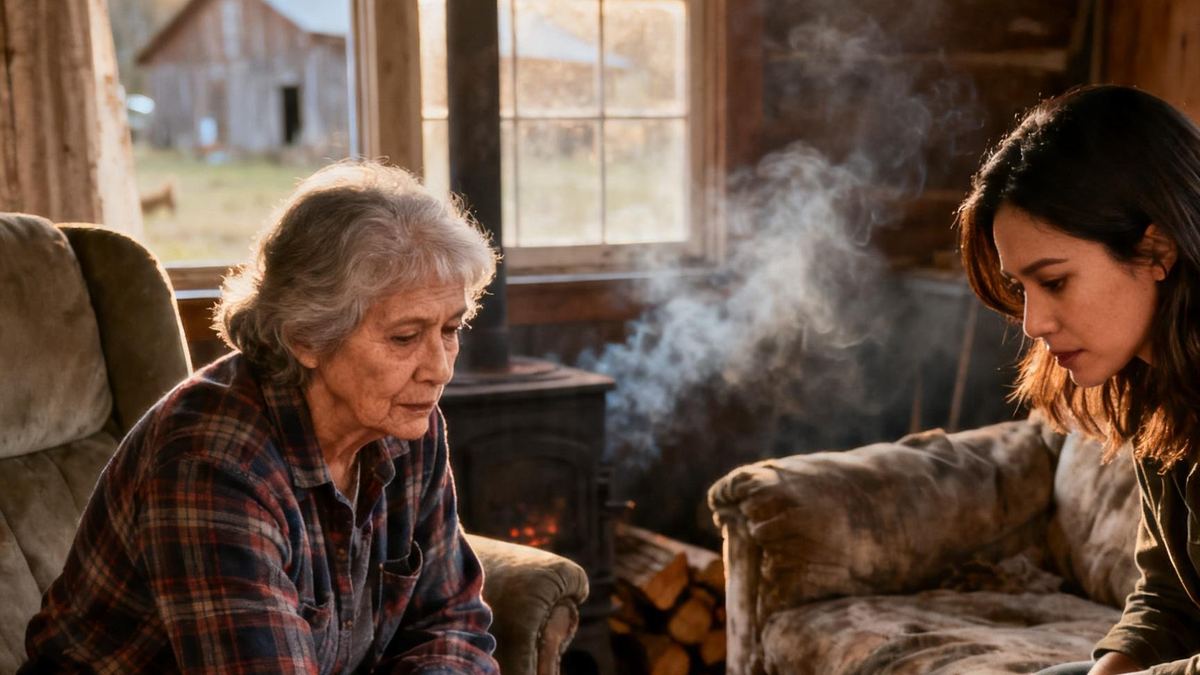
They sat in the living room. Tessa on the lumpy sofa, Doris in the recliner that had been her husband's. Between them, on the scarred coffee table, sat the custody petition Doris had filed at the Caledonia County courthouse three days prior. She'd paid the two hundred and fifty dollar filing fee in cash, and she had the stamped copy right there, face up.
"What's that?" Tessa asked, her voice still pleasant, still in the mode of someone who thinks this is a conversation.
"A petition for temporary custody. I'm asking the judge to keep the kids here while we sort this out. They've lived with me nearly two years now. Jacob's enrolled in the Vo-Tech program next fall. Emily's therapist is down in Lyndonville, and Lily — she hasn't spent more than three nights away from me since her daddy died."
Tessa's face went through three expressions in four seconds. Disbelief, then understanding, then the cold, clear stillness of someone who just realized she's been outmaneuvered by a woman who makes her own butter.
"You can't do this. Not after what I — after everything."
"After what, Tessa? After I wired you fifteen thousand dollars so you could buy that truck sitting in my driveway right now? I never once asked for it back, and I'm not asking now. But don't sit on my husband's couch and tell me what I owe you."
Tessa's mouth opened and closed. "That's not fair."
"No," Doris agreed. "None of it's fair. Jack being dead isn't fair. You having to start over isn't fair. Those kids losing their father isn't fair. I'm not trying to win a fairness contest. I'm trying to keep three children in the only home that's felt steady since the day two airmen stood on my porch."
—
The hearing was set for the second week of February, in a courtroom in St. Johnsbury with water stains on the drop ceiling and a radiator that clanked through every recess. Doris wore her church dress. Tessa wore gray, and Gerard did not come — his lawyer had told him it would look better if he didn't.
It took three sessions. The judge, a soft-spoken woman named Alvarez who'd raised four kids of her own on a Vermont salary, asked Jacob privately, in chambers, what he wanted. Doris never learned exactly what he said, but she watched his face when he came out — steadier than she'd seen it since the funeral.
In the end, Judge Alvarez didn't split the baby, because there wasn't a baby to split. She granted Doris primary physical custody, with the finding that removing the children from their established home, school, and community — especially so soon after their father's death — was not in their best interest. Tessa would keep legal custody and visitation rights: holidays, summers, video calls twice a week. If she wanted to petition again once she and Gerard had married and settled, and once the children had a full school year of stability behind them, the court would hear it.
Tessa cried in the hallway afterward, not the performed kind of crying but the kind that comes out sideways, ugly and real. Doris sat beside her on the hard wooden bench outside the courtroom and didn't say anything for a while.
"I'm not trying to erase you," Doris finally said. "I never once told them you didn't love them. You call every Sunday. You keep calling every Sunday, you hear me? That truck's still running. Use it to come see them."
Tessa nodded, wiping her face with the heel of her hand. "The recruiter thing. That's real, Doris. I meant that part."
"I know you did. But you can't keep a boy safe by moving him to another country. You keep him safe by being somebody he trusts enough to talk to when he's scared. That's true whether you're in Westmount or St. Johnsbury."
—
That spring, Jacob turned fifteen on the farm, in the kitchen that still smelled like wood smoke and cow feed, with a cake Emily had frosted crooked on purpose because she said it looked more like a real cake that way. Tessa came down for it, driving the gray Silverado, and stayed two nights in the guest room instead of the motel by the highway.
She and Doris didn't talk about the hearing. They talked about Lily's kindergarten teacher, and whether Albert the pig had finally gotten too fat to catch, and whether the Vo-Tech program took auto shop as an elective.
When Tessa left Sunday morning, Jacob walked her out to the truck. Doris watched from the porch as her grandson leaned into the driver's window for a long time, talking about something she couldn't hear, and his mother reached out and gripped his hand through the open window before she backed down the gravel drive.
Doris went back inside, poured coffee that had already gone lukewarm, and started a grocery list.





