Not polite silence.
Not curious silence.
The kind of silence that settles over a room when everyone suddenly realizes they’re already inside a scandal — and nobody’s found the exit yet.
Victoria Ashford still had one hand raised mid-gesture, frozen in place like the whole restaurant had hit pause before she could finish humiliating you. Her crimson dress was flawless. Her diamonds were flawless. Her face was not.
For the first time all evening, something that looked like fear crossed it.
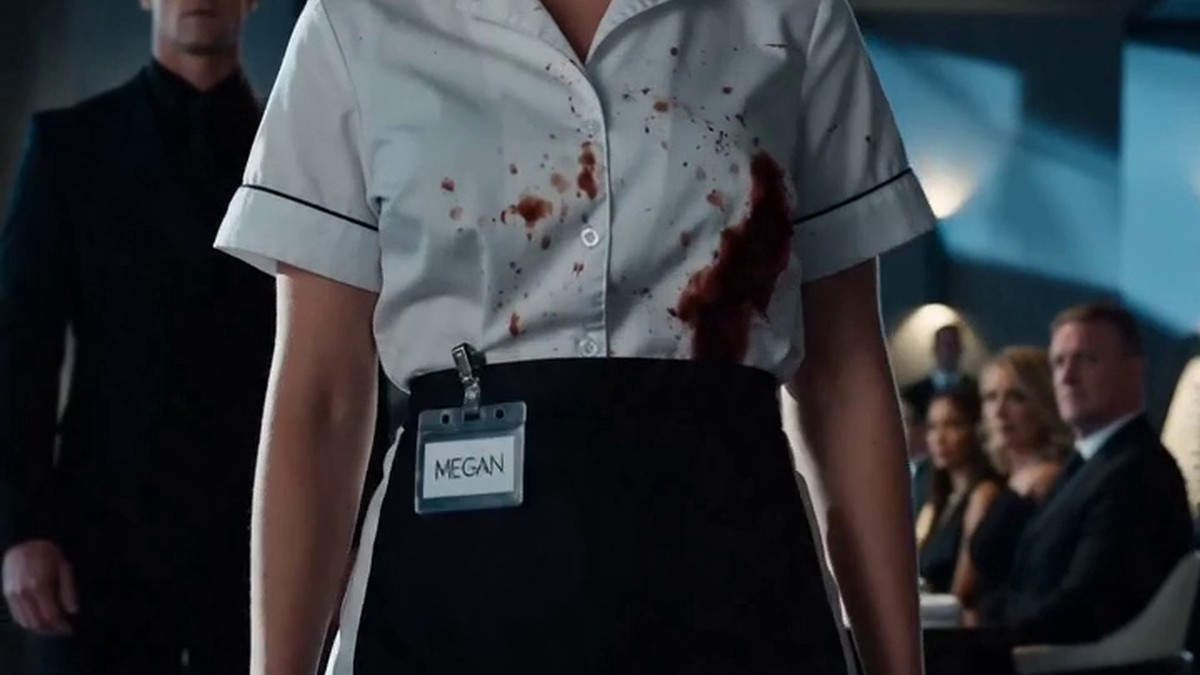
You looked down at the torn waitress uniform.
The seam had split at the collar. Red wine spread across the black fabric like an open wound. In your palm sat a cheap plastic name tag that read MEGAN — the false name that had made the whole disguise possible.
Victoria recovered first.
Women like her always did.
She let out a short laugh. Too sharp to sound natural.
“Is this supposed to be some kind of performance?”
Nathan crossed the dining room without hurrying.
That’s what people so often misunderstood about real power. It didn’t always arrive loudly. It didn’t rush. Sometimes it simply moved slowly enough that everyone felt it coming.
Your manager, Owen, went pale.
“Mr. Bennett.”
Nathan didn’t even glance at him.
His eyes stayed on you.
When he took in the torn uniform, something serious moved across his face. Not shock. Not confusion. Rage — but contained. Controlled.
You gave a slight shake of your head.
*Not yet.*
He stopped beside you but didn’t touch you. He understood better than to turn this moment into a rescue.
That was one of the reasons you’d married him.
He had the money to own a room, the power to command it, and the strength to dismantle it entirely.
But he also knew when to stand beside you and let you speak for yourself.
Victoria’s eyes moved from you to Nathan, then back again.
Her smile flickered — just barely.
“Nathan. How theatrical. Your staff gets more dramatic every year.”
Something went cold under your skin.
She’d said his name too easily.
Not Mr. Bennett.
Not Nathan Bennett.
*Nathan.*
Like she’d earned the right to it somewhere you hadn’t been told about.
A ripple moved through the room.
Guests glanced down at their plates, then looked back up. Phones shifted beneath napkins, half-hidden but ready. A few people had already started recording.
Good.
Let them.
Victoria tilted her head in your direction.
“Are you going to dismiss her, Nathan? Or does your wife let the help run your dining room now?”
The word *wife* landed strangely.
Because Victoria had delivered it with confidence.
Too much confidence.
Like she was waiting for you to flinch.
Like she knew exactly where to press.
Nathan’s jaw tightened.
You placed one hand lightly on his sleeve.
Then you looked directly at Victoria.
“The help?”
Her gaze slid back to you.
“Yes, darling. The help.”
You smiled.
“Then let the help introduce herself properly.”
The attorneys who had followed Nathan out of the elevator moved closer.
Owen swallowed hard.
At the bar, one of the waitresses had started crying quietly.
You saw her.
Hannah.
Twenty-two years old.
Smart.
Careful.
The girl who had written the third letter.
The girl Victoria had broken six months ago, according to the file now locked inside your office safe.
You took one step forward.
“My name isn’t Megan.”
The entire dining room seemed to lean toward you.
“My name is Claire Bennett.”
The silence stretched.
Then shattered.
Not in noise — in movement. Subtle, electric. A chair scraped somewhere toward the back. A wine glass was set down too carefully. Someone’s phone slipped from beneath a napkin and wasn’t hidden again.
Victoria didn’t move.
That impressed you, actually. She was good. Even cornered, she held herself like a woman who’d never once been cornered in her life.
“Claire Bennett.” She turned the name over slowly, the way you’d turn over a stone you already knew had something unpleasant underneath. “I’ve heard of you.”
“I know you have.”
“Nathan talks about you.” A pause, deliberate, surgical. “Not always recently, of course.”
The implication landed where she’d aimed it.
You let it land. Didn’t flinch. Didn’t reach for him.
Nathan stayed beside you, motionless.
Victoria’s eyes cut to him. “Are you going to say something, or are you just decorative tonight?”
“I’m here for her,” Nathan said simply. “Whatever she needs.”
“How romantic.” Her voice was silk and arsenic in equal measure. “Truly. The devoted husband arriving just in time.” She looked back at you. “But I’m still not sure what this is supposed to accomplish, Claire. You dressed up as a waitress. You served my table. You let me—” she paused, something almost like amusement crossing her face, “—humiliate you. And now your husband is here with lawyers.”
She glanced at the attorneys flanking the elevator.
“So what is this? A lawsuit? A scene?”
“Evidence,” you said.
The word dropped into the room like a stone into still water.
—
One of the attorneys stepped forward. His name was David Reece. Forty years old. Methodical. The kind of man who slept well at night because he never left a detail unaccounted for.
He set a leather folder on the nearest empty table.
Victoria looked at it the way people look at something they recognise but were hoping they wouldn’t see.
“Over the past eight months,” you said, “six women who worked in this building filed internal complaints. Against management. Against guests. Three of those complaints named you specifically, Victoria.”
“Guests file complaints about me all the time,” she said. “Jealousy is—”
“They weren’t about jealousy.” Your voice stayed level. “They were about leverage. About what you threatened to do to their careers if they didn’t cooperate. About what you actually did when they didn’t.”
Across the room, at the bar, Hannah had stopped pretending to polish glasses.
She was watching you.
Her hands were shaking, but she was watching.
“You’re describing fiction,” Victoria said.
“I’m describing a documented pattern.” You nodded to David, who opened the folder. “Dated communications. Financial records. Three recorded phone calls made from your personal cell to Owen’s office — the last one four days ago.”
Owen made a sound. Barely audible. Like a man stepping onto ice and feeling it shift.
Victoria turned her head toward him.
Just a fraction of an inch.
But everyone in the room saw it.
And Owen saw what was in it.
—
He broke first.
That surprised you slightly — you’d expected him to hold longer, to wait and see which way the wind was blowing before he abandoned ship. But the folder was open, and Owen had apparently spent eight months knowing exactly what was in folders like that, and knowing what it meant when they appeared in rooms like this.
“I want to cooperate,” he said.
His voice was remarkable in its steadiness, given that his face had gone the colour of chalk.
“I want to fully cooperate with whatever investigation—”
“Owen.” Victoria’s voice was quiet. Dangerous. The register of someone who had never once needed to raise it to be obeyed.
He closed his mouth.
Then opened it again.
“No,” he said. “No, I’m done.”
Something shifted in the room.
The dynamic everyone had spent the evening reading — the invisible architecture of who held power over whom — cracked audibly and reorganised itself.
Victoria looked at Owen for a long moment.
Then she looked at the phone in the hand of the man at table seven, who had stopped pretending he wasn’t recording.
Then she looked at Hannah.
Hannah, who had set down the glass she’d been holding, walked around the bar, and crossed the dining room to stand six feet away. Not close enough to be aggressive. Close enough to be unmistakable.
She didn’t say anything.
She just stood there.
Present.
Visible.
Refusing to disappear.
—
Something happened to Victoria’s face in that moment.
It was small. It was brief. It was real in a way that the calculated expressions she’d worn all evening hadn’t been.
She looked at Hannah and recognised what she was looking at: a woman who had decided she was done being afraid of her.
And then she looked at you.
And you saw her understand what you’d actually done.
Not the lawyers. Not the folder. Not even Nathan, standing quietly at your shoulder like a wall you could lean against if you chose to.
You’d gone undercover in a torn waitress uniform. You’d served her table. You’d let her perform her cruelty for an audience — cameras included — while you collected every word, every gesture, every carefully aimed dismissal.
You’d given her exactly the room she’d always taken.
And you’d let her fill it.
“You recorded tonight,” she said.
“The restaurant has cameras in every room. You consented to them when you booked the private dining reservation.” You paused. “Page four. Paragraph seven. The liability waiver your assistant signed.”
Victoria was quiet for a moment.
“What do you want?”
And there it was.
The question underneath all the performance. Underneath the diamonds and the calculated cruelty and the name she’d used like a key she’d cut without your knowledge.
*What do you want.*
“I want the six complaints investigated by an independent body rather than buried in Owen’s filing cabinet. I want the NDA your legal team pressured Hannah Reyes into signing voided. I want the two women you had blacklisted from three separate companies in the last four years to have their professional records corrected.” You held her gaze. “And I want you to sit down with David tomorrow morning and tell him everything you know about the arrangement you had with this building’s management going back to 2019.”
A long silence.
“And if I don’t?”
“Then we file tomorrow instead of settling quietly, and you explain to a judge why your personal cell called Owen’s office forty-seven times in eight months while six women’s complaints went nowhere.” You tilted your head slightly. “Your choice, Victoria.”
—
She didn’t answer immediately.
Women like Victoria Ashford had built entire architectures of power on the assumption that silence was something they could use and others couldn’t. That waiting was a weapon only they knew how to hold.
But she was the one facing the folder now.
And the cameras were still running.
And Hannah was still standing six feet away, not moving.
“Fine,” Victoria said.
It came out almost inaudible. Stripped of everything she’d walked into the room wearing.
“Fine.”
—
The attorneys moved.
Owen sat down heavily in the nearest chair, as if his legs had simply decided they were finished with the evening.
The room began to exhale.
Not all at once — gradually, table by table, the way tension drains when the thing everyone was bracing for has already happened and turned out to be survivable.
Nathan’s hand found yours.
Not for the room. Not for the cameras.
Just his hand finding yours, the way it had been doing for six years, in courtrooms and boardrooms and once in a hospital hallway at two in the morning when the world had briefly come apart and then, eventually, hadn’t.
“You okay?” he said quietly.
You looked down at the wine stain spreading across the black uniform. The cheap plastic name tag still in your palm.
*MEGAN.*
You’d worn it for eleven days. Learned Hannah’s section, memorised Victoria’s standing reservation, served three dozen tables and observed everything that happened when people assumed the woman holding the tray was invisible.
Turns out people say everything in front of the help.
“Yeah,” you said. “I’m okay.”
—
Hannah came to stand beside you.
She was still shaking, but her chin was up.
“Is it real?” she said. “The NDA — it’s actually void?”
“David will have the paperwork to you by Friday.”
She pressed her lips together. Nodded once, tightly, the way people nod when they’re trying to hold something large and overwhelming inside a small, controlled gesture.
“I thought—” She stopped. Started again. “I thought nobody was going to—”
“I know,” you said.
She nodded again.
Looked at the floor.
Looked back up.
“Thank you, Mrs. Bennett.”
You shook your head once.
“Claire,” you said. “Just Claire.”
—
The dining room cleared slowly.
Victoria left without another word, flanked by her own attorneys, who had materialised from somewhere and were already speaking in low, urgent voices. Owen left with David Reece, toward a quieter room where the conversation would take much longer and be considerably less pleasant.
The guests trickled out. Some of them paused near you, briefly, with the slightly dazed look of people who’d come for a quiet dinner and gotten something they hadn’t bargained for and weren’t quite sure how to categorise.
A few nodded.
One woman — older, silver-haired, someone you didn’t recognise — touched your arm as she passed and said nothing at all.
She didn’t need to.
—
Eventually it was just you and Nathan and the empty dining room.
The candles were still burning on the tables. The remains of expensive meals. Glasses half-full and half-abandoned.
You set the *MEGAN* name tag down on the nearest table.
Looked at it for a moment.
Nathan looked at it too.
“Eleven days,” he said.
“Eleven days.”
“You could have told me sooner.”
“You would have wanted to fix it.”
He was quiet for a moment. Then: “Yeah. I would have.”
“I know.” You looked at him. “That’s why I didn’t.”
He understood. He didn’t have to like it, and he didn’t fully pretend to, but he understood — that some things have to be done by the person they were done to, in the way that person chooses to do them, or they don’t mean the same thing.
He squeezed your hand.
“Victoria,” he said. Not a question. More like he was setting something down.
“She’ll cooperate.” You thought about her face when Hannah walked across the room. “She knows what she’s sitting on.”
“She called me Nathan.”
“I noticed.”
“There’s nothing—”
“I know,” you said. And you did. The easy familiarity had been exactly what it looked like: a calculated weapon, a pressure point she’d identified and aimed. Nothing more. You’d known it before he said it, the same way you’d known him well enough to read his face in the moment it landed.
That was what she hadn’t understood.
You didn’t need rescuing. And you didn’t need reassurance.
You needed a partner who knew the difference.
“Let’s go home,” you said.
—
Outside, the city was doing what cities do at midnight — moving, indifferent, enormous and lit up and entirely unaware that somewhere in a dining room on the fourteenth floor, something had shifted.
Six women’s names were in a folder.
Tomorrow, those names would be attached to something more than buried paperwork.
You walked beside Nathan through the lobby, past the front desk, past the door, and out into the cold October air.
You were still wearing the torn uniform.
You didn’t mind.
You’d worn worse to do harder things.
And some fights, you thought, are worth getting a little wine on you.