The day Ben died, he’d been sitting on a bench at Pack Square, the one with the chipped green paint, watching the dogwoods bloom. A blood clot took him between one cigarette and the next. A patrol officer called Kate at the Waffle House off Patton Avenue. She hung up the phone, told her manager she was leaving, and drove home in the old Ford. The engine light was on, the way it always was. She never let Ben fix it.
Two years clipped by. Emma turned ten, Liam seven. Kate worked the morning shift at Waffle House, cleaned the Methodist church on Merrimon Avenue three nights a week, and didn’t let herself stop. The kids needed shoes. The roof needed a patch. The only thing that didn’t need tending was Henry, the black cat Ben had found in a dumpster behind Ingles nine years ago. Henry slept twenty-three hours a day in Ben’s recliner. He ate a little, used his box, and otherwise stared at the wall.
Nobody in the house talked about Ben. Kate got up, made biscuits, poured cereal, drove to school, drove to work, came home. At night she’d lie in bed and miss him so hard her jaw ached. She’d think about the truck payment. She’d think about the way Ben’s hands smelled of electrical tape. She’d fall asleep around two, wake up at five thirty, and do it again.
On the second anniversary of his death — April 16 — the kids were in bed by eight. Kate was folding laundry on the couch when Henry stretched, jumped down from the recliner, and padded into her bedroom. She followed. The cat had never done that. He hopped onto the quilt and settled beside her pillow. She slid under the covers, and the moment her head met the case, sleep came down like a garage door.
Ben was sitting at their kitchen table. The one with the burned spot from a hot skillet. He was wearing the flannel shirt with the missing button. “Hey, Katie,” he said. She could smell coffee. She could smell him — Dial soap and drywall dust. She walked over and put her hand on his chest. It was solid. “You’re here,” she said. He grinned. “I’m here.”
They talked until the light changed. About Liam’s Little League, about Emma teaching herself guitar off YouTube, about the leaky faucet. He told her he’d come back tomorrow night. Then the sun came through the window, and she opened her eyes to her own bedroom. Henry was curled against her leg, purring.
The next night it happened again. And the next. Henry would settle onto the bed, and within seconds Kate was at the kitchen table with Ben. She started going to bed earlier just to get there faster. She tried to bribe the cat with tuna, with a new fleece blanket, but Henry ignored her. He did his job, then slept all day in Ben’s recliner.
After thirty nights, Kate had collected more minutes with her husband than she’d had in the previous two years combined. She had told him things she hadn’t said to anyone — how angry she’d been, how she’d screamed into a pillow the night of the funeral, how she’d almost thrown his boots away and couldn’t. Ben listened. Sometimes he held her hand. Sometimes he just watched her talk, like she was a movie he’d been wanting to see.
On the thirty-first night, he looked different. He was wearing the jacket she’d bought him for their fifth anniversary — the one he’d said was too nice. “It’s the last one,” he said.
Kate’s throat closed. She had known, somewhere, that the nights had a limit. “Why?”
“Because you’re ready.” He leaned over the table and put his palm against her cheek. “The truck’s still in the shed. Battery’s dead. You’re gonna need to jump it.” He was smiling, but his eyes were wet. “Katie, you’ve got to let it go. All of it. Me, the truck, the idea that you owe me a life of missing me. That’s not what I want.”
She woke up shaking. Henry was there, but he wasn’t sleeping. He was staring at her face, and for the first time in two years, he walked up her chest and butted his head into her chin. The cat who had never asked for a thing. He knew.
That morning, after she dropped the kids at school, Kate walked out to the shed. The Ford sat under a layer of pollen and pine needles, tires half flat. The battery was dead, the way Ben had said. She hooked up the charger, let it sit for an hour, and turned the key. The engine coughed, then caught. A 2002 F-150 with 183,000 miles and a NASCAR sticker on the back window. Ben’s truck.
She took a photo with her phone and posted it on Facebook Marketplace: $3,200 OBO. Asheville area. Runs, needs tires.
The phone rang forty minutes later. Her mother-in-law.
Loretta Harper lived in Candler, twelve minutes away on the highway, but she and Kate hadn’t spoken more than ten words since the funeral. Loretta had spent two years telling anyone who’d listen that Kate was “handling it wrong.” That she worked too much. That she didn’t keep the house the way Ben would’ve wanted.
“You’re selling my son’s truck,” Loretta said. It wasn’t a question.
“That’s right.”
“That truck was Ben’s. That truck is — is a part of him.” Loretta’s voice cracked and hardened in the same breath. “You don’t get to decide that. I’m coming over.”
“I’m not stopping you,” Kate said. “But it’s happening.”
She ended the call and went back to the shed with a bucket and a sponge. She scrubbed the pollen off the windshield. She vacuumed the cabin and found a cassette tape wedged between the seats: a mix Ben had made for a road trip to the Outer Banks. She pocketed it.
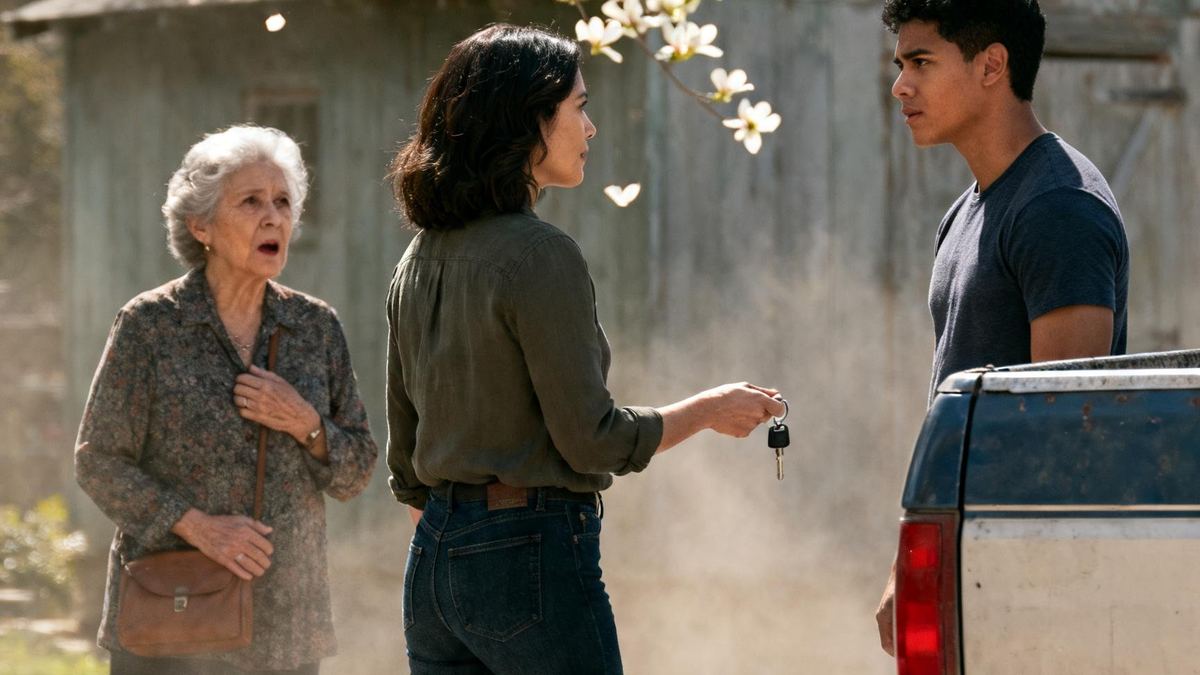
The buyer showed up at two. His name was Dalton, a kid in his early twenties with a busted knuckle and a firewood business he was trying to start. He walked around the truck, nodded at the rust over the rear wheel, and pulled $3,200 in cash from his back pocket. Kate had printed a bill of sale from a template online. They signed it on the hood.
Loretta’s Honda pulled into the driveway just as Dalton was testing the gas pedal.
She got out fast, purse swinging. “You are not selling that truck,” she said, louder than the engine. Her face was red, the kind of red that comes from crying more than anger. “You’ve got no right. Ben would’ve never — ”
“Ben asked me to,” Kate said.
Loretta stopped. The word hung in the air like the truck’s exhaust.
“He told me last night,” Kate said. “He said to sell it.”
It was the truth, and it was also the only thing that would make Loretta shut her mouth. Kate didn’t offer more. She walked over and handed Dalton the keys, the single Ford key with a worn fob. “It’s yours.”
Dalton looked at Loretta, then at Kate. “Uh… you sure?”
“Positive.”
He got in the truck. The door closed with the same heavy thud it had made every morning when Ben left for a job. Dalton pulled out of the driveway, old engine growling, and turned onto the main road. The cloud of dust hung there for half a minute.
Loretta stood on the gravel, watching the place the truck had been. She didn’t move, didn’t speak. Kate didn’t wait for her to. She walked into the house, the screen door smacking the frame.
Henry was in Ben’s recliner. Kate pulled the cassette tape from her pocket, rubbed the dust off with her thumb, and set it on the armrest. Then she picked up the cat — twenty-two pounds of black fur and old bones — and carried him to the front porch. The air was warm, the dogwoods holding on to the last of their blooms. Henry blinked at the light and tucked his head under her chin.
Inside, the recliner was empty. Kate didn’t look at it again. She had $3,200 in her back pocket, a shift at the church in three hours, and a cat who had done exactly what he was supposed to do.