The cat knew before anyone else. That March morning, as David Brewer poured his coffee at the kitchen island, the old black tom refused to move from the braided rug by the fridge. He just watched. Didn’t meow for his tuna flake, didn’t press his broad head against David’s shin. Laura noticed it at 7:10 a.m., the same time she noticed the daffodil shoots poking through the mulch outside the window. She’d remember both later.
David drove his ’02 Tacoma to the hardware store on East Main. He bought a new latch for the screen door, stopped at the bench outside the post office to light a Camel Blue, and a clot inside him woke up and traveled. He closed his eyes and leaned his head back. A neighbor walking her labradoodle saw him and thought he was just enjoying the sun. By the time the paramedics got there, the cigarette had burned down to the filter between his fingers.
Laura got the call at the dental office where she worked the front desk. She drove home with her blinker on for six blocks, forgetting to turn, and when she pulled into the driveway the cat was already in the window of David’s study, front paws on the sill, tail twitching.
Two years evaporated. Laura took a second job doing billing for an urgent care on the other side of Bend. Her daughter Emily was a sophomore at Oregon State, her son Jack drove a FedEx truck and came by on Sundays to mow the lawn. The old cat, Ink, slept seventeen hours a day in the same cracked leather armchair where David used to read old Car and Driver magazines. The cushion still smelled like him—or maybe Laura just told herself it did.
She didn’t cry anymore. She’d trained herself to turn her head when a song from their wedding playlist came on at Safeway. She stopped setting two cups on the drying rack. But every night, right before sleep, she’d lie in the dark and calculate: If not for the clot, he’d be fifty-one. They’d be arguing about whether to replace the deck. He’d be teasing her about her sourdough starter.
On the second anniversary of his death—a Thursday, the fourteenth of March—Ink did something he hadn’t done since David was alive. At 10:40 p.m., he hauled himself up the stairs, pushed the bedroom door open with his shoulder, and settled on the pillow next to Laura’s head. She was too exhausted to shoo him. She closed her eyes.
And David was there.
They were sitting on the tailgate of the Tacoma at Sparks Lake, the water glassy, the Three Sisters peaks sharp against a pink sky. He looked like he did at thirty-eight, before the gray showed up in his sideburns. She could smell pine sap and the faint motor oil that always clung to his jeans. They talked until the dream sky darkened—about Emily’s biology scholarship, about how Jack had finally fixed the irrigation line, about whether a person could learn to make a decent brisket from YouTube videos. He laughed, a low rumble she hadn’t heard in seven hundred and thirty days, and the sound landed in her chest like a stone dropped into still water.
She woke with a start at 6:14 a.m. Ink was still there, a warm weight near her shoulder. She reached over and touched his ear. He didn’t react—just blinked his yellow eyes and went back to sleep.
That night, he returned to the pillow. And the next. And the next.
By the fourth night, Laura understood: she didn’t fall into the dream until Ink was beside her. The cat was the bridge. She tried giving him salmon treats, brushing his matted fur, talking to him in the high voice she used for babies. He ignored all of it and spent his days in the armchair, paws tucked under his chest, a living monument.
For a full month, she and David met every night. Sometimes they were in the garage he’d turned into a workshop, the smell of sawdust thick in the air. Sometimes they walked the path along the Deschutes River, past the spot where a fallen ponderosa had created a natural bench. They covered twenty-three years of marriage in fragments. She asked him if he’d been scared, at the end. He said he’d felt the sun on his face and then felt nothing at all—just a kind of lifting. An angel with a clipboard, he joked. Very efficient.
On the thirty-first night, a Monday, the dream shifted. They were on the bench outside the post office where he’d died. The air was cool, the cherry trees starting to bloom. He took her hand. His grip was solid, callused on the palm from years of turning wrenches.
“This is it,” he said. “The last one.”
She knew it before he spoke; the dream had a different weight, like a door slowly closing. She didn’t argue. She’d had a month, four hours a night, one hundred and twenty-four hours that felt stolen from a bank account she never knew existed.
“The kids are okay,” she said. “You saw.”
“I saw.” He squeezed her fingers. “And you are too. Even if you don’t believe it yet.”
She woke at 3:33 a.m. The digital clock on the nightstand glowed blue. Ink was no longer on the pillow. She found him in David’s study, curled in the leather chair, his breathing shallow and slow. Something in the way his body was settled—completely still, like a stone worn smooth—told her he was done too. Not gone, but done. He’d delivered his last message and clocked out.
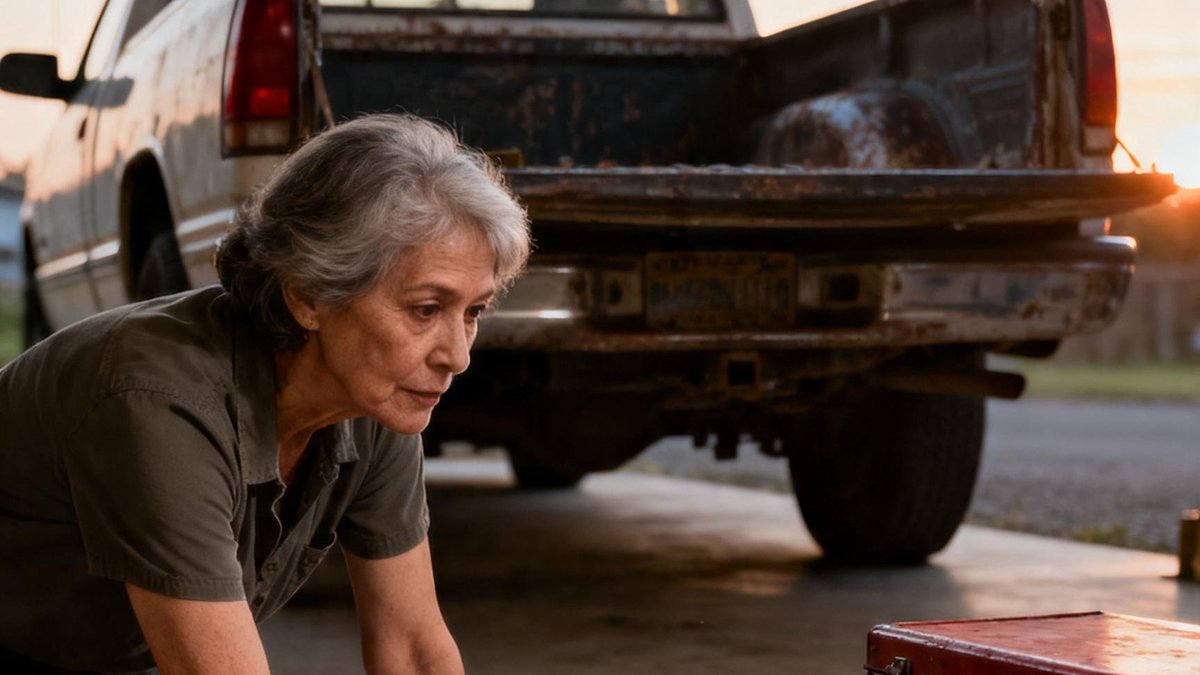
Laura stood in the doorway for a long time. The house was quiet except for the hum of the fridge. She didn’t cry, but she did something she hadn’t done since the funeral: she walked into the garage, flicked on the bare bulb, and looked at David’s tool chest.
The red Craftsman cabinet had been his father’s. He’d labeled every drawer with blue painter’s tape and a Sharpie: “SAE WRENCHES,” “METRIC SOCKETS,” “BITS & DRIVERS.” She’d avoided this corner of the garage for two years. Now she pulled open the top drawer and picked up a 10mm socket. The metal was cold in her palm.
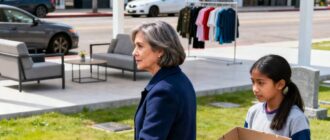
The next morning, she called the vocational program at Central Oregon Community College. “I have a full tool set,” she said. “Pro-grade. My husband—he’d want someone to use it.” The instructor, a man named Chuck with a voice like gravel, said he’d be happy to take it. Laura asked if she could bring it by that afternoon. She loaded the chest onto a dolly, lifted it into the back of the Tacoma (which she’d kept, against her kids’ advice), and drove to the campus. The odometer read 198,432 miles. She parked in the loading zone and unloaded it herself.
Chuck met her at the shop door. He opened the top drawer, saw the organized racks, and let out a low whistle. “This is the good stuff,” he said. “We’ll put a plaque on it, if you want. What was his name?”
“David Brewer. But just—no plaque. Just let them use the tools. That’s the point.”
She signed a donation receipt. The value was estimated at four thousand two hundred dollars. She folded the paper and put it in her wallet, next to a faded photo of David holding a baby Emily.
When she got home, Ink was on the armchair, awake for once. His yellow eyes tracked her as she crossed the room. She sat on the ottoman and put her hand on his back. He purred, a low, gravelly drone.
“You did your job, old man,” she said.
He closed his eyes and tucked his nose under his tail. The house was still the same house. The chair still smelled faintly of David. But the garage door was open, and the space where the tool chest had stood was just an empty patch of concrete.
Laura made herself a cup of coffee and walked to the mailbox. The mail carrier, a woman named Shirley who’d been on this route for eleven years, waved from her truck. A catalog for orchard supplies sat in the box—David had always talked about planting an apple tree. Laura studied the cover for a moment, then tucked it under her arm. It was a Tuesday. The irises along the front walk needed dividing. She’d need a trowel. She knew exactly which drawer it was in.