I was at the kitchen sink, washing the roasting pan, when I heard it. Todd was on the back steps, his voice low, but the screen door didn’t latch right. He said to his brother on the phone, “I just need another week. She’ll cave. Erin always caves.”
I let the water run over my hands. The sponge dripped onto the linoleum. I didn’t move.
He meant me. He meant my aunt’s house.
Three months earlier, my aunt Doreen had been found by the mail carrier at her kitchen table, a cup of tea gone cold in front of her. She was seventy-four, no husband, no kids. The house was a two-bedroom bungalow in Bay View, a few blocks from Lake Michigan. Built in 1928, a sagging front porch, a garage with a cracked slab, and a front step with a crack shaped like a lightning bolt.
I grew up knowing that house. My dad left when I was eight. My mother worked the register at a gas station and cleaned offices at night. We bounced between rentals off National Avenue, and I learned early: a woman without a deed is just a guest wherever she stands.
When Todd and I got married, we lived in his condo in West Milwaukee. His name on the title, his name on the mailbox. He never threw it in my face, but I never unpacked the last box of my books. Just in case.
Aunt Doreen left me everything. The lawyer, a tired man with a stained tie, read the will in his office on Oklahoma Avenue. “The whole of my estate, real and personal, to my niece Erin Callahan.” I remember the hum of the window AC. I remember not crying.
The day after the funeral, Loretta, Todd’s mother, cornered me in the church basement. She was holding a plate of cold cuts. “That house, honey. Brent and Amber are raising three kids in two bedrooms. You and Todd don’t need a house.”
“I do need a house,” I said. “I’ve never had one.”
She set the plate down. “So you’d let family suffer?”
I looked at her. “I’ll rent it to them. Fair market. Or they can buy it with a mortgage, like normal people.”
“Normal people. Interesting.”
That Sunday, Todd and I went to Loretta’s for lunch. Ham, scalloped potatoes, a bowl of potato chips on the table. Brent was there with Amber and the three kids. Tyler, eight, sat on a beanbag in the corner playing on a tablet. Madison, six, had a glittery unicorn backpack by her feet. The baby, Junie, was strapped in a high chair, smearing applesauce.
Loretta didn’t wait for grace. “So, Erin. Have you thought about what you’re going to do with the house?”
I kept my eyes on my plate. “I thought about it. I’m going to keep it.”
Brent laughed, but it was the kind of laugh that has no air in it. “You don’t need a house. You’ve got Todd’s place.”
“I don’t have Todd’s place. Todd has Todd’s place. I have a box of books in the closet.”
The table went quiet. Even the baby stopped banging her spoon.
Todd sighed. “Erin. Don’t make this weird.”
“I’m not making anything weird. I’m just saying no.”
Loretta passed the rolls. “A woman without children doesn’t understand. Your aunt had no one. You have Todd. Brent has three mouths to feed. It’s simple.”
I didn’t say anything to that. What could I say? That I’d spent my whole childhood being told I was taking up too much room?
The pressure built. Every phone call. Every text. Brent sent me an email with a link to a “fair market valuation” he’d gotten from a friend, offering me ninety thousand dollars below what the county assessor said the house was worth. Amber called and left a voicemail saying she didn’t want to be the reason a family broke up, but “you have to understand what it’s like when the furnace goes out and you have to choose between heat and braces for Tyler.”
And then Todd started in. At breakfast. At night when we were brushing our teeth. He’d say, “It’s just a house, Erin. Why are you holding onto it so tight?”
Because it wasn’t just a house. It was the first place that was mine. It was the cracked concrete step and the stuck screen door and the kitchen drawer that always jammed. It was the one thing in my life that nobody could take away from me if I just didn’t hand it over.
The night I heard him on the back steps, I didn’t come out and confront him. I went to bed and lay there with the ceiling fan clicking. At 2 a.m., I got up and drove to the house. I sat in my car in the driveway with the headlights off, looking at the dark windows. The neighbor’s porch light was on. A fat beagle named Lou was asleep on the mat across the street.
I could give it to them. It would be easy. Sign a quitclaim, walk away, go back to the condo and the box of books. Nobody would call me selfish.
But then what would be left of me?
The next morning, I told Todd: “I’m not selling. I’m not signing anything over to Brent. I’m not taking ninety thousand less than it’s worth. And I want you to stand with me.”
He was pouring coffee. He didn’t look up. “Stand with you against my own brother?”
“I’m your wife. That’s supposed to mean something.”
“Don’t.” He set the carafe down. “Don’t make me choose.”
“I’m not making you choose. I’m asking you to see me.”
He shook his head. “You’re being selfish. That’s what I see.”
“Then maybe I don’t know what we’re doing anymore.”
He looked at me then. “Neither do I.”
Two weeks later, he moved out. He took the coffee maker, the garage fridge, and the snowblower. He left his key on the counter.
My mother came over with a roast chicken and we sat on the floor of the empty living room, eating off paper plates, looking at the peeling wallpaper. “You know, Doreen used to hide her tips under the silverware tray,” she said. “She worked at the DMV for thirty-two years to buy that house. Don’t you dare give it away.”
We filed no-fault in September. It was a stack of forms, a six-month waiting period, and a filing fee that hurt less than the signatures. He didn’t want the house. He just wanted me to not have it on my terms.
I moved into the house in October. The night I got the keys — the actual keys, not Todd’s condo keys — I stood in the kitchen and cried. Then I got to work.
I worked at Miller’s Hardware on Kinnickinnic Avenue. I’d been there three years. I knew which paint rollers were worth the money, how to scrape off 1970s wallpaper, how to reset a GFCI outlet. I gutted the kitchen over two weekends with a pry bar and a shop vac. I painted the living room a gray called Silver Sage. I sanded the oak floors until my arms ached.
Aunt Doreen had a saying taped inside the kitchen cabinet door, written on a square of yellow legal paper: “A woman has to have her own. Even if it’s small.” I left that paper where it was. It’s still there.
Three months after the divorce, Todd texted: “I left a box of my dad’s tools in the garage. I’ll grab them Saturday.” He didn’t ask. He told.
I didn’t answer. That Friday, after my shift, I bought a new deadbolt — a Schlage, brass finish. I went home, took a screwdriver, and swapped out the old lock. The old lock had been there since 1962. The screws were painted over. I had to tap them with a hammer.
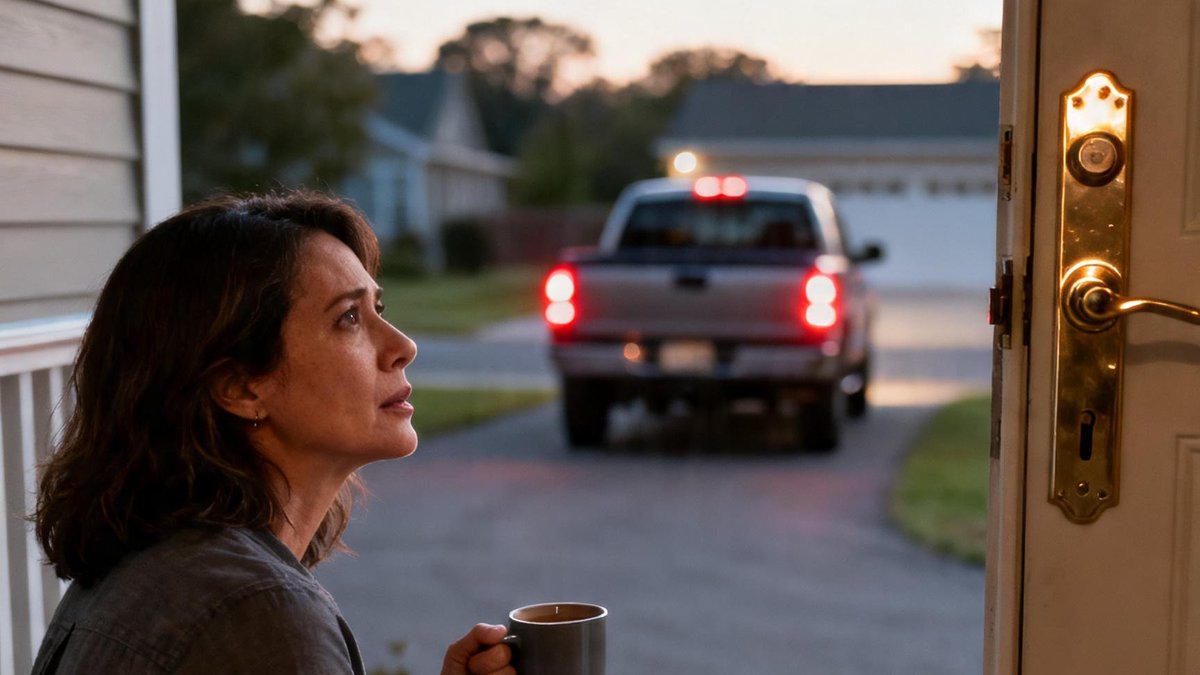
Saturday, I was on the front porch with coffee when his F-150 rolled up. He got out, walked around the side to the garage, lifted the door. The box was right there, next to the recycling bin. I’d moved it myself. He grabbed it, carried it to the truck, loaded it. Then he came around to the front door.
He put his key in. It didn’t turn.
He looked at me. “You changed the locks.”
“I did.”
He pulled the key out and studied it, then looked at the new deadbolt, shiny against the old brass plate. “That’s a Schlage. Good lock.”
“I know.”
He stood there with the box in his arms. “You could’ve told me.”
“The trash comes Thursday. The box would’ve gone out.”
He didn’t say anything else. He got in the truck and backed out of the driveway. The brake lights flashed once at the end of the block.
I sat back down on the porch steps. The new key was in my pocket. It was warm.
Lou the beagle barked once across the street. I finished my coffee. The screen door latched behind me.