I worked next to Denise Rubens for six years at the medical billing office on Southeast Hawthorne, and I can tell you the exact week her marriage started to die. It wasn't a fight. It was the way she stopped putting creamer in her coffee. The little rituals went first.
Denise was the one who remembered birthdays. She brought sheet cake from the Safeway on César Chávez Boulevard when someone left or got promoted. She kept a spare phone charger in her drawer for anyone who needed it. In six years, I never heard her raise her voice.
So when she inherited the condo from her aunt, I thought: good. Someone like that deserves a break.
Her aunt had lived in a two-bedroom unit near Mount Tabor. Old building, steam heat that knocked in the walls, a garage door that jammed in the wet months. Nothing fancy. But it was paid off. And Denise had grown up poor — single mom, dad walked out when she was nine, the whole story she told me once during a power outage while we sat in the break room eating cold pizza from a place on Belmont.
Her mother cleaned houses. Denise learned early that a woman without her own name on a deed is a woman with a suitcase packed in her mind, always ready to be asked to leave.
That's what she said to me, more or less. I wrote it on a sticky note and threw it away because it felt too private to keep.
The inheritance hit right around Thanksgiving. Her aunt — no kids, lived alone, died in her sleep at 68 — left everything to Denise. The condo, the old Honda in the garage, the Christmas ornaments from the 1970s. All of it.
At first, Denise was happy. She showed me photos on her phone. Hardwood floors with a dark stain, a galley kitchen with ceramic tile from an era I couldn't name. She pointed at the tile and said, "That's the first thing I'm tearing out."
Then the phone calls started.
Chris, her husband of seven years, worked as a project manager for a commercial roofing company in Clackamas. Decent guy. I met him at the office Christmas party two years back. He had a younger brother, Ryan, who lived in a rented duplex off Foster Road with his wife and three boys. Ryan went through jobs the way Portland goes through rain: a different one every season.
Patricia, the mother-in-law from Gresham, called Denise on Black Friday. I know because Denise took the call at her desk, and she sat up straighter in her chair, like a kid called to the principal's office.
I caught the end of it. Denise said: "I'm not saying no, Patricia. I'm saying I won't sell it for half what it's worth. There's a difference."
Then she hung up and typed something on her keyboard that made no sense. Just random letters. I saw the screen because our monitors sat side by side.
The pressure built through December. Sunday dinners at Chris's parents' place turned into what Denise called "the budget hearings." She'd come in Monday mornings with her jaw set, and she'd tell me pieces of it over lunch at the taco cart on Division while the rain drizzled on the awning.
"The mother haunts me with soup," she said once. "She ladles out minestrone and guilt at the same time. Every week it's the same: Ryan needs a break, the boys are growing, rent's gone up again. And I'm sitting there with a deed in my name and no kids, so somehow I'm the problem."
I did what I always did. I ate my carne asada and kept my mouth shut. It wasn't my place. But I watched her not eat.
The worst part came in February. Denise mentioned a work trip for Chris — a roofing conference in Seattle, two nights. But then she found out from a neighbor that Chris had been on the back porch of their house in Lents, talking to his brother on the phone. She'd heard it through an open window.
What she heard: Chris had said, "Give me one more week. She always caves. She's been caving for seven years."
That word *always* did something to her. She came into work the next day and she was calm — the kind of calm that sits on top of a decision already made. She asked me if I knew a good divorce attorney, and I said I'd ask around. My cousin's friend works at a firm near the county courthouse. A woman named Marla Schwartz.
Chris filed first, because he was that kind of angry. He moved out within two weeks, took the French press and the good towels and the espresso machine from the kitchen counter. Patricia, I'm told, called around to the whole extended family and said Denise had "chosen real estate over people." I know this because a mutual friend — someone who used to work with Chris's sister — texted me a screenshot of a Facebook post. I didn't show Denise.
The divorce took four months. Denise asked for nothing except her aunt's condo and her own car. Half the joint account — she let him have it. The 401(k) — she didn't touch his portion.
"What I need from you," she told me one afternoon when the whole office had that late-day hush and she was supposed to be entering CPT codes, "is for someone to just believe me when I say I'm not the villain in this."
I said, "I know you're not."
And that was six years of watching. That's all.
The Saturday she changed the locks, I wasn't there. But I saw the photo she posted. It was the old keys on the kitchen counter, three brass ones and a fob, sitting next to a receipt from Home Depot on Mall 205.
Sixty-three dollars and forty-two cents. That's what it cost to make sure that no one else could walk in.
She didn't post the part where she found a note from Patricia taped to her garage door. I know about the note because Denise texted me a photo of it. *"You should be ashamed. Ryan's kids are sleeping three to a room."*
Denise didn't respond. She peeled the note off, folded it into a neat square, and dropped it in the recycling bin next to the garage. Then she went inside, locked the door behind her, and unpacked the takeout she'd brought from a pho place on 39th.
That evening, Chris called her. I know because she forwarded me the voicemail. His voice had that uneven pitch men get when they're trying not to beg.
"Denise, listen. Mom said you changed the locks. That's… that's a final. Can we at least talk about Ryan? Just one conversation. For old times' sake."
Denise texted back: "The locks cost $63.42. I can send you the receipt if you want to reimburse me."
He didn't reply.
The condo went up for rent six weeks later. Two thousand four hundred dollars a month, two bedrooms, Mount Tabor, updated kitchen. She showed me the listing on her phone, swiped through the photos. The kitchen had been redone in a pale gray tile. She did it herself over five weekends, with a wet saw she borrowed from a neighbor and a playlist of early 2000s rock.
I went over one evening in late May to help her move a bookshelf. The whole city smelled like rain and cedar. Denise was painting the bedroom a shade she called "driftwood," which is beige with a better name. I was holding a tape measure against the wall when the doorbell rang.
Denise looked through the peephole. She turned to me, and her face didn't change, which was the most remarkable part. She wiped the paint off her hands with a rag that had once been a T-shirt and opened the door.
Chris stood on the porch. Behind him, parked at the curb, was Patricia's Subaru Outback.
"I need to speak with you," he said. He looked past Denise, saw me, and took a step back. "Privately."
Denise didn't move. "Say it here."
Patricia got out of the Subaru. She walked up the porch steps with a look like she was attending a performance she'd rehearsed. In her hand, she carried a manila folder.
"You need to understand what you've done to this family," Patricia said. She thrust the folder toward Denise. "Ryan's eviction notice. They're being put out in thirty days because they can't make the rent. Your husband's brother. Your family."
Denise didn't take the folder. She looked at Patricia for a long moment, then at Chris, then back at me — a quick check, like she was making sure I was seeing this.
"I'm going to show you something," Denise said.
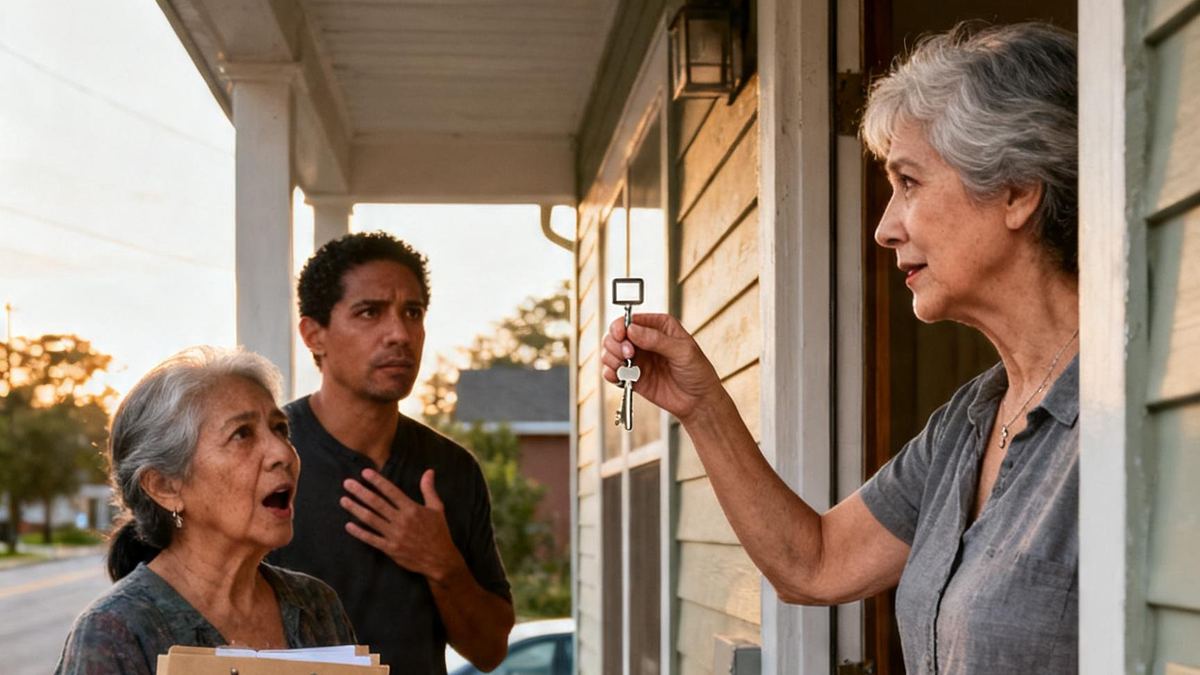
She walked back inside, and I heard a drawer open in the kitchen. When she came back, she had a single key in her hand — a new Schlage, the kind with a square head and a code etched on the side.
"This," she said, holding it up between two fingers, "is the only key that opens this condo now. Not Chris's. Not yours. Not the spare you had made two years ago from the one I left at your house for emergencies."
Patricia's face went slack. Chris looked at the key, then at Denise, then at the key again, and I saw the exact moment he understood that the last door he could walk through had just closed.
"The condo is mine," Denise said. "I'm renting it out for twenty-four hundred a month. The lease is signed. The tenants move in on the first." She tapped the key against the doorframe. "So if Ryan needs help, you'll have to find another way. I'm not the family bank anymore."
Patricia opened her mouth, closed it, opened it again. Chris put his hand over his face for a second. Then he turned and walked down the steps, and Patricia followed, but not before she left the manila folder on the porch. It was already wet from the rain, the corners curling.
Denise picked it up. She didn't open it. She carried it to the recycling bin by the garage, opened the lid, and dropped it in. The lid made a hollow click.
When she came back inside, she said: "I need to finish the trim in the bathroom."
And that's the whole story. I helped her move the bookshelf, and we ordered pizza from a place on Hawthorne, and she paid with her own card. The receipt said thirty-one seventy-two. She tipped the driver five bucks in cash.
She wasn't bitter about it. That's what stuck with me. The woman I worked with for six years peeled a wet eviction threat off her porch and threw it in the recycling, and after that she asked me if I wanted pepperoncini on mine.