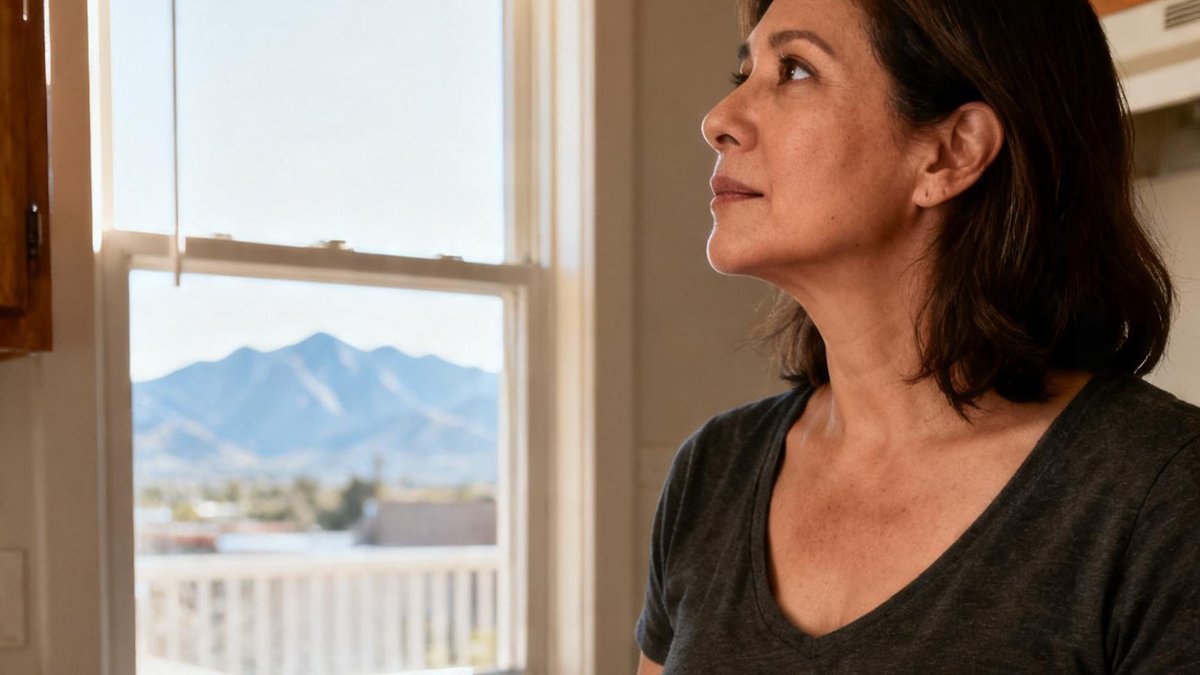
The kitchen window was cracked open. They didn’t know I’d come around the side of the house to grab the spare key from under the planter. I stopped dead when I heard Rachel’s voice, tight as a guitar string.
“She’s doing it again, Mom. Playing the martyr. I asked her to pick up Jake from practice tomorrow and she gave me this whole speech about being tired. Tired! She lives alone, no husband to deal with, no kid. What’s she tired from?”
The screen door was still between us. Through the mesh I saw my mother, Evelyn, sitting at the pine table, folding a paper napkin into smaller and smaller squares. She didn’t answer. Rachel kept going, her back to the window, and I could see the way she jabbed a spoon into the sugar bowl.
“Honestly? Without all her drama, life would be a whole lot easier for everybody. She makes everything into this big sacrifice. It’s exhausting.”
The spoon clattered. My mother smoothed the napkin and said, quiet enough to break my heart, “She does an awful lot, Rachel.”
That one line—*an awful lot*—landed harder than the rest. My mother knew. But knowing and doing something about it were two different train stops, and we’d been riding the same quiet track for three years.
I didn’t go in. I set the key back under the geranium pot, got in my twelve-year-old Subaru, and sat there with the engine off, staring at the pine needles on the windshield. Every cent I’d given them, every afternoon I’d rearranged my own schedule, every prescription I’d picked up, every dinner I’d carted across town—it all condensed into that one word: drama.
My name is Maggie, I’m forty-two, and I live in a two-bedroom apartment on the south side of Flagstaff. You can see the San Francisco Peaks from my front stoop, still dusted with snow in April. It’s the kind of town where the altitude makes you lightheaded and the tourists come for the mountain air they can’t afford to bottle. I’m not a tourist. I’ve been here since my marriage fell apart six years ago, my son Caleb left for ASU down in Tempe, and my father’s heart gave out two weeks after his sixty-eighth birthday. I stayed because my mother needed someone close, and because my sister Rachel’s world was always one cracked transmission away from collapse.
Rachel works the register at a Walgreens on Milton Road. Her husband Tom runs a handyman “business” out of a pickup that burns oil like a campfire, and their son Jake is ten and has a body made entirely of elbows and a sugar addiction. For three years I’ve been the family’s glue and fuel. Every Tuesday I’d drive Mom to her cardiologist in the medical plaza off Fourth Street, then wait in the car while she argued with the billing department over her Medicare copay, then pay the difference myself because her Social Security barely covers the HOA fees on the little paid-off house near the university. I’d swing by Bashas’ for her groceries, cook her meals for the week in a single Sunday-afternoon marathon, and leave them stacked in Tupperware marked with blue tape.
For Rachel and Tom, I was the emergency fund that didn’t require a credit check. Two hundred here for Jake’s baseball registration. A hundred fifty there when the water heater blew. I set up an automatic payment from my checking account to the after-school program so Jake could stay till six every day, and another one to the pharmacy for Mom’s Eliquis because the doughnut hole swallowed her whole by March. All told, I was shoveling about eight hundred dollars a month into their lives on top of my own rent, my car insurance, and the student loans I still had from my accounting degree.
In the beginning, there were thank-yous. Little cards, a jar of raspberry preserves left on my doorstep, a text that said “You’re an angel.” Then the texts became shopping lists. The requests became assumptions. And the thank-yous dried up so completely that I’d sometimes scroll back through my messages just to see if I’d imagined them.
Last winter I drove Mom to Phoenix for a specialist consultation and ended up waiting four hours in the parking garage because the office was overbooked. When I got back to Flagstaff, Rachel called and said, “Hey, can you grab Jake from school? I’m stuck in line at the post office.” Not a word about the appointment. Not a “How was the drive?” I was the help. The delivery service with a pulse.
I broke, quietly, in March when my landlord raised the rent two hundred dollars a month. I sat at my kitchen table with a yellow legal pad and did the math. After all the “family” payments, I had roughly sixty-three dollars a week left for everything else—food, gas, a pair of shoes when mine wore through the sole. That night I called Rachel and told her, as calmly as I could, that I needed to pull back on the financial help for a while. Not forever. Just until I could catch my own breath.
There was a beat of silence, then a laugh that wasn’t a laugh. “So what, now we’re supposed to just figure it out on our own? You know Tom’s truck is in the shop, and Mom’s blood-pressure meds are due—”
“Rachel. I’m not saying I won’t help with Mom. I’m saying I can’t keep being the bank.”
The line went dead. Not hung up—just dead air while she fumed. Then: “Fine. Whatever.” Click.
That was the first time I ever heard my sister sound like a stranger. The second time was through the kitchen window.
I didn’t answer my phone for three days. It buzzed like a trapped hornet on the nightstand. Day one: “Mom needs bread.” “Jake’s waiting for pickup.” Day two: “Seriously you’re going to ignore us?” On the third morning, Rachel sent a voice message that I still have saved. Her tone was clipped, managerial. “Maggie, if this is about the money, you’re being incredibly petty. Mom’s worried. Call us.”
Mom wasn’t the one who called. Mom never called when things got tense. She folded napkins.
I cried on the floor of my hallway, back against the coat closet, while my neighbor’s chihuahua yapped through the wall. I loved my mother. I loved my nephew. I even loved some ghost of my sister that existed before adult life sanded her raw. But I couldn’t keep trading pieces of myself for their convenience and pretending it was love.
After the two weeks I’d mentally promised myself, I drove to Mom’s house on a Thursday afternoon when I knew Rachel would be at work. I used my key—it still worked—and found my mother in her recliner, watching a cooking show with the sound off. The napkin was there on the armrest, already folded into a sharp triangle.
I pulled a dining chair close and sat facing her. “Mom, I’m going to keep helping you with doctors and prescriptions, but I’m not doing everybody’s everything anymore. I can’t.”
She studied the mute television for a long time. Then she said, so soft I almost missed it, “I guess I just got used to you making things run. You always made things run.”
It wasn’t an apology. But the raw, unvarnished admission of it—*I got used to you*—told me she’d seen it all along. She’d just been too tired, or too scared, to say it out loud.
I started rebuilding the next week. I picked up two freelance bookkeeping clients from an ad I’d left at the library, and I opened a separate savings account at the credit union with a label in my head: Coast Fund. Oregon, with its damp green air and the sound of waves that don’t care who neglected you. I’d been saying “one day” since I was thirty. I’d buried “one day” under everybody else’s Mondays.
On a bright Saturday morning, I sat down with my phone and the bank app. I tapped on the recurring payment to Jake’s after-school program—$300, withdrawn like clockwork every first of the month for the past two years—and I hit *Cancel*. My finger hovered, then pressed. The screen blinked a confirmation. I felt my heartbeat in my teeth. Then I opened the travel site and booked a week in a yurt near Cape Perpetua. The booking confirmation sat in my inbox like a small, defiant light.
It took exactly ten days for Rachel to notice. Her call came while I was packing.
“Did you stop paying for Jake’s program? They called me today and said the balance was overdue.”
“I did. I let you know a while ago that I couldn’t swing the extras anymore.”
A beat. Then her voice turned sharp, the way it had in the kitchen. “You’re going on a *vacation*? Tom told me he saw an envelope from a booking company in your mail pile. You can’t help your own nephew but you can blow money on some trip?”
I had my phone in hand, the confirmation screen open. I read off the number. “Three hundred forty-six dollars. That’s exactly what I’d been paying every month for the program. I’m not blowing anything, Rachel. I’m just redirecting it back to me.”
She didn’t answer right away. I could hear the Walgreens intercom in the background, paging someone to the photo counter. “You’re different,” she said at last. “You never used to be this way.”
“You’re right. I’m not.”
That was the end of the call. It wasn’t the end of the coldness—Rachel still goes stiff in the canned-goods aisle when she sees me—but it was the end of something heavier. The quiet, creeping idea that I existed only as a function, a faucet you turned on when you got thirsty.
Before I left for the coast, I stopped by Mom’s with a fresh batch of pot roast and a week’s worth of her favorite bran muffins. She took the Tupperware and held it against her chest like a shield. Then she asked, almost shy, “Do you think you’ll send me a postcard?”
I nodded. I hadn’t expected that.
Driving out of town, I rolled the window down and let the ponderosa-scented air fill the car. The peaks in my rearview mirror shrank to a blue hazy line. I didn’t feel victorious. I felt lighter, like a cabinet that had finally been emptied of other people’s dishes.
My phone buzzed—a text from my son. *Saw a picture of where you’re staying. Looks legit. Proud of you, Ma.*
I didn’t reply right away. I just set the phone on the passenger seat, a compass pointing toward something that was, for the first time in years, mine.