The symphony hall on Michigan Avenue was built to make fortunes feel inadequate.
Even the air had a price tag—some blend of old wood, champagne, and lilies that probably cost more per breath than most people’s monthly rent. Chandeliers the size of compact cars hung from the vaulted ceiling, casting a honey-colored glow over twelve hundred guests in black tie and gowns that whispered against Italian marble.
It was the annual Cross Foundation gala. The kind of night where a handshake could fund a pediatric wing, and a single glass of the ’09 Dom Pérignon cost as much as a CTA monthly pass—forty-eight dollars on the menu, though nobody bothered reading prices.
Daniel Cross owned half the luxury hotels between the Loop and the Gold Coast. At forty-four, he’d built an empire on precision—every deal structured, every risk hedged, every variable controlled. Forbes called him Chicago’s most disciplined developer. His staff knew a different word for it.
But Daniel wasn’t thinking about business tonight.
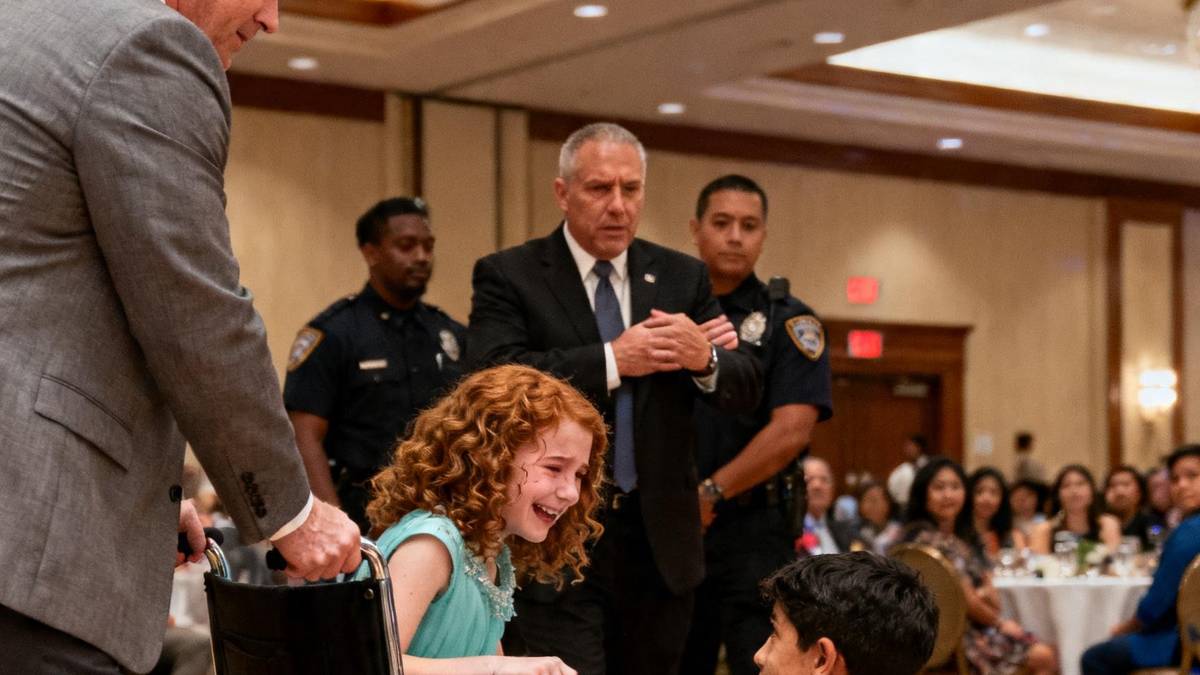
His ten-year-old daughter, Lily, sat beside Table 7 in a titanium wheelchair, her auburn curls held back by a pale green ribbon from an Etsy shop in Andersonville. Her dress was the color of seafoam, falling past her knees. Ballet flats that had never touched a dance floor. Her hands rested in her lap the way they always did at these events—folded, patient, like she was waiting for something nobody had told her about yet.
A spinal injury from a Lake Shore Drive crash three years ago. Her mother, Sarah, had been killed instantly when an F-150 crossed the center line near Belmont. Lily survived with nerve damage that specialists at Northwestern, then Johns Hopkins, then the Mayo Clinic had all described with carefully worded phrases like “uncertain trajectory” and “manage expectations.”
Daniel had spent just under four million dollars chasing a different answer.
Nothing had put strength back into Lily’s legs.
“You doing okay, bug?” he asked, leaning down.
She gave a quick upward tip of her chin. She’d learned that adults needed that gesture. Without it, they got this look—half pity, half panic—and started talking slower and louder, like her chair meant she’d gone deaf.
Daniel’s hand found the back of her wheelchair. It stayed there most of the night.
“We can leave after the speeches.”
“I’m fine, Dad.”
A jazz quartet had started near the stage. On the far side of the room, two kids around Lily’s age were spinning in careful circles under one of the chandeliers while their parents laughed. Daniel shifted his weight, just slightly, and the wheelchair angled away from them.
He didn’t mean to. It was reflex at this point.
Somewhere near the service entrance, a scrawny twelve-year-old boy was crouched behind a stack of unused table linens.
His name was Mateo Vargas. His feet were bare, the soles calloused and cracked along the heel like old leather. His jeans were too short—floodwater style, his cousin called it—and his sweatshirt, once navy, had faded to the color of February sky. A tear ran near the collar, and he’d patched it with a strip of duct tape that peeled at one corner. He’d been kicked out of the Palmer House lobby twice in the last hour by a concierge who pronounced “sir” with a French twist that made Mateo’s teeth itch. After the second ejection, he’d circled back through the loading dock when the kitchen staff got busy with the fourth course.
He’d heard about Lily Cross from a janitor at the free clinic on Western Avenue where an older cousin worked three shifts a week. The janitor—a skinny white guy with a faded lightbulb tattoo on his forearm—said the Cross girl could move her legs but wouldn’t put weight on them. Said her father had fired three physical therapists who pushed too hard and two more who didn’t push enough.
Mateo knew what fear did to a body.
His kid brother, Emilio, had stopped walking for eleven months after their mother passed. Every time Emilio tried to stand, his legs would shake and buckle. The doctors at Stroger called it a trauma response. Their abuela called it a heart that forgot how to trust the ground.
Mateo had been the one to get Emilio standing again. In the parking lot of a homeless shelter on Roosevelt Road, with one hand that never pulled too hard and a voice that never sounded like a doctor’s.
Emilio took his first steps toward Mateo on a Wednesday morning.
Pneumonia took him two weeks later, in a county shelter during a cold snap that dropped temperatures to eight below. Mateo had called the ambulance, and the dispatcher said fifteen minutes. It took forty-five. By the time the paramedics pushed through the door, Emilio’s lips were blue.
Mateo never forgot the feel of his brother’s small hand.
And he never forgot Emilio’s last request, whispered through a fever in a church basement on a cot with sheets that smelled like bleach and mothballs.
The quartet’s number ended. Applause rolled through the hall. A surgeon from Children’s Memorial was walking toward the podium.
Mateo slipped between two tables near the back wall.
A woman in a silver dress noticed his bare feet first. Her mouth opened. But Mateo was already past her, moving through the sea of gowns and tuxedos with the quiet precision of a kid who’d learned to be invisible in places where he didn’t belong.
He reached Lily’s table just as Daniel was adjusting her chair for the speeches.
“Hey,” Mateo said.
Daniel’s head snapped around. His body stiffened. His hand moved in front of Lily the way it did when photographers got too close.
“I’m not gonna hurt her,” Mateo said. His voice was steady. “Can I ask her something?”
Security guards were already cutting across the dance floor.
Lily leaned sideways, peering around her father’s arm.
Mateo knelt down until his eyes were level with hers.
“You want to stand up?”
Daniel’s jaw tightened. “That’s enough.”
“She doesn’t have to,” Mateo said, not looking away from Lily. “But I think she wants to.”
Lily’s fingers curled against the armrests.
She’d stood up before. In physical therapy rooms with gait belts and parallel bars and therapists counting every second like a stock ticker. She’d stood because it was expected—because her father needed proof that the money and the specialists and the endless consultations hadn’t been for nothing.
She’d never stood up because she wanted to.
“My legs don’t—” she started.
“I know,” Mateo said. “So I won’t let you fall alone.”
The words landed somewhere below her ribs, in a place no doctor had ever reached.
She put her hand in his. His palm was dirty and warm.
Daniel’s mouth opened. Whatever he meant to say got stuck.
Mateo stood, easing upward. He didn’t pull. His grip was soft enough that Lily could let go without consequence, firm enough that she knew he was there.
She pushed against the armrests.
Her knees shuddered. For a long second, nothing happened—her body remembering all the times it had tried this and failed.
“Don’t think about walking,” Mateo said. “Just think about right now. One second of standing. That’s all.”
Her quads tensed. Her knees straightened.
She rose.
The wheelchair slid back an inch. Daniel caught it, his knuckles white against the frame.
Lily was standing.
A fork clattered against a plate somewhere near the stage. The hum of conversation thinned, then died completely. Twelve hundred people in formal wear, and the only sound in the room was the soft rush of the HVAC system.
Lily looked down. Her ballet flats touching marble. Her own weight held by her own legs.
She started laughing—this wild, hiccuping sound that was half sob and half victory.
Then her knees buckled.
Mateo caught her, easing her back into the chair without a single jerking motion. His hands moved to steady her shoulders, then hovered near her elbows—the way you’d check a scared animal for injury without spooking it.
Daniel was touching her shoulder, her hair, her face. “Baby. Baby, are you okay?”
But Lily was still laughing, tears cutting tracks through her makeup.
“I did it. Daddy, I did it.”
Daniel looked at the boy who had appeared from nowhere. The torn sweatshirt. The bare feet. The face smudged with what looked like days of city grime.
A hotel manager was whispering urgently to the head of security. “Mr. Cross, this boy was removed from the premises twice tonight. He appears to have entered through the loading dock.”
Daniel’s expression hardened. “Who are you?”
“Mateo.” The boy straightened. “A nurse at the clinic told someone. I heard about your daughter.”
“You heard about her and you thought you’d just—what? Walk into a private event and perform a miracle?”
“She didn’t need a miracle,” Mateo said. “She needed somebody who wouldn’t be scared with her.”
Daniel flinched.
“When did you last eat?”
Mateo blinked, thrown by the question.
“What?”
“Food. When?”
“I don’t—” The boy shrugged one shoulder. “Yesterday morning, I guess. There was a cart on Division that gives out day-olds from the bakery. Got a bagel.”
The security guards were closing in. Mateo saw them coming before Daniel did. His body tensed—that instinctive coil of a kid who knew exactly what happened when men in uniforms reached for him.
He darted left, dodged between two tables, knocked over a chair, and vanished through the service corridor before anyone could grab him.
Daniel shouted for security to follow.
But by the time they reached the loading dock, the boy was gone.
On the polished marble where he’d knelt, the faint gray smudge of a footprint remained.
And in Lily’s hand was something he’d pressed there before he fled: a worn hospital bracelet with a child’s name on it.
The video hit the internet before midnight.
A scrawny kid with no shoes walks into a billionaire’s charity gala. A girl in a wheelchair stands up for the first time in three years. Within six hours, seventeen million people had watched it. Cable news ran the clip on a loop between segments about the mayor’s reelection problems and a warehouse fire in Gary.
Morning shows called it the Miracle on Michigan Avenue.
The AMA released a statement by noon cautioning that a few seconds of standing did not constitute a cure.
Conspiracy forums claimed the whole thing was staged.
Lily watched the video on an iPad in the family’s penthouse overlooking the lake. She’d replayed it eleven times by breakfast.
“What happened last night was encouraging,” said Dr. Eliza Chen, the latest in a long line of rehabilitation specialists. She was pressing gently along Lily’s spine. “But we need to be measured. The mind can override the body’s signals in moments of high adrenaline. It doesn’t mean—”
“I know what it means,” Lily said.
Daniel stood by the window, arms crossed, staring at the gray chop of Lake Michigan in February.
The crash had already taken his wife. For three years, every decision he’d made—where Lily went, who she saw, which treatments he approved—had been shaped by the conviction that one more mistake would destroy whatever was left of his family.
He’d built walls around his daughter and called it protection.
Now a kid who smelled like the back of a bus had walked through those walls in under sixty seconds.
Daniel hired a private investigator that afternoon.
Mateo Vargas was twelve. No permanent address. His mother, Cecilia Vargas, had overdosed in a motel bathroom near Midway Airport two years ago. Oxy, laced with fentanyl, the coroner’s report said. His father’s name wasn’t on the birth certificate. After Cecilia’s death, Mateo and Emilio had gone to live with their grandmother, Gloria, in a two-bedroom apartment in Little Village.
Gloria lost the apartment when Emilio’s hospital bills ate through every dollar she had—including the six hundred she’d borrowed from a storefront lender on 26th Street at twenty-three percent.
The family bounced between shelters, church basements, and the homes of relatives who eventually stopped answering their phones.
Emilio died of pneumonia in a county shelter during a cold snap that dropped temperatures to eight below. The coroner listed “lack of timely medical intervention” as a contributing factor—the ambulance had taken forty-five minutes.
Three months later, Gloria had a stroke in a waiting room at Mount Sinai and never woke up.
Mateo had been placed in foster care twice. Both placements failed.
“The first family said he was aggressive,” the investigator reported, flipping through his notes. “The second reported theft.”
“What did he steal?”
“Canned goods. Blankets. A space heater.” The investigator paused. “He gave them to an elderly woman and two younger kids sleeping behind a boarded-up laundromat on Kedzie. The foster parents didn’t press charges.”
Daniel thought about the way Mateo had recoiled when he’d reached toward him at the gala.
They found Mateo three days later underneath the Ashland Avenue overpass near the river.
He was sitting beside a small fire in a steel drum with three other children and an old man in a tattered peacoat who introduced himself as Walter. A frayed blue tarp was tied between two concrete pillars. Shopping carts held a makeshift pantry: bottled water, granola bars, baby wipes, a change of socks, a half-empty jar of Jif.
On a milk crate beside the fire sat a glucose testing kit.
The same kind Mateo had used to check Emilio’s blood sugar, back when his little brother’s body had started failing in ways none of them understood until it was too late.
Daniel stood at the edge of the encampment in a dark overcoat and a pair of Red Wing boots that cost more than everything under the overpass combined.
“I need to talk to you.”
Mateo didn’t look up. “So talk.”
“Privately.”
“These are my people,” Mateo said. “Whatever you got to say, you can say in front of them.”
Daniel hesitated. Then he crouched down, his expensive trousers touching the grimy concrete.
“How did you know my daughter would stand up?”
“I didn’t.”
“You walked into a room full of security and told a paralyzed girl to stand. You had to believe something would happen.”
Mateo poked at the fire with a stick. “I believed she wanted to try. That’s different.”
“She’s tried before. With therapists. Specialists. Equipment that costs more than you can imagine.”
“Yeah.” Mateo’s voice was flat. “And every time she tried, somebody was standing there waiting to see if she’d fail. You think she didn’t feel that?”
Daniel opened his mouth. Closed it.
“My brother stopped walking after my mom died,” Mateo said. “Doctors said it was trauma. Said his body just… forgot how. Every time he tried to stand, his legs would shake and he’d fall. And the more people watched, the worse it got. Because he could feel them hoping. And hope like that—it’s heavy. It’s like somebody handing you a weight and telling you to swim.”
“How did you get him to stand?”
“I stopped caring if he did.” Mateo’s eyes were fixed on the flames. “I told him we were just gonna sit there. If he wanted to try standing, cool. If not, we’d just talk. And he talked for like an hour about some stupid cartoon—this yellow sponge character who lived in a pineapple—and then he just… stood up. Like his body forgot it was supposed to be scared.”
Daniel exhaled. It came out shakier than he intended.
“My daughter thinks you gave her courage,” he said. “I think you took a dangerous risk. Both can be true.”
He reached into his coat and pulled out a small envelope.
Inside was the hospital bracelet—EMILIO VARGAS printed on a faded white band—and a folded note.
*Dad—I stood up again today. Three whole seconds this time. You were in a meeting so I didn’t tell you yet. Dr. Chen says it’s “encouraging but not diagnostic” which is doctor talk for she doesn’t want to get sued.*
*I want to know about Emilio. The boy who helped me, he left his brother’s bracelet in my hand. I looked up the name. He was six. He died in a shelter. Dad, nobody should die in a shelter. Can we find him? The brother, I mean. The one who’s still here. — Lily*
“She looked up your brother,” Daniel said.
Mateo’s hands stopped moving.
“She’s ten years old and she spent two hours on the internet trying to find out who Emilio was. She read the coroner’s report. The one that listed ‘lack of timely medical intervention’ as a contributing factor. She knows what that means.”
“Why are you telling me this?”
“Because I needed to know who walked up to my daughter. And because…” Daniel paused. “Because my wife died in a car I should have been driving. And I’ve spent every day since trying to make up for a decision I can’t undo. So I recognize it. That look—the one that tallies every loss you can’t afford to repeat.”
Mateo’s jaw tightened.
“I’m not asking you to come with me,” Daniel said. “I’m telling you there’s a guest apartment near our place that’s going to be empty for the next year whether anyone sleeps in it or not. I’m telling you there’s a rehab facility one floor down where my daughter is going to be working three hours a day, and she’s asking for you. I’m telling you that the old man and the kids under this bridge—they should be somewhere warm tonight.”
“You want to adopt me or something? Is that what this is?”
“I want my daughter to have someone who believes she can stand. I think you might be that person. The rest…” Daniel spread his hands. “We figure out as we go.”
Walter, the old man in the peacoat, had been listening silently. Now he cleared his throat.
“Boy,” he said. “You been taking care of everybody since your brother got sick. Maybe let somebody take care of you for five minutes.”
Mateo stared at the fire for a long time.
Then he stood up.
The doctors ran tests when he arrived at the penthouse. Lily’s medical team had been skeptical—some kid from under a bridge, no training, no credentials—but Daniel had made it clear that wasn’t a discussion.
The results came back the next morning.
Mateo had a congenital heart condition. A murmur that had gone undiagnosed and untreated for twelve years. Not immediately life-threatening, but serious enough that the cardiologist, Dr. Park, wanted him in a hospital bed within forty-eight hours.
“Absolutely not,” Mateo said.
“You could have a cardiac event,” Dr. Park said. “You’ve been living in freezing conditions. Your body is in a state of severe stress.”
“Hospitals take people,” Mateo said. “That’s what they do.”
Everyone in the room fell silent.
His mother. His brother. His grandmother—who’d had her stroke while waiting for a follow-up and never came home. Every person Mateo had ever loved had gone into a hospital and never walked out again.
Lily wheeled herself across the room. She didn’t say anything. She just put her hand on top of his, the same way he’d done for her at the gala.
“I’ll stay,” Daniel said. “The whole time. I’ll be in the room. If I have to leave, Lily will be there. You won’t be alone. I swear it.”
Mateo’s eyes flicked between them, wild and cornered.
But he tipped his chin down once—a single, jerky motion.
The first night at Lurie Children’s, Mateo woke at 3:17 a.m. from a nightmare so violent he’d torn out his IV and was halfway to the door before Daniel caught him.
“He couldn’t breathe,” Mateo was saying, his voice fractured. “Emilio. He couldn’t breathe and I called the ambulance and they said fifteen minutes and it took forty-five and by the time they got there he was blue—he was blue, Mr. Cross, and I couldn’t—”
Daniel pulled him in. The boy’s body was rigid, then shaking, then collapsing all at once.
“I know,” Daniel said into Mateo’s hair. “I know.”
He didn’t say it would be okay. He didn’t say God had a plan. He just held on, feeling Mateo’s heart hammer against his own chest, and let the boy soak the shoulder of his three-hundred-dollar shirt.
After that night, Daniel stopped positioning himself beside Lily’s wheelchair whenever she entered a room. He’d stand near the doorway of the rehab gym, arms loose, scrolling through emails, and when she wobbled he’d grip the edge of his phone case hard enough to leave dents—but he wouldn’t cross the floor.
The physical therapy sessions shifted under Mateo’s presence.
“Talk to me about something dumb,” Mateo would say, and Lily would launch into a story about a kid at her online school who’d accidentally sent a meme of a dancing hamster to the entire eighth grade, and somewhere in the middle of her laughing, she’d stand for four seconds. Then six. Then twelve.
Some days she stood long enough to finish a whole sentence.
Some days she couldn’t stand at all.
On the bad days, Daniel’s whole body would tense, his knuckles going white on whatever was in his hands. Every instinct screamed at him to intervene, to fix, to protect.
Learning not to was the hardest thing he’d ever done.
“You flinch every time she falls,” Mateo observed one evening, watching from across the gym while unwrapping a stick of Juicy Fruit.
“I know.”
“She sees it.”
Daniel rubbed his face with both palms. “What am I supposed to do?”
“Let her fall. She’s gonna fall. That’s what legs do—they fall down and get back up. If you catch her every time, she never learns she can catch herself.”
Daniel Cross, who had built a career on controlling every variable, walked to the bench and sat down. When Lily’s knees buckled during her next attempt, he didn’t move—he just squeezed his eyes shut and listened to the sound of her catching herself on the parallel bars.
Six months after the gala, Lily could stand with only a hand on a railing.
A year later, she took fourteen steps across the rehab gym. On the thirteenth, her left knee wobbled. Daniel flinched, a small jerk of his shoulder, but stayed on the bench. She corrected, wobbled again, and finished the fourteenth step with a furious exhale that was equal parts exhaustion and defiance.
Mateo’s foster placement with the Cross family became permanent. Daniel never rushed the paperwork, never forced the language of family. He just kept showing up. Kept the guest apartment warm. Kept Walter and the underpass kids in a subsidized unit on the South Side—a two-bedroom near 47th and King Drive where Walter planted marigolds in a window box. Kept his promises small and his presence steady.
The internet, predictably, had opinions about all of it.
A gossip site published details about Cecilia Vargas’s drug arrests—mugshots from eight years ago, a list of possession charges that looked worse than they were because the system was what it was. A cable news commentator called Mateo “a troubled runaway elevated by viral fame into a billionaire’s charity project.” A guest at the gala gave an anonymous interview claiming Mateo had coordinated the whole thing to extort the Cross fortune. Strangers online accused him of manipulating a disabled child for clout.
Mateo stopped opening his phone. Stopped answering Lily’s texts.
Daniel found the guest apartment empty one Tuesday morning. On the kitchen counter were the sneakers he’d bought Mateo three months ago—Nikes, size 6.5, worn at the heels, laces still double-knotted—and Emilio’s hospital bracelet, curled in a small circle beside them.
“You let them talk about him like he was dangerous,” Lily said when she found out. Her voice was quiet, which was worse than if she’d yelled. She was gripping the arms of her wheelchair so hard the tendons stood out on the backs of her hands.
Daniel had no answer.
Three days of searching turned up nothing.
On the fourth day, Lily decided she was going to prove she didn’t need anyone. She set her jaw, gripped the parallel bars in the gym, and pushed herself upright without calling for a spotter. Her legs held for three seconds, four, five—then her wrist rolled wrong and she pitched sideways. She hit the rubber mat with her left arm twisted under her, and the crack was audible from the doorway.
Fractured radius. The ER doctor at Northwestern, a young woman with exhaustion bruises under her eyes, said it was a clean break but would need six weeks in a cast.
Lily sat in the hospital bed, the new cast already covered in Sharpie doodles from a nurse’s kid who’d wandered in with a handful of markers. Her face was blank in a way Daniel hadn’t seen since the months right after the crash.
“He’s not coming back,” she said.
Daniel didn’t argue. He just drove to the underpass industrial district on Kedzie, walked past the boarded-up laundromat, and climbed down the embankment to the spot where Walter still kept a fire going most nights.
Mateo was there. He was sorting cans of soup into a milk crate, his back to the path.
“She broke her arm,” Daniel said. “Tried to stand on her own. Wanted to show you she could do it without you.”
Mateo’s hands went still on a Campbell’s label.
“She’s in a bed at Northwestern right now telling herself you’re done with her. Telling herself everyone leaves. You know what that feels like, don’t you?”
Mateo set the can down with a small, precise click.
“I didn’t leave because of her.”
“I know.”
“I left because they were saying I used her. Like she was a stepping stone. I heard what they called my mom, too—‘drug-addicted welfare case,’ like that was her whole name.”
“I should have shut it down faster,” Daniel said. “That’s on me. But right now, there’s a ten-year-old girl in a hospital bed who thinks the one person who believed she could stand has walked out for good.”
Mateo turned around. His face was harder than it had been at the gala, older somehow, but his eyes were red-rimmed.
“She doesn’t need me. She proved that the first night.”
“She needs you not to vanish,” Daniel said. “She’s already lost one person she loved. She can’t lose another.”
For a long moment, Mateo didn’t answer. Then he picked up a small, gray stone from the edge of the fire pit—smooth, river-worn, nothing special—and slipped it into his pocket.
“Fine,” he said. “Take me to her.”
They drove back in the black Audi SUV. Neither of them spoke much. At a stoplight on Ashland, Mateo pulled the stone from his pocket and rubbed it with his thumb, the way a kid might rub a worry stone in a gift shop, except this one had come from the bank of the North Branch.
When he walked into Lily’s hospital room, she was staring out the window at the gray lake. Her cast rested on a pillow. She didn’t turn around.
Mateo sat down in the plastic chair beside her bed. He didn’t say he was sorry. He didn’t explain.
He pulled the stone from his pocket and put it on the bedside table.
“It’s just a rock,” he said. “But I’ve had it for two years. Found it the day we buried Emilio. I figured if a rock could hold onto a riverbank for a thousand years, maybe it could hold onto something else, too.”
Lily turned her head. Her face was blotchy from crying.
“You left your shoes,” she said.
“Yeah. I was gonna come back.”
“You took the bracelet.”
“I always take it. It’s mine.”
She looked at the stone. “You don’t think I’m weak?”
“I think you’re the strongest person I know. And I think you broke your arm because you were too stubborn to wait for a spotter. That’s not weak. That’s just dumb.”
A short, wet laugh escaped her.
Mateo pulled his chair closer. “You want to try standing? Not today—I mean when the cast is off. But I’ll be here. I’ll still be here.”
Lily’s good hand reached for the stone. She held it in her palm, feeling its weight.
“Okay,” she said.
Two years later, the Emilio Vargas Rehabilitation and Trauma Recovery Program opened its doors in a converted tortilla factory on a quiet block in Pilsen. The walls were painted a sort of burnt orange, the color of sunrise over the lake, because Mateo had vetoed anything that looked like a clinic. “No white walls. No fluorescent lights. No doctors who talk over kids’ heads,” he’d told the architects, and Daniel had written it into the contract.
The waiting room had a green corduroy couch that came from a resale shop in Humboldt Park. There were no posters of people climbing mountains. No before-and-after photos promising transformations. Just a window that looked out onto a small garden where Walter’s marigolds grew in repurposed paint buckets.
Above the entrance, hand-painted letters spelled: THE CENTER FOR EMILIO’S GROUND.
On opening day, a girl in a hot-pink wheelchair sat near the therapy room, her father hovering behind her with a white-knuckled grip on the handles. The girl kept her eyes on the floor, her mouth pressed into a tight line.
Mateo walked over. He was fourteen now, taller than Daniel’s shoulder, wearing a hoodie that fit and sneakers that matched. He knelt down until he was at her eye level.
From his pocket, he produced a smooth, gray stone.
The girl looked at it. “What’s that?”
“Something to hold onto,” Mateo said. “It’s not magic. But it’s been around.”
She turned the stone over in her fingers. Her father shifted his weight, opened his mouth, closed it.
Across the room, Lily Cross walked out of the storage closet carrying a stack of fresh towels. She crossed the floor without a cane, her steps uneven but sure—a little hitch in the left leg that would probably always be there. She set the towels on a shelf and came to stand beside Mateo.
The girl in the pink wheelchair looked up at her. The father’s grip on the handles tightened, then eased.
“You don’t have to do anything today,” Mateo told the girl. “But if you want to try something—anything—you’ve got company.”
The girl slipped the stone into the pocket of her jacket. She didn’t say yes. She didn’t say no. She just kept her fingers wrapped around that small, worn weight, and after a moment she shifted forward in her chair, just enough to test the balance.
Lily bumped Mateo’s shoulder with her own. He bumped her back. Neither of them spoke.