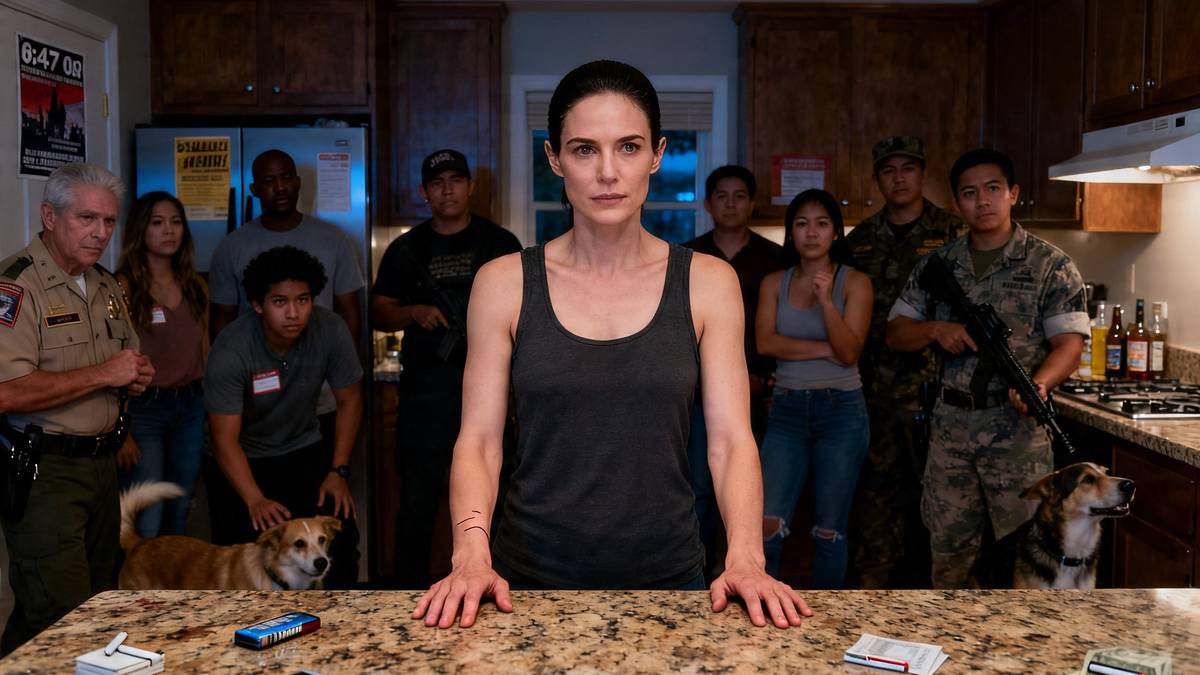
The kitchen timer went off at 6:47 p.m., and Rachel Doyle didn't move to shut it off.
She was standing at the counter with her hands flat against the granite, staring at the space where the high chair used to be. Her husband Mark had put it in the garage three weeks ago, and she still walked into the kitchen sometimes expecting to see it there, expecting to hear Emmy banging a spoon against the tray.
The casserole burned. She let it burn.
Six weeks earlier, Emmy had been fine. Eighteen months old, thirteen words, obsessed with the neighbor's dog. Then a Tuesday nap that lasted too long, a silence from the monitor that Rachel should have caught sooner, and a call to 911 that the dispatcher would later tell her, gently, wouldn't have changed anything. Sudden Unexplained Death in Childhood, the medical examiner in Columbus called it. Rare. Unpreventable. A phrase that meant nothing and everything.
Mark grieved by fixing things — the garage door, the gutters, a leaking faucet he'd ignored for two years. Rachel grieved by standing very still in rooms that used to have a second heartbeat in them.
The smoke alarm started shrieking. Mark came down the stairs two at a time, waved a dish towel under it until it stopped, and found Rachel exactly where he'd left her an hour before.
"You didn't eat," he said.
"I know."
He scraped the casserole dish into the trash without comment. This was the fourth dinner she'd ruined since the funeral. He'd stopped mentioning it after the second.
What he hadn't stopped mentioning — what he brought up again that night, standing at the sink with his back to her — was the embryo. They had one left in storage at the fertility clinic in Dublin, Ohio, frozen since before Emmy was even born, a sibling that never got its turn. Mark wanted to try again. Rachel wasn't sure her body could survive wanting something that badly a second time.
"I called Dr. Patel's office today," Mark said.
Rachel picked up a dish towel and folded it in half, then in half again, giving her hands something exact to do. "You didn't ask me."
"I'm asking you now."
"That's not the same thing, Mark."
He turned around. There were dishes half-washed in the sink behind him, water still running. "I can't keep living in a house where we're both waiting to disappear," he said. "I need something to happen. I need a reason to get up that isn't just getting through the day."
"And I need you to not decide things for me while I'm still learning how to breathe again."
The water kept running. Neither of them moved to shut it off.
It was Rachel's sister, Denise, who suggested the alternative three days later, sitting at the kitchen table with a legal pad and a pen like she was building a spreadsheet instead of proposing something that would upend both their lives. Denise was thirty-four, twice divorced, no kids of her own by choice, and she loved her sister with the blunt, unsentimental loyalty of someone who'd never learned to soften bad news.
"Let me carry it," Denise said.
Rachel actually laughed — a short, ugly sound she didn't recognize as her own. "You want to be a gestational surrogate. For my dead daughter's sibling embryo."
"I want to carry a baby for you and Mark because I watched you almost die of grief for six weeks and I have a working uterus I'm never going to use for myself. Those are two separate facts that happen to line up."
"You don't know what you're offering."
"I know exactly what I'm offering. I looked it up. Legal contracts, medical screening, agency involvement if you want a buffer — Ohio's actually decent about surrogacy law, better than a lot of states. I talked to a reproductive attorney in Cleveland yesterday."
"Yesterday. You did this yesterday."
"I did this the day after the funeral, Rach. I've been sitting on it because I didn't want to hand you one more decision before you were ready."
Rachel looked at her sister's handwriting on the legal pad — bullet points, a rough timeline, a phone number for an attorney named Whitfield. It was so like Denise to grieve by organizing.
Mark, when they told him that weekend on the back porch, went quiet in a way that made Rachel brace herself. He sat with a beer sweating in his hand, untouched, and looked out at the yard where Emmy's swing set still stood.
"I need to say something and I need you both not to hate me for it," he said finally.
"Say it," Denise told him.
"I don't want you to do this because you feel guilty for being fine. I don't want to build a family out of somebody's survivor's guilt."
Denise's jaw tightened. "That's not what this is."
"Isn't it? A little?"
"Maybe a little," Denise admitted. "But mostly it's that I love my sister and I have room in my body to help her, and I'm allowed to want to do a good thing for a reason that isn't pure as snow, Mark. Nobody's motives are that clean."
Rachel had gone very still during this exchange, the way she'd been going still for six weeks, but this time it wasn't grief locking her joints — it was something closer to hope, and hope, she'd learned, was more dangerous than sorrow. Sorrow only asked you to survive it. Hope asked you to bet again.
"I want to talk to the clinic," Rachel said. "Before we talk about wanting or not wanting. I want to know if the embryo even survived the thaw process, if it's viable, if any of this is even possible before we tear each other apart over a maybe."
That silenced the porch. It was, Mark realized, the first fully formed sentence of intention Rachel had spoken since the funeral — not a reaction, not a defense, but a plan.
The embryo had survived. Dr. Patel's office confirmed it on a Thursday call that Rachel took sitting on the bathroom floor with the door locked, phone pressed so hard against her ear it left a mark. Viable. Graded well. Ready whenever they were.
What followed was not a montage of easy healing — Rachel wanted that made clear to everyone who asked, especially her mother, who kept saying things like "this will help you move on" as though a baby were a bandage. It took four months of screening for Denise: psychological evaluation, blood panels, a uterine assessment, a lawyer named Whitfield drawing up a contract that specified everything from delivery hospital to who would be in the room, because that was what Ohio law required and because Mark, still fixing things, wanted every variable controlled that could be controlled.
Rachel went to every appointment. She held Denise's hand through the transfer procedure in April, in a room with fluorescent lights and a television bolted to the ceiling playing a nature documentary neither of them watched. She was in the room, not because the contract required it, but because she'd asked to be, because she needed to watch this thing become real in front of her instead of hearing about it secondhand.
"You don't have to stay for this part," Denise said, feet in stirrups, trying to make a joke of it.
"I'm not going anywhere," Rachel said, and meant it in a way that went well past the room.
The pregnancy test came back positive nine days later. Denise called Rachel first, before her own mother, before the clinic even confirmed with blood work, and Rachel drove to Denise's apartment in Grandview Heights so fast she got a red-light camera ticket she'd later frame and hang in the nursery as a joke only the family would understand.
Seven months of ordinary miracles followed — an ordinariness Rachel clung to like a rope. Denise complaining about heartburn. Ultrasounds where the baby, a boy, kept covering his face like he was camera-shy. Mark converting the garage-stored high chair back into the kitchen, sanding down a scuff mark on the tray with more care than the job required. Rachel didn't stop him. She stood in the doorway and watched him work and didn't feel her chest cave in the way she'd expected to.
She still thought about Emmy every day. She would for the rest of her life — the fertility doctor had warned her that a second child never replaces a first, that grief and joy could occupy the same house without one evicting the other, and Rachel had needed to hear that from a professional before she believed it from herself.
Denise went into labor on a Tuesday in November, three weeks early, in the produce section of a Kroger on High Street, water breaking between the apples and the cantaloupes. Rachel got the call while she was at work and ran a red light for the second time that year, this one without a camera to catch it.
The delivery room was crowded — a nurse, an OB, Mark pacing by the window, Denise sweating and swearing with a creativity that made the nurse laugh despite herself, and Rachel gripping her sister's hand the way she'd gripped it during the embryo transfer seven months earlier, except now there was nothing clinical about it, nothing to watch on a screen. There was just Denise's face, red and furious with effort, and then, at 11:52 p.m., there was a sound — a thin, outraged wail — that Rachel felt in her sternum before she processed it as her son's first cry.
They named him Owen. Not after anyone. Just a name they liked, a name that belonged only to him and not to comparison, not to a sibling he'd never meet.
Denise held him first, for exactly four minutes, because that was what they'd all agreed on months before in a conversation that felt clinical at the time and sacred in retrospect — the surrogate's brief, deliberate claim on the child she'd carried, a small ceremony of letting go built into the plan on purpose. Then she passed him to Rachel with both arms, no hesitation, the way you'd hand someone something you'd been carrying carefully the whole way home.
Rachel looked down at Owen's face — red, furious, blinking against the hospital light — and didn't say anything wise. She didn't think anything wise. She thought about the swing set in the backyard that would get used again, and about the framed traffic ticket that would hang crooked on the nursery wall, and about her sister lying exhausted in the bed beside her, already reaching out one finger to touch the baby's fist.
"Hi," Rachel said to her son, because it was the only word that fit.
Behind her, Mark was crying without trying to hide it, and Denise was laughing at him for it, and outside the window the Columbus skyline held its ordinary lights against an ordinary November sky, indifferent and steady, the way the world kept being indifferent and steady no matter what happened inside a single hospital room on a single Tuesday night.