Evelyn cracked her eyes open to the sound of the mattress springs groaning. The bedroom was still half-dark, the way early March mornings always were out here—not quite night, not yet day, just a gray smear across the sky above the windbreak. Something wasn't right. A knot had settled high in her chest, like she'd swallowed a mouthful of cold, dense river clay. She tried to pull a deeper breath, but the air caught halfway and she let it out in a thin, shaky exhale.
Joe was already sitting on the edge of the bed, rubbing the back of his neck. He pulled on his work jeans, the ones with the patched right knee, and the floorboards whined under his weight. She watched the way his shoulders curved forward—a lifetime of lifting feed sacks and wrestling with a stubborn baler had carved that shape into him.
“Don't get up,” he said, voice gravelly from sleep. “I’ll see to the hens and get the paper. You’re pale as a sheet, Evie. Just stay put.”
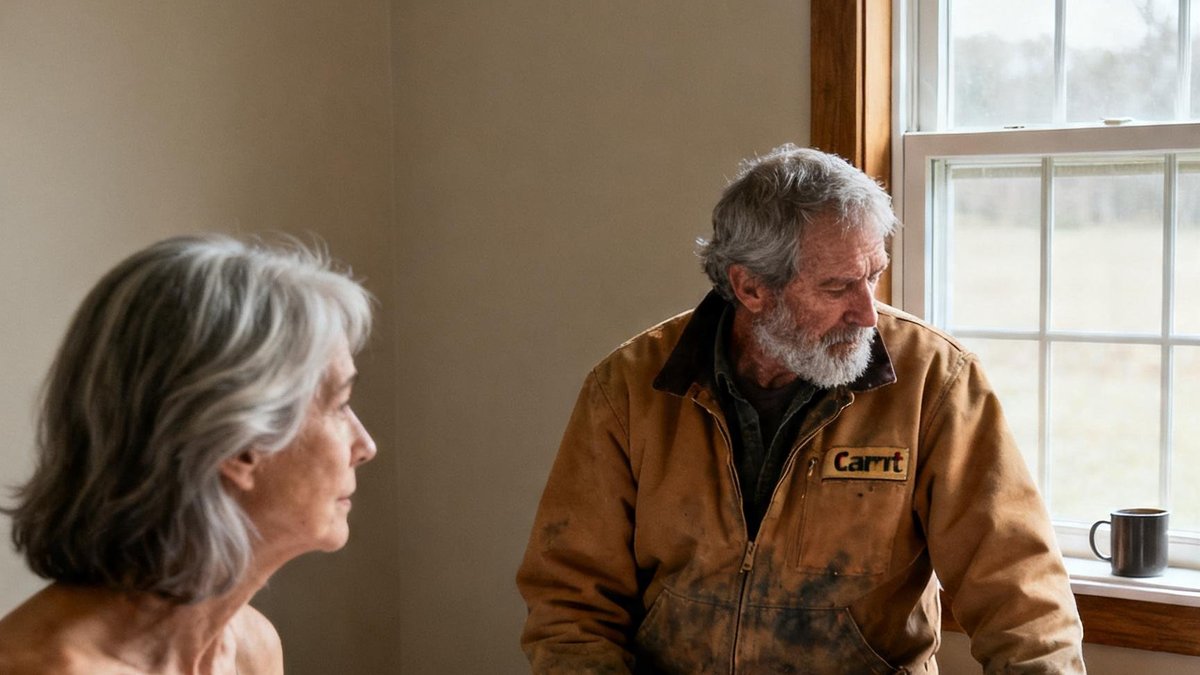
She didn't argue. Her tongue felt thick, and the thought of standing on the cold linoleum made the knot in her chest tighten another notch. Joe shrugged into that old Carhartt jacket, the one with the tear on the pocket, and stepped out. The screen door slapped shut behind him.
From the window, she could see him cross the yard. He paused by the well head—they hadn't used that well in twenty years, but he always walked past it—and then stooped to inspect the bare earth near the rose trellis. Searching for green shoots, she knew. Every year, the same ritual. He'd be muttering about the frost and the soil temperature and whether the asparagus crowns survived the winter.
A few minutes later, he came back inside carrying the *Salina Journal* and a yellow flyer from the co-op. He dropped them on the kitchen table and poured himself a cup of coffee from the pot she'd set the night before. The scent drifted into the bedroom, sharp and bitter.
Evelyn's heart thumped against her ribs. The paper. The flyer. That was all? She strained to hear any other rustle, any crinkle of an envelope.
“That's all the mail?” she called, trying to keep her voice light. “Just the paper?”
Joe grunted. “Paper and a notice about a farm auction over in Ellsworth. Nothing else. Why, you expecting a letter from that quilting club again?”
The knot in her chest turned to ice. Thirty years of intercepting that mail. Thirty years of meeting Dottie the carrier at the end of the lane with a paper bag of warm zucchini bread or a dozen fresh eggs, always with the same request: *If my husband's home, just leave the mail with me. He gets so worked up about bills, you know how he is.* She'd built a wall out of kindness and baked goods, and this morning, because she couldn't lift her head off the pillow, she'd left a crack in it.
What if there had been a lilac-colored envelope today? What if the one letter she'd been dreading for three decades had finally shown up, and Joe had seen it lying in the mailbox next to the auction flyer?
Her fingers twisted the edge of the quilt. “Joe, come sit with me. I need to tell you something.”
He ambled back into the bedroom, coffee cup in hand, and eased down onto the cedar chest at the foot of the bed. His eyes narrowed. “You're scaring me now, Evie. You want me to call Mike?”
“No. Don't call Mike.” She swung her legs over the side of the bed, the cold floor biting her soles. “Mike's got his hands full with that transmission shop in Wichita, and besides… this isn't about him. It's about something I did. A long time ago.”
The room went very still. The only sound came from outside: a meadowlark, perched somewhere on the fence line, pouring out its first long, liquid trill of the morning. Joe tilted his head toward the window.
“You hear that? That's the first meadowlark I've heard this spring. Saw him on the post when I went out. Always means the ground's about to warm up.” He smiled, a tired, gentle smile. “Remember the spring we planted the east field in soybeans? You said you'd never seen so many meadowlarks in your life.”
Evelyn’s throat seized. The meadowlark's song cut straight through her, and suddenly she wasn't in Kansas anymore. She was in a cramped, sterile hospital room in Galway, Ireland, with rain drumming against the glass and the sound of a bird—some Irish bird she never learned the name of—singing outside as if the world hadn't just split in two.
“Joe, when I went away to work in Ireland… thirty-two years ago this April… I didn't tell you everything.”
He set the coffee cup on the floor. His hands went still on his knees.
“I told you I was taking care of an old woman in Galway. That was true, for a while. But I also… I got pregnant. There was a man, a local man. It didn't last. I was alone over there, and I had the baby at University Hospital Galway, on the twenty-third of March. A girl. I named her Caitlin.”
Joe’s face didn't move. It became something carved from the same rough limestone that lined the creek bed out back.
“She's alive, Joe. I gave her up. A couple from County Mayo, the Murphys, they took her. They were good people—they'd been waiting for a child for years. They paid for everything: the hospital, the papers, even the flight home for me. And I… I came back with enough money to put a new roof on the barn and buy that used John Deere. You remember. You thought I'd earned it all scrubbing floors.”
He opened his mouth, but nothing came out. His knuckles were white where he gripped his thighs.
“I intercepted the letters,” she said, the words rushing now, a dam breaking. “The adoption agency sent updates every few years—school photos, a lock of hair, a report card. I made sure Dottie never put anything in the box when you were home. I hid them all in a tin, behind the jars of peaches in the cellar. The last one came six months ago. She's thirty-two now. She lives in Dublin. And she… she wants to meet me. That's the letter I've been terrified would show up in your hands.”
She stopped, breathless. A fat drop of rain hit the window, then another. The meadowlark fell silent.
Joe rose. He walked to the window, his back to her, and stood there watching the sky darken over the corn stubble. She couldn't see his face, but the set of his shoulders—that same weary curve—made her want to reach out and never stop crying.
“Thirty-two years,” he said. The words were flat, hollow. “You let me believe we built that barn together. But it was bought with… with what you gave away.”
“I gave away my child so we could survive. So Mike could have a chance. I thought if you knew, you'd never look at me the same. And I was right, wasn't I?”
He didn't answer. The rain came harder, drumming on the porch roof. Evelyn lay back on the pillow and closed her eyes. The knot in her chest hadn't dissolved, but it had shifted, turned into something she could finally breathe around. She'd carried the secret so long it had calcified into her bones, and now, with it out in the open—even if it shattered the man she loved—her body felt lighter than it had in three decades.
She heard Joe cross the room. She expected the slam of the front door, the roar of the pickup engine. Instead, she felt the weight of the cedar chest creak as he sat back down. A long pause. Then, so quietly she almost missed it, he said, “What did she look like? In the last photo.”
Evelyn opened her eyes. Joe was staring at the window, but his hand had come to rest on the edge of the bed, just inches from her own. Outside, the rain eased to a fine drizzle, and somewhere beyond the windbreak, the meadowlark started singing again.