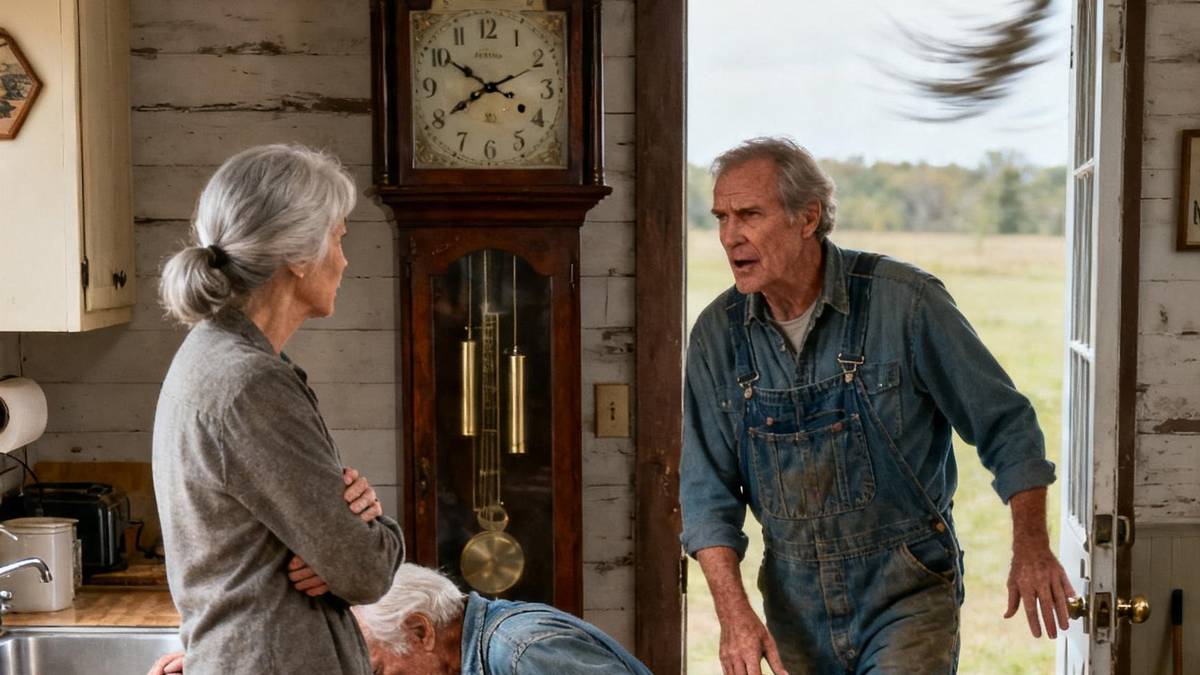
Deborah had been awake since an hour before dawn, her heartbeat bumping against her ribs in a way that made her hold her breath without meaning to. The window over the bed framed a sky the color of dishwater, and down the hall the furnace kicked on with its usual shudder. She shoved her feet into slippers and shuffled to the kitchen, but by the time she got there the tightness had already migrated from her chest to her throat, so she just stood at the sink, fingers curled around the edge of the counter, waiting for the feeling to pass.
Eugene found her like that when he came in from the barn, his Carhartt jacket smelling of hay and diesel. He didn’t say anything, just slid a box of oatmeal to the back of the stove and poured coffee into the speckled blue mug she’d had since their son was in middle school. She took it, let the heat burn her palms, and watched him wipe his boots on the rug—the one with the faded rooster that their daughter-in-law Lauren always made a face at. Forty-one years of mornings, and he still stomped his left foot three times.
“I’ll run into town for the feed after breakfast,” he said, settling into the chair by the door. “Marty said the grain elevator’s got a new batch of alfalfa, supposed to hold weight better on the yearlings.”
Deborah nodded, but her eyes were on the kitchen window. The mailbox sat at the end of the lane, a dented black shape against the bare maples. It was Tuesday. Grace, their regular mail carrier, always came before nine, and Deborah always—always—met her at the road. She took her an apple pie in the fall, a jar of honey in the spring, and four years ago she started handing her a twenty-dollar bill every December “for the trouble.” The trouble being that anything with an international return address, anything that smelled of bureaucratic forms and embossed seals, was to go straight into Deborah’s hands before Eugene checked the box.
That morning, though, she hadn’t made it outside. By eight-thirty her legs had started shaking, and she’d had to lie down on the sofa with the afghan pulled up to her chin. Eugene walked out to the lane himself while she was in the bathroom. She heard the screen door bang, then his heavy boots on the gravel.
When he came back in, he had only the newspaper and a flyer from the Co-op. Nothing else.
“Grace’s kid brought it,” he said, tossing the paper onto the table. “Said she’s out with the flu. Bicycle had a flat, too—poor boy looked half-frozen.” He rubbed his hands together and went back to his coffee.
Deborah kept her face still, but her fingers were twisting the fringe on the afghan so hard that one thread snapped. She’d been expecting a letter from Milan—from the agency that handled background documentation, the one she’d contacted two months earlier after a panic attack in the parking lot of a Walmart. She’d paid the processing fee with cash so there would be no trace on their joint account. The reply, they’d said, would arrive in four to six weeks.
It was going to rip her open either way. If there was a letter and Eugene found it first, the life she’d built would crack down the middle. If there was no letter, she’d have to decide whether to tell him anyway—whether to cut the crack herself while she still had the strength.
She decided when she saw him outside again, bent over the bed of his old F-150, fiddling with the hitch pin. He’d lost so much of the man he was in his forties. His shoulders swept forward now, the way his father’s had, and his hands moved carefully around metal parts, like he was always afraid something would pinch. She watched him through the glass and thought: I laid next to that man through storms and layoffs and the night our boy got arrested for tagging the overpass, and he never once looked at me as if I owed him anything I didn’t give freely. He deserves to know what he’s been sleeping beside.
She called him in. The words were quiet but not a whisper, because whispers felt like something you could still take back. “Gene. Come sit. I need to tell you about the money. The house money. From when I went to Italy.”
He froze with one hand on the refrigerator door, a carton of half-and-half tilting in his grip. “What about it? That was thirty years ago, Deb.”
“Thirty-two. And I lied to you.”
The carton thudded onto the shelf. He turned and crossed to the sofa, settling into the corner where the cushion was permanently flattened. His knees cracked. The grandfather clock in the hall ticked and kept ticking.
She told him she’d worked in a textile factory outside Bologna, twelve-hour shifts, shared a room with two Moldovan girls who taught her curses in four languages. She told him the owner paid under the table and let her sleep in a storage room after she got sick one winter—the kind of sick that lasted months, that made her throw up every morning until she couldn’t pretend it was bad food.
And then she told him about the birth. A clinic on the edge of the city, nuns who spoke no English, a window that looked out onto a courtyard where someone had planted sunflowers even though the light was wrong. She’d been alone. Her aunt had already moved to Germany for another job, and she’d lost the phone number she’d scribbled on a napkin. When the baby came—a girl, six pounds and change, with a shock of dark hair—they laid her on Deborah’s chest for eight minutes before a social worker with kind eyes and an accordion folder took her away.
“Her name,” Deborah said, and her voice broke so the clock sounded louder, “was Rosa. After my mother. The family that adopted her—the Lombardis—they let me name her. They were in the room next door. I could hear them crying when they heard her first breath.”
Eugene did not speak. His hands, which had been resting on his knees, flattened out and pressed into the denim of his jeans as if he were trying to push himself up but couldn’t find the leverage. His mouth opened and closed. He looked at the ceiling, at the shelf of cookbooks, at the cross-stitch sampler his mother had made for their wedding. Anywhere but at her.
“The money I sent home,” she continued, because stopping now would be like stopping mid-surgery, “was part factory wages and part… a gift. The Lombardis paid for my care and my ticket back. They weren’t rich, he was a mechanic, but they wanted a child so badly. They said they’d make sure she knew she was loved from two directions. I came home with nine thousand dollars and a scar you never noticed.”
The nine thousand had patched the roof, bought a used tractor, and paid for Kevin’s first semester of community college. Eugene always called it the year they finally caught a break.
He finally looked at her, and his eyes were wet in a way she’d seen only once before, when they’d had to put down his dog, Bud, on a Thursday afternoon in 1998.
“Every spring,” Deborah said, “when you’d point out the first bluebird, I’d think of that courtyard. You’d be so sure you’d spotted a sign of winter ending, and I’d be seeing sunflowers in a country where I left a piece of myself. I couldn’t tell you then. I thought if I did, the rest of the life we’d built would just evaporate.”
“Evaporate,” he repeated, the word coming out half-chewed. “You think that little of the life, that you’d lose it over the truth?”
“I thought that little of myself, maybe.”
He got up. He didn’t storm out; he walked to the fireplace, rested his forearm on the mantle, and stared into the cold grate where a layer of ash had been sitting since March. His reflection in the brass clock face was pale and slanted. She counted the ticks: one, two, three, all the way to twenty before he spoke again.
“Is she alive?”
“I don’t know. That’s what the letters I’ve been hiding were about. I’ve been writing to the agency, trying to find out. The last thing I heard was ten years ago—a photo from her sixteenth birthday. She had her hair cut short, and she was laughing at something off-camera. I kept it in a tin under the linoleum in the pantry.”
She pulled the tin out later, after he asked to see it. They sat at the kitchen table in the dimming afternoon, passing the photograph back and forth between them as if it were a fragment of something radioactive that might still warm them. The girl—Rosa—had her mother’s cheekbones, and Eugene touched the image with the pad of his thumb right over that spot, dragging the callus across the glossy paper.
They didn’t decide anything that day—not about searching for her, not about telling their son, not about who owed whom an apology for three decades of silence. But around suppertime, when the porch light buzzed on and a neighbor’s border collie started barking at a bicycle going past, Deborah found herself standing at the sink again. This time Eugene came up behind her, put a hand on her shoulder, and then reached past her to turn off the faucet she’d left running.
“You don’t have to get the mail yourself anymore,” he said. “I’ll pick it up. Whatever comes.”