I saw the dog before I stopped the U-Haul. She sat beside the mailbox like she had papers to serve. Rain had flattened the gray fur along her spine, and her ribs showed through when she turned her head.
Sarah already stood in the mud with a box of kitchen junk against her hip. “She’s been there since we got here. Just watching.”
I killed the engine and got out. The dog’s muzzle was white around the edges. Her tail lay flat in the wet grass. She did not move when I walked toward the gate.
“She’s got to belong to somebody,” I said.
“Then why is she outside in this rain?” Sarah asked.
The dog let out a low rumble from her chest. Not a bark. A warning.
We had bought the old Hensley place two weeks earlier, an estate sale handled by two nephews from Bellevue who wanted it gone before the leaves turned. The realtor called it a “handyman special with pastoral views.” She never mentioned the German shepherd mix standing guard at the property line.
We carried boxes inside and left the dog by the mailbox. That first night, the scratching began around eleven. Fingernails against the front door. I parted the curtain. She was on the porch, out of the rain now, lying with her head on her paws, watching the door like it might open for someone else.
“Let her in,” Sarah said from behind me.
“She’ll bite.”
“She won’t.”
“It’s not our dog.”
Sarah didn’t answer. She went back to the bedroom, and the old floorboards creaked under her steps. The house had its own way of talking back.
The next morning the dog was still there, curled under the porch bench. Sarah put out a bowl of water and a can of tuna from one of the moving boxes. The dog didn’t touch either.
Around noon, a woman in a yellow raincoat came up the gravel drive holding a foil-covered dish. She handed it to me. “You’re the new people. That’s a smoked salmon casserole. I didn’t know if you liked it.”
“Thank you.”
She looked past me at the dog. “Oh, she’s still here.”
Sarah came out to the porch. “You know the dog?”
Peggy set her hands on her hips. “That’s Lady. Old Walt’s dog. He died back in August. The nephews drove over from Seattle, cleaned out the house in one Saturday, and stuck a For Sale sign in the yard before the flowers on his grave had even shriveled.”
She told us Walt had lived alone since his wife passed eleven years earlier. He and Lady walked the ditch road every morning. He used to tell Peggy, “She’s the only family I’ve got left.”
“Didn’t the nephews want her?” Sarah asked.
Peggy shook her head. “One of them said she was too old. The other said his apartment in Redmond didn’t allow dogs. So they left her. I’ve been putting scraps by the fence, but she won’t come near me.”
That night Sarah and I fought in the kitchen while the dog lay on the porch. I said we couldn’t afford another mouth. She said we couldn’t afford to be the kind of people who looked the other way.
“You want to save everything,” I said. “But some things can’t be saved.”
Sarah’s hand tightened on the edge of the counter. “That’s not about the dog.”
“No,” I said. “It’s about us. And that’s why I can’t.”
She didn’t speak. She went to bed.
I woke at two to a sound that climbed the walls. A long, raw howl from the yard. I stepped into my boots and went out to the porch.
The dog sat on the grass, head tipped back, singing at a moon I couldn’t see through the cloud cover. I sat on the top step.
“You’ve got a better voice than I do,” I said.
The howl stopped. She looked at me but didn’t run.
“When we lived in Seattle, I’d stand on our apartment balcony at night and want to do that. Just open my mouth and let it out. But somebody would’ve called the police.”
The dog lowered her head. I kept talking. Maybe because she didn’t interrupt.
“Our daughter, Rosie, died eight months ago. She was seven. Her school called while I was in a meeting. I silenced my phone. By the time I called back, they’d already taken her to the hospital. I got there, but her backpack was still on the floor by the bed. Pink, with a unicorn patch.”
I picked at a splinter on the step. “So I know what it’s like to be left outside the door. To wait for somebody who isn’t coming.”
The dog stood, took two steps closer, and sat down again just beyond arm’s reach. Sarah’s hand touched my shoulder. I hadn’t heard the screen door open. She lowered herself next to me, and for a while the three of us sat in the dark, listening to the rain start again.
In the morning, Sarah left a note on the kitchen counter: “Gone to Port Angeles to return the U-Haul. Stop at Safeway for dog food. Feed Lady. Her bowl is by the fridge. M.”
I hated how easily she could just move forward. Like deciding was that simple.
I opened the front door. The porch was empty.
My first reaction was relief. Then I saw the drag marks in the wet leaves leading toward the shed.
I found her behind the shed, lying on her side. Her left flank was torn, matted with mud and something darker. She tried to lift her head when I came close, then gave up. Her eyes followed me.
“What did you get into?” I asked.
No answer, just the shallow rise and fall of her ribs.
I carried her into the house—she was lighter than she looked, all bones and wet fur—and laid her on a blanket in the kitchen. The cuts looked like teeth marks, maybe a coyote, maybe a dog from the next farm over. I cleaned them with warm water and the last of the peroxide from our bathroom. She let me.
At the vet in Sequim, the doctor said infection had already set in. “She’ll need surgery and three nights here. It’s going to run you twelve hundred and forty dollars.”
I handed her my credit card. “Do it.”
Sarah met me at the clinic the next afternoon. She didn’t ask how much. She walked to the recovery kennel, and Lady’s tail thumped once against the metal door.
The next six weeks turned our house into a rehab ward. I slept on the couch next to her the first week. I changed bandages, crushed antibiotics into wet food, carried her outside three times a night. Sarah and I barely spoke, but we worked around each other like we’d done it for years.
One evening, after the staples came out, I sat on the floor with Lady’s head in my lap. Sarah was at the sink, peeling apples for a pie. The radio played an old country station from Port Townsend.
“I blamed you for Rosie,” she said without turning around.
I didn’t move.
“I blamed you for not answering. I blamed myself for not being there sooner. Then I blamed the school, the hospital, God.” She set a peel down on the counter. “But Lady doesn’t know any of that. She just wants to be fed.”
“I forgot to renew her EpiPen prescription,” I said. I’d never said that out loud to anyone.
Sarah turned. “You forgot to renew a prescription. You didn’t plan it. You didn’t make her sick. You just weren’t God, Ben.”
The dog’s tail swished across the floorboards. I laughed, then stopped myself. The sound surprised me.
On a Saturday in November, three months after we found Lady behind the shed, Sarah hung a new wind chime of driftwood and sea glass on the porch. It clattered in the wind from the Strait. We drove to Dungeness Spit and walked to the lighthouse while Lady trotted ahead, nose down, finding every dead crab. On the way back, Sarah said, “Rosie would have been eight today.” I didn’t answer right away. I watched Lady chase a seagull. Then I said, “She would’ve wanted a dog.”
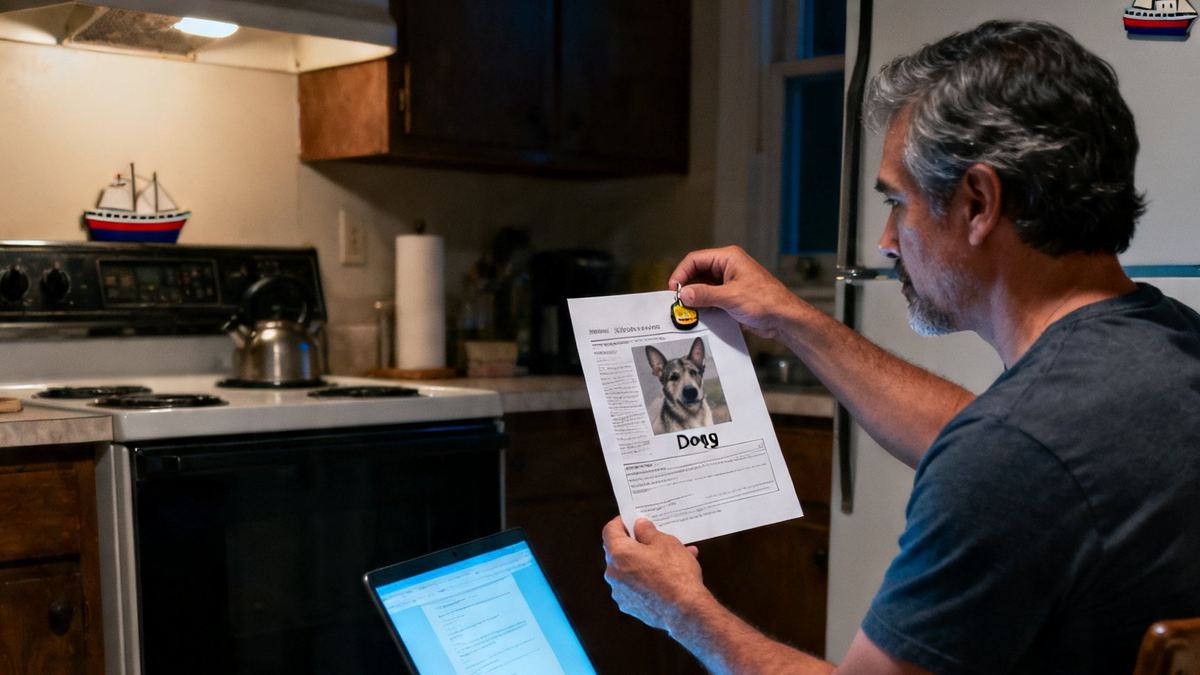
That night, after Sarah went to bed, I sat at the kitchen table with my laptop open. The microchip registry showed Lady’s registered owner as Walter Hensley, with his nephew Curt listed as secondary contact. I typed in the new address, uploaded the vet records, and paid the thirty-eight-dollar transfer fee.
A minute later, my phone buzzed. Curt Hensley.
“What do you want?” he said.
“I don’t want anything,” I said. “I just registered Lady in our name.”
“That dog wasn’t part of the sale.”
“She’s microchipped, licensed, and she’s got more medical records than I do. You left her behind to starve.”
There was a pause. I heard a television in the background, some game show.
“Keep her,” he said. “She’s old and worthless anyway.”
“Then you won’t miss her.”
I ended the call. The printer on the shelf whirred and spat out a single sheet—Lady Porter, 14 Lavender Road, Sequim, Washington. I hung it on the fridge with a magnet shaped like a ferry.
Lady padded into the kitchen, sniffed the paper once, and settled onto the mat by the stove. Her tags ticked against the floor.