I was nineteen when Trey Fannin put his thumb against the back of my neck in the dry stockroom at Fannin's Family Buffet and said I owed him for every free plate he had slipped me. I drove an elbow into his ribs and slapped him hard enough to make the shelving ring. The next morning, his mother Tanya cut my hours to zero. Her text said: “We won’t need you after this week, sweetie.” She owed me for seventy-one hours, and she knew it.
I grew up in Boone County, in a hollow off Route 3, raised by my mamaw Jo. My mother Angela took up with a gas-line contractor from Nitro and moved two counties over before I finished high school. Mamaw never called it abandonment. She called it “your mama chasing a hard hat.” She pushed me toward BridgeValley Community and Technical College. “You get a little certificate in patient care, and you’ll never have to scrape gravy off a steam table.” She was wrong about the last part.
Miss Pauline’s house sat on Ringer Street between the Kanawha River and the railroad tracks. Her front porch swing needed one more link in the chain. The coal train came through every night at 2:47 a.m. and rattled the teaspoons in the dish drainer. I paid her eighty dollars a week for the back bedroom and half a shelf in her fridge.
Fannin’s Family Buffet was on the service road behind the Holiday Inn. I cleared trays, restocked the salad bar, and washed sheet pans. Tanya paid me $8.75 an hour, under the table, which is why I didn’t say anything when she rounded my hours down. Her son Trey came through the kitchen most afternoons. He was married to a dental hygienist named KayLeigh, but he liked standing too close to the ice machine and asking if I had ever thought about doing hair.
After the stockroom, I didn’t go back. I texted Tanya about my last check. She wrote back: “Come talk like an adult. Trey said you tore a case of single-serve dressings.” That was a lie. I had seventy-one hours on my own count, including overtime, and no way to prove it.
Miss Pauline found me at her kitchen table at two in the morning, eating peanut butter from the jar with a fork. She said, “Baby, you got a face like a fist.” Then she told her neighbor Mr. Cecil I needed work.
Mr. Cecil lived two doors down. He had a new hip, an old beagle named Possum, and a checkbook he balanced by hand every evening. Possum had one eye and a bark that sounded like a screen door swinging in wind. Mr. Cecil offered me $140 a week to cook, clean, and drive him to physical therapy in Teays Valley on Tuesdays and Thursdays. I said yes before he finished the sentence.
His grandson Landon showed up the last week of November. He played shortstop for Marshall’s club baseball team. He arrived with a box of apple fritters from Tudor’s and a bag of road salt for the porch. I liked him before he took off his cap, and I didn’t like that about myself.
Landon stayed three days. We washed dishes side by side after supper. He asked me questions about the patient care program and didn’t make fun of my old Honda with 287,000 miles. When he left, he took my number written on the back of a dry-cleaning receipt.
On December 23, he came back.
Mamaw called while I was packing. Her voice was thin but sure. “Angela’s staying at Dwayne’s through Sunday. So I’ll be here with the chickens and the gas logs.”
“I’ll be down by dark,” I said. “I’m bringing somebody you ought to meet.”
She didn’t ask who. She just said, “Wear boots. The creek’s up.”
At four o’clock on Christmas Eve, Possum started barking in the front yard. I stepped out onto Mr. Cecil’s porch and saw Trey Fannin’s black Silverado blocking the drive. One fog light was busted out, and the engine ticked like it was about to die.
He got out, drunk enough to swing the door twice. “Heard you took a job cleaning up after some old man. Thought you had standards.”
I didn’t answer. I set my phone on the porch rail, propped it against a dead pot of geraniums, and pushed record.
Trey put one foot on the bottom step. “You slapped me. You think that goes away?”
“You don’t get to stand on this property,” I said. “Go home to KayLeigh.”
He laughed, but it didn’t reach his eyes. “You gonna make me? Your little ball player inside?”
Landon stepped out then. He didn’t shout. He said, “You’re on camera, man. And I already hit 911.”
Trey looked at the phone on the rail. For a second, he didn’t know if Landon was lying. So Landon lifted his own phone from his coat pocket, already lit up. A woman’s voice came through the speaker: “911, what’s your emergency?”
Trey froze with his hand on the rail.
“Trespassing,” Landon said into the phone. “Guy drove up to 17 Ringer Street and won’t leave. I’ve got his plate.”
Trey said the phone was fake, but he was already backing toward the Silverado. “I’ll be back when your boyfriend leaves,” he told me. “Count on it.”
He spun out, scattering gravel across Mr. Cecil’s mailbox.
Landon waited until the taillights vanished past the railroad crossing. Then he said, “You’re not driving down to Boone County alone. We take my truck, and I stay.”
I said okay.
We drove through Charleston and got to Mamaw’s cabin by dark. She had set out a plate of fried pies and a new package of tube socks for me. When she saw Landon, she looked at me with one eyebrow up and said, “Get the folding chair from the coal shed.”
That night, the three of us ate pinto beans and cornbread. Landon didn’t flinch when Mamaw asked how many people lived in his dorm. I split wood the next morning while he watched and pretended not to be sore about it.
Two days after Christmas, I went to the magistrate’s office in Winfield. I brought a thumb drive with the video from the porch and the older one from the stockroom, the one I had never shown anybody. I filled out two forms.
The first was a petition for a protective order.
The second was a wage complaint. I wrote the number with a pen that kept skipping: one thousand one hundred eighty dollars and forty-two cents. It covered seventy-one hours at $8.75 an hour and thirty-one minutes of overtime at $13.13.
The clerk stamped both and gave me a receipt.
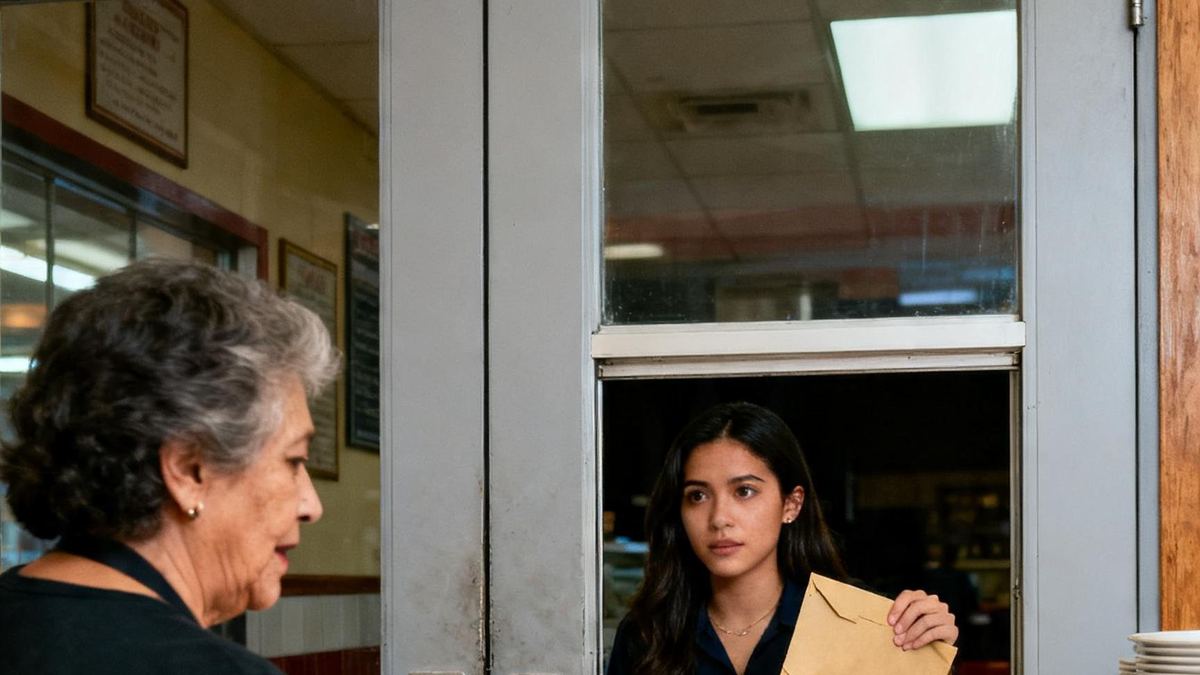
That afternoon, I walked back through the double doors of Fannin’s Family Buffet with a manila envelope in my hand. The cashier was a high school girl I didn’t know. Tanya Fannin stood at the end of the salad bar, refilling blue cheese dressing. Trey was in the back, visible through the pass window, hollering about covering somebody’s shift.
Tanya saw me and the pitcher in her hand tipped. “You don’t work here no more.”
I set the envelope on top of the register. “Inside is a copy of the protective order I filed this morning. There’s also a docket sheet with the hearing date and a thumb drive of Trey grabbing me after I told him to stop.”
Tanya’s mouth opened. “You filed what?”
“I also filed for unpaid wages with the state. The amount is in there. You can wait for the sheriff to deliver it, or you can read it now and save yourself the trip.”
Trey came out of the back. “Who let her in?”
Tanya’s voice cut through the dining room. “What did you do in my kitchen? And don’t tell me nothing, because she’s got you on tape.”
“That’s not—” Trey started.
“On what?” Tanya ripped open the envelope. “She’s got the thing right here!”
I didn’t need to watch the rest. I turned and stepped back into the parking lot. Through the window, Tanya had the thumb drive in one hand and the folded complaint in the other, and she was screaming at her son in front of the salad bar.
Landon was waiting in his truck across the road at the Go-Mart, because he didn’t think I should go alone. I walked over and rolled down the window on my Honda.
“I dropped it off,” I said.
“You get your check?”
I shook my head. “Not yet. But she’s going to pay.”
Then I pulled out toward the highway, with his headlights in my mirror.