Maya Thompson learned two things in her first year away from home: a good meal could open a door, and a closed one could save your life.
She was nineteen when she left Zanesville, Ohio for Ashland, a speck of a town eighty miles north. Her grandmother, Ruth, had raised her in a single-wide trailer off County Road 14, next to a cornfield and a repair shop that never seemed to open. Ruth was seventy-three, with hands that could strip a chicken in ninety seconds flat and a voice that carried across the yard like a weather report. Maya's mother, Karen, had left when Maya was eleven — run off with a man who installed gutters and drank too much on weekends. The phone calls got shorter, then stopped coming altogether.
"You're not living in any dorm," Ruth said when Maya got accepted to the culinary program at North Central State College. "I found you a room with a retired teacher. Mrs. Hartley. Clean house, good neighborhood, and you'll keep your head on straight."
Mrs. Hartley's house sat at the end of Maple Street — a white two-story with a front porch swing and a rusted Pontiac up on blocks in the side yard. The living room smelled like lemon polish and the pages of old books. A cross-stitch above the couch read "Bless This Home." Maya's room was upstairs, with a dresser that had belonged to Mrs. Hartley's mother. The drawer liners were yellowed newspaper from 1987. One of them showed a Ford dealership advertising a summer sale. $4,995 for a new Escort.
Rent was $250 a month, utilities included. Ruth paid the first three months from her Social Security. "After that, you're on your own, girl. I ain't made of money."
Maya got a job at The Corner Spoon, a diner on Main Street with a neon sign that flickered just enough to make you think it might die. She worked evenings — clearing tables, washing dishes, scraping plates. The owner, Darlene, ran the place like a warden: efficient, loud, and always watching.
Darlene's son Bradley was twenty-eight, married to a woman named Cindy who worked at the county clerk's office. Bradley came in every afternoon for a cheeseburger and sat at the counter, watching Maya move through the dining room. He wore a wedding ring and smelled like cigarettes and cheap cologne.
One Tuesday night, Maya went into the storage room for a box of napkins. Bradley followed her in. He blocked the doorway with his body. His hand found her waist.
She turned and hit him. Open palm, hard, across the face. The sound bounced off the metal shelves.
"You little —"
She pushed past him and walked out the back door. The next morning, Darlene called her into the office. "My son says you attacked him. I can't have that kind of energy in my kitchen."
Maya took her final paycheck — $387.50 after taxes — and left. The neon sign buzzed once and went dark as she passed under it.
Mrs. Hartley had a neighbor two houses down, an old machinist named Frank Dawson. He was seventy-two, widowed six years, living alone with a one-eyed cat named Samson and a 1968 Plymouth Fury he only drove to church on Sundays. His knee was bad, his blood pressure spiked when the weather turned, and he needed help around the house.
"Mrs. Hartley said you can cook," Frank told her, sitting on his porch with his leg propped on a milk crate. "I can pay a hundred-fifty a week. I know it ain't much."
"I'll take it," Maya said.
She came over after classes, usually around three. She did his laundry, swept his floors, made dinner. Frank wasn't picky. Meatloaf, chicken, spaghetti with meat sauce. The first time she made beef stew, he looked at the bowl for a long time.
"My wife used to add a little cinnamon," he said. "Nobody else knew that."
After that, Maya added cinnamon to the stew. Frank never mentioned it, but he always asked for seconds.
The cat, Samson, followed her everywhere. He sat in the doorway while she folded laundry, his single eye tracking her hands. When she cooked, he parked himself under the kitchen table and waited for scraps.
One afternoon in late October, Maya showed up to find a young man on Frank's porch. Short brown hair, broad shoulders, a duffel bag at his feet. He stood up when she approached.
"You must be Maya," he said. "I'm Tyler. Frank's grandson."
Frank came out, grinning. "Tyler plays baseball. Full ride at Ohio State. He's home for a few days."
Tyler shook her hand. His grip was warm and solid. "Grandpa's been telling me about you. Says you make the best pot roast in Wayne County."
Maya felt her face go warm. "I just follow the recipe."
"That's what all good cooks say." Tyler had a small scar above his left eyebrow, a faded line that pulled when he grinned.
Frank insisted on dinner together. Maya made pot roast, mashed potatoes, peas. Mrs. Hartley came over too. They sat at Frank's kitchen table — the one with chrome legs and a cracked Formica top — and Tyler talked about baseball, about getting drafted, about a girl in Columbus who had wrecked his heart. He kept looking at Maya, and she kept looking at her plate.
Later, after the dishes were done, Tyler walked her back to Mrs. Hartley's. Two houses. He made it feel like a procession. At the bottom of the porch steps, he said, "Can I call you?"
Maya's voice came out smaller than she meant. "I'd like that."
He called the next day. And the day after. He texted photos of the baseball field at sunrise, his teammates, the view from his apartment window. He came back to Ashland every few weeks. When he was in town, he sat in Frank's kitchen while Maya cooked, drinking a beer and watching her.
Once he said, "You're the most interesting person I've ever met."
"What's so interesting about me?"
"You don't complain," he said. "Most people complain."
The months passed. Maya kept her grades up, kept working for Frank, kept sending money home to Ruth. Karen called twice. Once to ask about Ruth's health, once to borrow $300. Maya said no to the money. Karen didn't call again for a while.
In December, Tyler gave Maya a silver necklace with a tiny spoon pendant. "It's for a cook," he said, laughing. "I thought… I don't know. It's dumb."
"A little dumb," she agreed. She put it on anyway. The spoon lay against her collarbone, cool and light.
That's when he kissed her. On the porch, under the yellow bug light, with the first snow ticking against the windows.
In January, Maya got her associate's degree. Ruth couldn't make it because of the weather, but she sent a card with a $100 bill inside. "For your future," the card said. Maya put the bill in her dresser drawer and didn't touch it.
Spring came. Maya got a job offer from a farm-to-table restaurant in Ashland called The Blue Heron. Line cook, $14 an hour. Real work, in a real kitchen, under a head chef who had cooked in Chicago. She took it and kept helping Frank in the afternoons.
Tyler's baseball season started. He was good — good enough that scouts came to his games. But his throwing elbow had been bothering him, and he wouldn't talk about it. Maya noticed him rubbing it when he thought no one was looking.
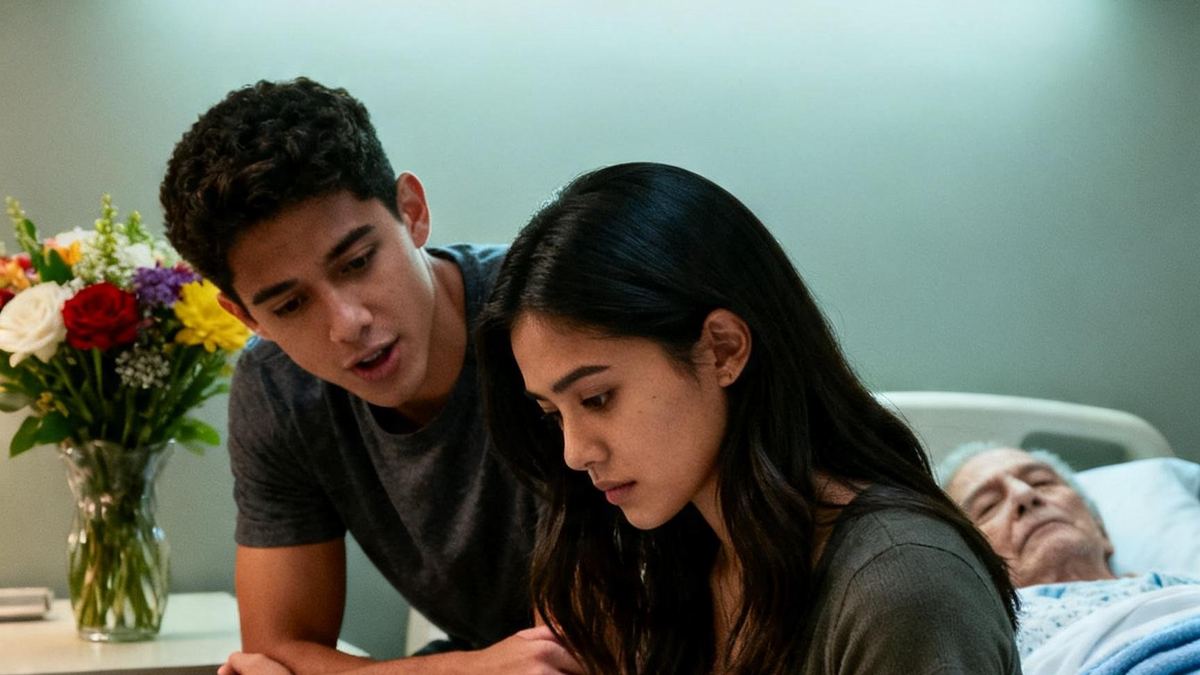
In April, Ruth had a stroke. Maya drove forty-seven miles to Zanesville in a borrowed Chevy and found her grandmother in a hospital bed, her left side paralyzed, her face slack. The doctor used words like "significant" and "long recovery."
Maya sat by the bed for three days. Karen didn't come. She called once, said she was in Cincinnati, said she'd try to make it. She never showed.
Ruth survived. But she couldn't live alone anymore. The doctor said she needed full-time care. Maya looked at the options: a nursing home, a home health aide, or moving back to Zanesville.
Tyler came to the hospital. He stood in the doorway of Ruth's room with a bouquet of flowers, his face pale. "How is she?"
"Alive." Maya's voice cracked. "But she can't go back to the trailer. I don't know what to do."
Tyler sat beside her. He put the flowers on the bedside table. "You don't have to figure it out alone."
But she did.
That night, Maya made a decision. She would move back to Zanesville. She would take care of Ruth. She would put her life on hold — again.
Tyler didn't argue right away. He picked at the edge of the flower wrapping, folding the plastic into smaller and smaller triangles. "I've got two years left at Ohio State," he said finally. "There's a community college outside Zanesville. Guys transfer down a level all the time. It's not the end of the world."
"Don't do that. You have a full ride."
"I've got a grandpa with a bad knee and a girl who makes cinnamon stew. I think I can find a diamond somewhere near Zanesville." He tried to smile, and it came out crooked. "I'm not good at the noble speech thing, Maya. I just don't want to be three hours away wondering how you're doing."
"This isn't fair to you."
"No," he agreed, rubbing his elbow without seeming to notice he was doing it. "It's not. I hate it, actually. But I'd rather hate it here than in Columbus."
The following week, Maya was back in Ashland, packing. She gave Mrs. Hartley her last rent check — $250, with a note that said "Thank you for everything." She cleaned Frank's house one final time, made him a casserole to freeze, and explained she was leaving.
Frank nodded, his eyes wet. "You take care of your grandma. She raised a good one."
On Maya's last night in Ashland, she and Tyler sat on Frank's porch. The street was empty. A neighbor's dog barked somewhere in the distance. The bugs were starting to come out.
"I meant what I said," Tyler told her. "I'll transfer. I'll be there."
"Finish the semester first," she said. "Then we'll talk."
"Promise?"
Maya twisted the silver spoon pendant between her fingers. "I promise."
The next morning, she loaded her things into the borrowed Chevy and drove south. The trailer was smaller than she remembered. The roof leaked in the kitchen. The porch railing was loose. Mrs. Kowalski next door had been checking in, but the place needed work.
Maya spent the first week cleaning, repairing, making the trailer livable. She got a job at the Sunrise Grill in Zanesville, working the morning shift. She hired a home health aide named Diane for the hours she was gone — $18 an hour. The money was tight. But Ruth was better. She could sit up, move a little with a cane, speak slowly but clearly.
That's when Maya started thinking about her own thing.
She had no money for a restaurant. No money for a food truck. But she had hands, she had skill, and she had a growing list of people who'd asked her to cook for them. So she called Tyler.
"I need to borrow $4,200," she said. "For permits and supplies. I'll pay you back in eighteen months with interest."
"Let me give it to you."
"No. It has to be a loan. I need to do this myself."
Tyler laughed. "OK. But the interest is dinner. You cook for me. For free. Forever."
"I think I can manage that."
Maya started small. She cooked out of Ruth's kitchen, prepping meals for seniors in the area — people who were homebound, couldn't shop for themselves, or just needed company. She charged $9 per meal. Fresh ingredients, never missed a delivery.
Word spread. Within six months, she had forty-two clients. The money went into a separate account, and on the first of every month, she transferred $350 to Tyler — principal plus interest.
On a Saturday afternoon in September, Maya was in the kitchen, up to her elbows in chicken pot pie filling, flour dusted across the counter and a pot of stock simmering behind her. Ruth was dozing in her chair in the living room, the TV murmuring a rerun of something with a laugh track. The doorbell rang, thin and rattling, like it always did.
Maya wiped her hands on her apron and answered the door. Standing on the porch was Karen. She looked thinner, harder, a bruise fading yellow-green on her cheek. She was wearing a denim jacket with a torn sleeve.
"Hey, baby," Karen said.
Maya didn't move.
"Can I come in?"
Maya stepped aside. Karen walked in and looked around. The kitchen. The living room. The photos on the wall, the new grab bar by the bathroom door.
"Place looks good," Karen said. "You fixed it up."
"What do you want?"
Karen's eyes went damp, but she didn't cry. "I need a place to stay. Just for a while. Things didn't work out in Cincinnati."
From the living room, Ruth stirred and called out, thick-tongued from the stroke, "Who's that at the door, hon? Tell your mother dinner's not for another hour."
Maya didn't answer her grandmother. She walked past Karen into the kitchen, opened the utility drawer next to the stove, and took out a business card wedged between rubber bands and a church bulletin. She set it on the table, not in Karen's hand.
"That's the shelter on Maple Street. They've got beds and a job training program starting in October."
"You're kicking me out?"
Maya didn't answer that either. She went back to the counter, picked up the bowl of pie filling, and started folding in the peas and carrots, the wooden spoon scraping against the sides. Her back was mostly to the door.
Karen stood there a long moment. "You think you're so much better than me."
Maya kept stirring. The stock behind her had started to bubble, and she reached over without looking and turned the burner down. "The card's on the table," she said. "I've got to get this in the oven before Ruth's dinner."
Karen picked up the card. Her hand shook a little. She looked at Maya's back, at the flour on her wrists, at the pie shell waiting on the counter. Then she turned and walked out. The screen door banged behind her, and a moment later Maya heard the crunch of gravel as Karen's footsteps faded down the drive.
"Who was it?" Ruth called again.
"Nobody, Grandma." Maya poured the filling into the crust. "Just someone at the wrong house."
That evening, Tyler showed up still in his baseball uniform, grass stains on the knees, cleats hooked over two fingers. He sat on the front steps next to her and picked a burr off his sock.
"Long practice?" Maya asked.
"Coach had us running suicides for forty minutes because Danny showed up late." He bumped his shoulder against hers. "You look wiped. Bad day?"
She told him about Karen — flat, no embellishment, just what happened. Tyler listened without interrupting, working a blade of grass between his fingers.
When she finished, he was quiet for a second, then said, "You want me to heat up that pie, or are we eating cereal again?"
Maya laughed, short and surprised, and some of the tightness went out of her shoulders. "There's plenty of pie."
They sat there while the sky over the trailer park went orange, then pink, then the deep blue-gray that meant Ruth would want the porch light on soon. Somewhere down the row, a dog barked at nothing, and the smell of someone's dinner — fried chicken, maybe — drifted between the trailers. Tyler's hand found hers, calloused palm against her flour-dry fingers, and neither of them said anything else about it.