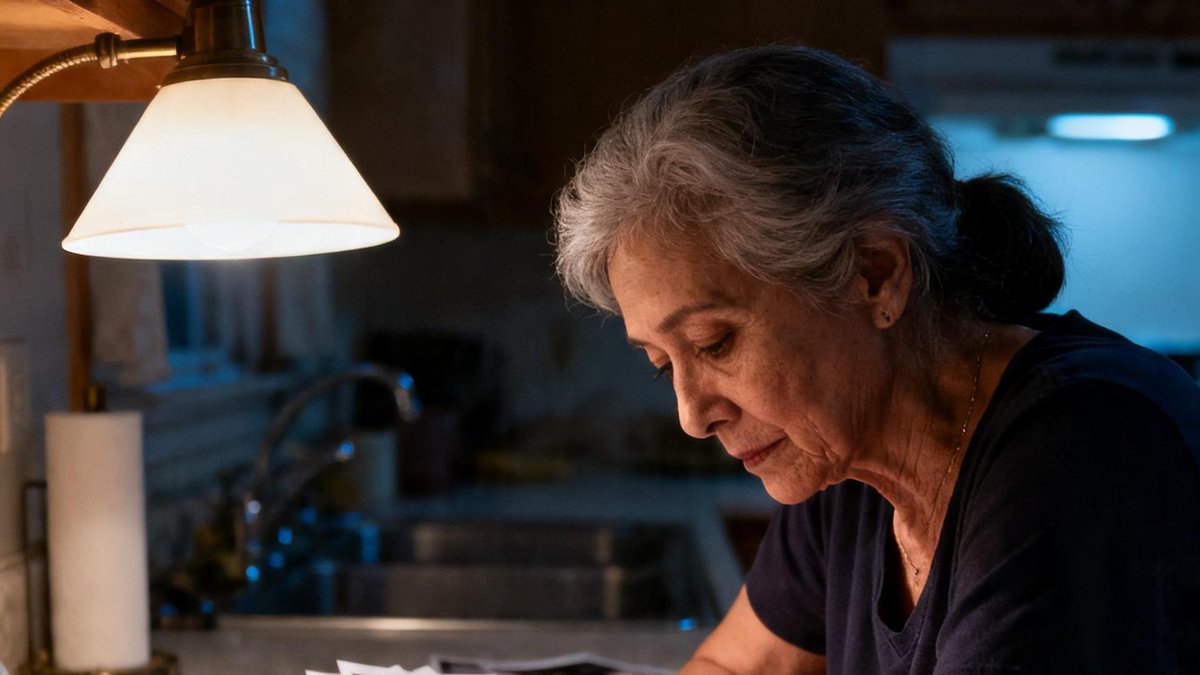
There were seventeen photographs in that envelope. I counted them three times.
I hadn't planned to open it at one in the morning. The party at the Elks Lodge had ended hours ago, and I'd already dragged the leftover pasta salad to the car, returned the folding chairs, and kicked off my shoes at the front door. My feet hurt in a way that sixty-five doesn't explain. The envelope sat on top of the gift pile on my kitchen counter — a brown kraft mailer with my name in blue ballpoint: *Elaine*.
Inside: no cash. No gift card. Seventeen photographs and two sheets of lined notebook paper, folded in half.
The first photo was from 1986. My son Daniel, age three, sitting on my lap in a plastic wading pool in the backyard of the house on Orchard Street. I remembered the neighbor's sprinkler hitting the fence at exactly two every afternoon, and how Daniel would shriek every time the water sprayed over the side.
The photos covered a whole life. Daniel missing a front tooth. Daniel in a superhero cape made from an old pillowcase. Daniel at his eighth-grade band concert, clarinet tilted wrong. Daniel and his dad at Lake Macatawa, the summer before the diagnosis. Daniel on high school graduation day, cap crooked. Daniel and Rachel at their wedding, her veil blowing sideways in the wind off Lake Michigan. Lily wrapped in the yellow blanket I'd crocheted. Owen asleep on Daniel's shoulder.
The letter was handwritten on both sides of both sheets. Rachel's writing is small and pressed hard into the paper. Blue ink, same as the address on the envelope.
*Dear Elaine,* it began. *I'm not good at saying things in person. You probably know that about me by now.*
I won't repeat the whole letter, but I will say this: it mentioned the first time I met her, when she was twenty-six and terrified to meet her boyfriend's mother, and I made her mint tea and asked about her vegetable garden instead of asking about her intentions. It mentioned the afternoon after Owen was born, when I showed up without calling and cleaned their kitchen and didn't say a word about the mountains of laundry. It mentioned the weekend Daniel and Rachel drove to Traverse City for their anniversary, and I took Lily and Owen to the children's museum and let them eat ice cream before lunch.
And then it said: *I know you sometimes wonder if you're in the way. I've seen you hesitate before calling, like you're afraid we're too busy. You're never in the way. You're the reason Daniel knows how to be a good father. You're the reason I know what a real family looks like.*
I set the letter on the kitchen table. My hand left a smudge on the corner of the page. I hadn't realized I'd been crying until I tasted salt on my upper lip.
The party had started at three that afternoon. I'd spent six weeks planning it because I wanted everyone else comfortable. The menu, the seating chart, the playlist on Daniel's old iPod. I'd told myself it wasn't a big deal, turning sixty-five, but the number sat in my chest like a stone. My husband had been gone eleven years. Daniel had his own family. My old teachers' union friends had moved to Arizona and Florida. I kept wondering if anyone would even show up.
They showed up. The Elks Lodge smelled like coffee and floor wax. My friend Carol pinned a corsage on my teal dress. The neighbors brought a fruit tray from D&W. My old principal drove in from Grand Haven. Daniel and Rachel came early to set up the tables, and Rachel handed me the brown envelope without a card.
"This is from us," she said. "You can open it later."
I thanked her and set it aside. She didn't say much else. That was Rachel. She'd been my daughter-in-law for nine years, and we'd never had a fight, but we'd also never had a long conversation on the phone. Sometimes she'd go quiet at family dinners, checking her phone under the table, and I'd wonder if I'd done something wrong. When she handed me that plain envelope, I assumed it was a restaurant gift card. Maybe a Netflix subscription. Something practical and easy.
At one in the morning, with the refrigerator humming and the clock reading 1:22, I realized I'd been wrong about everything.
I went through the photos a second time, then a third. I lined them up across the counter — seventeen moments from thirty-nine years. The letter I read twice more. By the last line, I had to hold it away from my face because the ink was starting to blur.
I didn't cry at the party. I cried alone in my kitchen, surrounded by leftover cake and borrowed chairs, my hands shaking over a brown envelope that cost nothing and meant everything.
The next evening, I stood in my kitchen with the phone in my hand for a long time before I dialed. I'd rehearsed three different opening lines and hated all of them. Part of me wanted to just send a text — *thank you, it was beautiful* — something short enough that she couldn't hear my voice shake. I set the phone down once, picked up a dish towel, folded it in thirds, set it on the counter, then picked the phone back up before I could talk myself out of it.
"I opened your gift," I said, when she answered.
She didn't answer right away. I could hear Lily in the background, singing something from a cartoon. The pause stretched long enough that I started to wonder if I'd said the wrong thing, if I should have led with something lighter.
"Was it okay?" Rachel finally asked. Her voice had an edge to it I hadn't expected — tight, bracing for a verdict.
"It was more than okay."
Another silence, shorter this time. Then she said, "I almost didn't give it to you. I stood in the parking lot with it in the car for ten minutes. I thought it might seem — I don't know. Over the top. I almost swapped it for a gift card at the last second."
"Where did you find all those photos?"
She told me. Six weeks of work. A drive to Daniel's aunt's house in Holland to scan old slides. Digging through the childhood albums I'd given them when they bought the house. Scrolling through her own phone for the newer pictures. She'd written the letter three times because the first two drafts got smeared with tears before she finished them.
"I just wanted you to know," she said, "that you're not just Daniel's mom. You're my family too. I don't say it because I'm not good at saying it."
I sat down on the edge of my bed, the phone pressed to my ear, and for a moment neither of us said anything. I almost let it go there — almost said *well, thank you again* and hung up, the way I usually did. Instead I made myself keep talking.
"I need to tell you something," I said. "I wasn't sure you even liked me."
The line went so still I thought the call had dropped.
"Rachel?"
"I'm here." Her voice cracked on the second word. "I've never not liked you, Elaine. I just — I don't know how to be around mothers. My own mother and I haven't spoken in six years. You know that. So I kept waiting for you to find something wrong with me. And you never did. You just kept showing up. I didn't know what to do with that, so I think I just — went quiet instead."
That was when I understood. All those clipped answers at family dinners, the eyes on the phone screen — it wasn't coldness. It was bracing for a door to close. She'd been afraid of being turned away by her husband's mother, and I'd been afraid of being a burden to my son's wife. Two women, nineteen years apart, each one waiting for the other to make the first move.
The call didn't fix nine years in twenty minutes. There was an awkward stretch near the end where neither of us knew how to say goodbye, and Rachel said "well" twice before either of us actually hung up. But when she finally did say goodbye, she added, "I'll call you tomorrow." And she did — a short call, mostly about Owen's soccer schedule, nothing dramatic. That ordinariness meant more to me than the first call had.
That weekend, I drove to Meijer and bought a photo album, the kind with peel-back plastic sheets and a blue fabric cover. I put all seventeen photographs inside, in order from 1986 to now. On the inside of the front cover, I tucked the letter, folded behind the first page.
Before I set the album on the shelf next to the old shoebox where I keep my husband's letters from college, I took one photograph out — the one from Daniel's graduation day, the two of us standing in the high school gymnasium, his cap crooked and my eyes red from crying. I bought a five-dollar frame from the dollar bin at D&W and put that photograph in it.
Then I sat down at the kitchen table and wrote Rachel a letter by hand, on the same kind of lined notebook paper she'd used. It took me four drafts — the first one sounded like a eulogy, and I threw it in the trash with the pasta salad container. I wrote about the first time I met her, about the day she married my son, about the Sunday mornings she lets me come over and make pancakes for the kids. I sealed it in a plain white envelope, wrote her name on the front, and drove to their house on a Tuesday afternoon when I knew she'd be at work. I slid it under the front door, next to the boots Owen leaves in the entryway, and sat in my car for a second, half tempted to knock instead and take it back.
Two days later, my phone rang while I was standing at the dresser, setting the graduation photo down next to the picture of my husband and me at our wedding. I almost let it go to voicemail — old habit, waiting to see if it was really for me.
"I got your letter," Rachel said.
"Was it too much?"
She laughed, a wet laugh, the kind you make when you're trying not to cry. "No. It was exactly right."
Through the window over the dresser, I could hear the neighbor's sprinkler ticking against the fence, the same rhythm it always kept in August, the same one that used to make Daniel shriek in that plastic wading pool thirty-nine years ago. I nudged the frame an inch to the left until it lined up straight.
"Good," I said. "Because I meant every word."