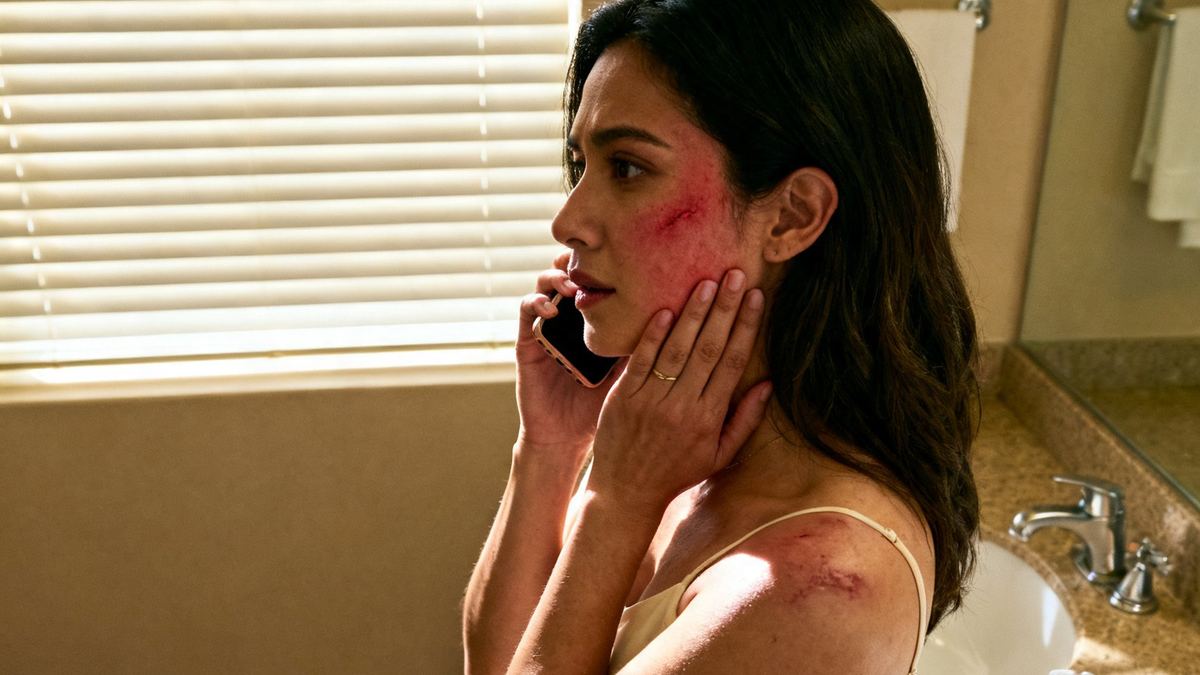
The morning after my wedding, my husband's open hand connected with my face in front of his entire family because I didn't kneel fast enough. I didn't cry. I didn't beg. I didn't explain. I picked up my purse, walked out of that sunlit dining room, and drove away. What the Callahan family didn't know was that I'd spent the last six months of our engagement quietly finishing an audit that would end them. By noon, their empire started to crumble.
The house was in Greenwich, Connecticut, the kind of old stone estate where the hedges look like they've been trimmed with nail scissors. My new in-laws insisted on a formal breakfast the morning after the wedding — apparently the reception at the country club wasn't enough performance for one weekend. I'd gotten maybe four hours of sleep. The Callahan family crest was embroidered on the napkins. A pitcher of fresh orange juice sat sweating on the sideboard. Margaret Callahan, my new mother-in-law, presided at the head of the table like a woman who'd never once doubted her own reflection.
She made a comment before I could even sit down.
"Traditionally, the new bride serves the coffee," she said, not looking up from her plate. "It sets the right tone."
So I served the coffee. I wore the cream dress she'd sneered at during the rehearsal dinner. I kept my expression pleasant at the right moments. I ignored the way Claire, my sister-in-law, examined me like a questionable piece of fruit.
Then Margaret tasted the breakfast casserole I'd made — my grandmother's recipe, brought all the way from Akron, Ohio — and set her fork down with a little clink.
"Rather heavy," she announced. "But perhaps that's the Midwest palate."
My husband, Darren, let out a nervous laugh. It was the first time I'd seen him do that in front of his parents. Claire jumped in right on cue.
"Midwest palate. Is that like an oxymoron? Like jumbo shrimp?"
The whole table snickered. His father, Arthur Callahan, folded his Wall Street Journal and cleared his throat.
"A Callahan wife accepts criticism with grace," he said, as if he were quoting scripture.
I set the coffee carafe down. "A Callahan wife shouldn't be treated like the hired help on her first morning."
The room went so quiet I could hear the grandfather clock in the hall. Margaret's mouth tightened into a thin, lipsticked line.
"I beg your pardon?"
"You heard me."
Darren was on his feet before I finished the sentence. His chair scraped against the limestone floor. His face went red — not from anger, but from exposure. For six months he'd played the part of the progressive, attentive fiancé. The man who sent orchids to my office. The man who said he loved my independence. That performance had already been cracking for weeks — a shove into a doorframe he blamed on the wine, a fistful of my sleeve at his cousin's engagement party that left four small bruises. I'd started keeping a folder. I hadn't planned to use it yet.
"You don't speak to my mother that way," he snapped.
"I speak to people the way they've earned."
The slap came before anyone could react. Margaret didn't flinch. Claire smiled into her napkin. Arthur went back to his newspaper.
My cheek burned. I could feel the seam of my grandmother's ring pressing into my finger, suddenly heavy, suddenly foreign.
Darren stood there breathing hard, waiting for tears. That's what he expected. That's what the script demanded. I gave him nothing but a long, level look — not shocked, not frightened. Confirming. Everything I'd suspected now had a timestamp and a witness count.
"You'll apologize," he said.
I picked up my purse from the back of the chair. "I won't."
No one at that table tried to stop me. They didn't know who they'd just hit. The Callahans thought they'd added another decorative wife to their collection — a small-town girl from Ohio with a dead teacher for a father, grateful for the upgrade from a rental apartment to a stone mansion.
They didn't know I was a forensic accountant, and that six weeks earlier the City of Stamford had hired my firm to audit municipal contractors after an anonymous tip about padded invoices. They didn't know that Callahan Group Ltd. was on my client list under a case number, not a name — that I'd recused myself from presenting the findings only because I'd started dating Darren, and my partner Mara had taken over the file instead, feeding me nothing, by my own insistence, until the wedding was behind us. They didn't know that Mara had spent those same weeks finding what auditors always find when a family firm gets sloppy: invoices billed twice, change orders that existed only on paper, a private accountant named Wallace quietly wiring money to an account in the Caymans.
The valet brought my car around. I could see them through the window, still at the table, drinking coffee as if nothing had happened. That's what got me. The casualness. The way violence was just another morning ritual in that house, like the fresh-squeezed juice and the monogrammed napkins.
All twenty minutes back to the hotel, I kept one hand pressed against my cheek.
I didn't write it down. Not at first. I just sat in the hotel bathroom with a bag of ice, looking at the phone on the tile counter, waiting for some instinct to kick in. I held my toothbrush for a long moment without unscrewing the cap. Around ten-thirty, I unlocked the phone.
The first thing I did was call my partner, Mara, who'd run the Callahan file alone for six weeks while I played bride-to-be.
"He hit me," I said, no preamble.
"I'm calling Candace Whitmore in the morning," Mara said. "I wasn't going to wait much longer anyway. The invoice discrepancies alone are enough to open a formal review. Are you safe?"
"I'm at the hotel. I'm fine. Send everything to her tonight. Don't wait for morning."
"You know what that does to your marriage."
"I know what he did to my face."
Candace Whitmore was the city's procurement officer — a woman Mara had worked with on two prior audits, known around the finance committee for opening a formal inquiry within twenty-four hours of any credible complaint and for never once letting a case go quiet. She hadn't taken a vacation in four years. Mara filed the complaint that night, case number and all, flagged "material breach, municipal contracts."
That gave me the rest of the night to do the thing I'd refused to do for six months out of some misplaced sense of fairness: read through what Mara had already found on Wallace, the Callahans' personal accountant, and on the debt Darren had never mentioned.
Wallace had been skimming for at least three years — small percentages off supplier invoices, routed through a shell he'd set up under his cousin's name. Mara had traced it two weeks earlier and flagged it in the shared case file, the one I'd deliberately avoided opening. I opened it now. There was also a promissory note, dated two days before my wedding: Darren had personally guaranteed $780,000 against the company's own receivables, structured to roll over every ninety days, co-signed by his father. It wasn't leverage. It was a family running out of runway and betting the house on a wedding announcement to steady their credit rating.
I didn't control any of it. I couldn't freeze an escrow account or become a signatory on someone else's debt by sending a text message — nobody can. But I didn't need to. I only needed the city to stop paying, and the bank to start asking questions, and both of those dominoes were already leaning.
At six that evening, a regional bank called an emergency meeting on the Callahan debt consolidations after Whitmore's office requested a hold on pending payments pending review. Arthur's lawyer walked out looking gray. Claire posted an Instagram at seven, standing on the deck of the family's powerboat, captioned "feeling blessed ✨." She had no idea what was happening on land.
When I finally called the house that night, Margaret answered, her voice still wearing that smug little ribbon.
"So you've come to apologize," she said. "Sweetheart, I'm not angry. I just think you got off on the wrong foot. Why don't you come for brunch tomorrow and we'll start over?"
"He hit me, Margaret."
A pause. "He's passionate. That's not a crime. It's family."
That was the moment I stopped being angry and started being a professional. Because when a person says that, there's no reasoning left to be done. There's only the work.
"Tell Wallace to check his own server," I said. "There's a folder he thinks is hidden. He'll want to have a lawyer look at it before the morning conference call."
I hung up before she could answer.
I'd met Wallace once, at the engagement party, months before I ever saw his name in an audit file. He'd looked at me the way a particularly mangy dog looks at a porterhouse.
"I like you," he'd said. "You count the good stuff."
"I count everything," I'd replied. I hadn't known then how true that would turn out to be.
By midnight, Wallace had called Darren, panicked, trying to get ahead of it. By twelve-thirty, Darren had called me fifteen times. I let every one go to voicemail.
His messages started with "What did you do?" and ended, three hours later, with "Please. My father is in the hospital." Arthur had read the city's letter over his evening brandy and had what the family called "a spell." I pictured the grandfather clock in the hall marking the exact minute.
Somewhere in the fourth or fifth voicemail, his voice dropped into something uglier, something I recognized from two months earlier when he'd found out I still texted my old assistant from my last job. "If you talk to anyone else about this, if Priya hears one word of this, I will make sure —" The message cut off. I'd saved that one, and three others like it, in the same folder as the bruises.
The next morning, I walked into the Greenwich branch of the bank that held our joint account and closed it. I'd opened that account with my own money six weeks before the wedding, a small joint fund for the honeymoon, nothing more — but it was enough to close, and closing it felt like the only clean thing I could do with my hands. The teller didn't try to talk me out of it.
I still had the check in my wallet — the one I'd written the week before the wedding, on a strange impulse, for exactly one dollar, folded inside a white envelope with "For your trouble" written across the front. I'd copied the words from an old note of my grandmother's, the closest I could come to her handwriting, because some part of me had known, even then, that I'd need to leave something behind that felt like her.
I never got to give it to anyone that morning. But I carried it with me when I drove out to the house two days later, once Whitmore's inquiry had gone public and the bank had frozen disbursement on the Callahan accounts pending review.
They were all there. All four of them, standing in the living room like they'd been arranged by a photographer. Margaret in her cashmere and pearls, Claire with her phone in one hand and a wine glass in the other, Arthur pale and sweating in an armchair. Darren in the middle, his collar undone, his eyes red-rimmed, the skin around his mouth raw from pressing his hand there.
I set the bank envelope on the table. Inside was a copy of Wallace's Cayman transfers, the rolled-over promissory note, and a printed summary of the city's open inquiry into three Callahan Group contracts. And the dollar bill.
"I'm not pressing charges," I said. "Not yet. I'm not suing you. I'm not here to destroy your family single-handedly — the city's doing most of that on its own."
Darren let out a breath. For a second, something like understanding flickered across his face.
Then I set my business card on the table, face up.
"This is my real firm. I've been on the city's contractor audit since July. Everything I just handed you is already with the state attorney general's office and the city finance committee — filed by my partner, not by me, because I recused myself the day I found out I was dating one of the men in this room. I didn't do that for your protection. I did it so no defense lawyer could argue conflict of interest and get the whole case thrown out." I looked at Arthur. "Your first payment on the note comes due Friday. Four hundred twelve thousand dollars. I'd talk to a restructuring attorney today, not tomorrow."
Arthur's mouth opened. No sound came out.
Margaret took a step forward, the pearls clicking. "You vicious little—"
"Mrs. Callahan." I held up one hand. "I didn't do this. Wallace did this. Darren did this, three years before I ever sat at your table. I just stopped looking away."
She stopped. She actually stopped, and in the silence I could hear the refrigerator humming in the kitchen.
I turned to Darren.
"I want a divorce," I said. "You'll sign the papers, because I have four voicemails from last night, and I have a folder with dates and photographs going back two months, and I have my old assistant's phone number if anyone wants a second opinion on what 'passionate' means in this family."
Darren looked at me then. Not the way he had in the dining room. This was different. This was the look of a man watching the scaffolding of his entire life get dismantled by someone he'd once called "his little accountant."
"I loved you," he said.
"You loved the story of me," I said, and I walked out.
The last thing I saw through the car window was Claire, still holding her wine glass, mouth slightly open, trying to take a selfie of the moment. To this day I don't know if it was for the family group chat or for the memorial to her father's career.
It wasn't as clean as I wanted it to be. Arthur's lawyers fought the recusal, arguing I'd used privileged information from the engagement to target the family, and for three weeks a judge in Stamford weighed whether to throw out the entire municipal case on conflict-of-interest grounds. Mara and I spent those three weeks rebuilding the evidence chain from her records alone, stripping out anything that had touched my hands after the wedding, so the case would stand even if I never testified again. It held. Barely. Whitmore's office confirmed Mara had opened the file six weeks before I ever mentioned Darren's name to her, and the judge let it proceed.
Two months later, the divorce was final. Darren signed rather than have the voicemails read into a public record. The hearing on the contracts opened, and Candace Whitmore asked questions that made Arthur's lawyer sweat through his suit. Wallace fled to the Caymans and stopped answering calls. The Callahan estate went up for short sale by summer, and I heard, secondhand, that Darren was renting a one-bedroom in Stamford and had been asked to leave his father's company entirely.
I used the one dollar from the envelope to buy a stamp. I mailed a letter to my grandmother's grave, thanking her for the recipe, and telling her I'd used her handwriting once, copied as best I could, on the morning that changed everything. I told her I was proud of her for teaching me that a casserole should never be called "heavy" by someone who's never made one.
Then I closed the book on the Callahans for good. I bought the little three-bedroom house in Hartford I'd been renting, on the corner with the giant maple tree out front. I kept the key on a ring with a tiny brass owl my grandmother always carried.
The first morning in my new house, I made myself an omelet. It was light, with chives and cheddar. I sat at my own table, by the window, and ate the whole thing.
It tasted perfect.