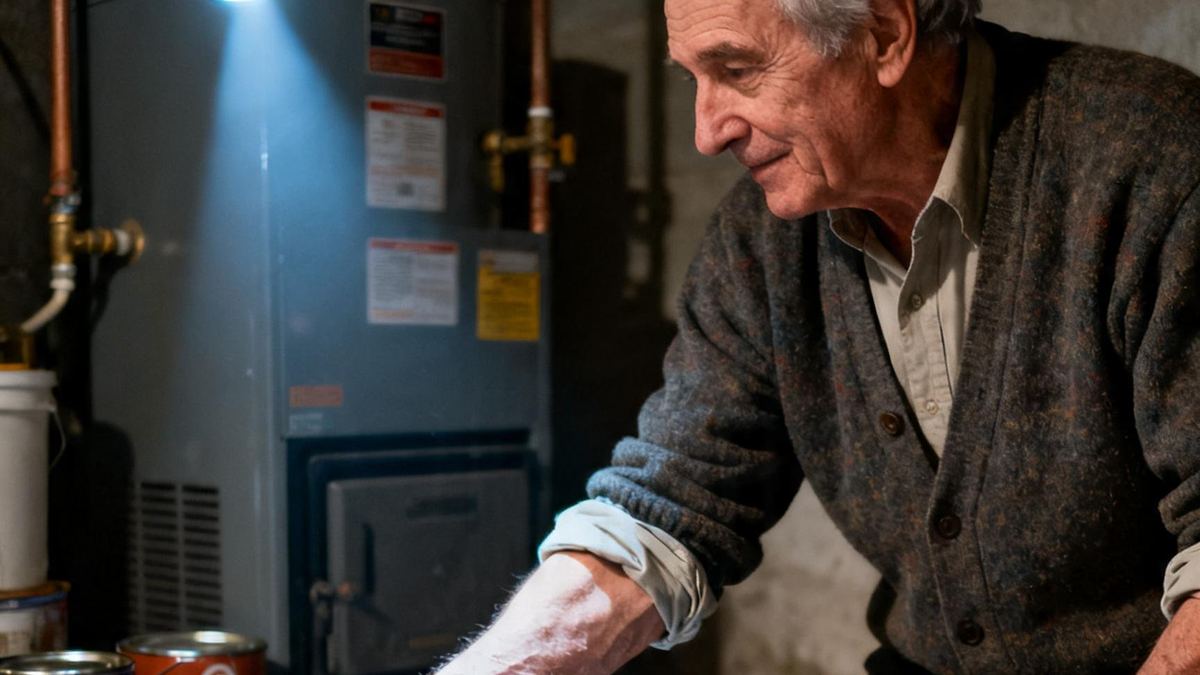
Ray Dobbs had just stepped into the basement to grab his winter parka from the storage locker when he heard it. A thin, desperate mewing, like tissue paper being torn. He stopped, one hand still on the light switch. The fluorescent tube above the stairs flickered, buzzed, then went steady.
The sound was coming from behind a stack of paint cans near the furnace. He took out his phone, turned on the flashlight. A gray cat lay on a scrap of old carpet, her sides heaving. Four tiny bodies pressed against her belly, eyes still shut.
“Well, hell,” Ray muttered.
He crouched, careful not to put weight on his bad knee. The cat lifted her head. Around her neck was a faded red collar with a small brass tag. He turned it over with two fingers. “Muffin.” And a phone number.
Upstairs in his kitchen, he dialed while the kettle heated. A woman answered on the third ring.
“Hello?”
“Hi, I’m calling about a cat. Is this… Muffin’s owner?”
A pause. “What about her?”
“She’s in the basement of my building. She just had kittens. Four of them. I found her behind some paint cans.”
Another pause, longer this time. Ray could hear a TV in the background on her end—some kind of court show with a judge yelling at people.
“Listen,” the woman said, “I don’t want her anymore. She’s old, she’s always sick. Let nature take its course.”
“What does that even mean, ‘let nature take its course’?”
“It means I don’t have time for this. She’s not my problem anymore.”
The line went dead.
Ray stood in his kitchen, the phone warm against his ear, the kettle starting to whistle. He set the phone down on the counter and turned off the burner. The whistle died with a little sigh.
He went back down to the basement. Muffin was still there, kittens squirming. One of them, a scrawny orange one, mewed louder than the others.
“You got yourself a real piece of work for an owner,” Ray told the cat. He grabbed a slice of deli turkey from the fridge on his way down—hadn’t even thought about it, just did it—and tore off a strip. Muffin ate it from his fingers like she hadn’t eaten in a week.
Ray had taught high school English for thirty-one years. Retired now, widowed for six. He lived alone in a one-bedroom apartment on the second floor of a brick building on Tuscarawas Street, not far from the old Hoover plant. He knew every tenant by name, which floorboards creaked, which radiators knocked. What he did not know was what to do with a cat and four kittens.
So he called his granddaughter Kayla.
“Grandpa, come on. You found a cat in the basement?”
“She had kittens down there. Four of them. The owner said she doesn’t want her.”
Kayla laughed—not mean, just surprised. “You can’t leave them down there. Let me come over tomorrow. We’ll get a box, take some pictures, post them online. Somebody will want them.”
“Somebody will want them,” Ray repeated. He wasn’t so sure.
Kayla showed up the next morning with a cardboard box, an old flannel sheet, and a can of kitten formula from the pet store on Whipple Avenue. They set up a little nest in a corner of the basement, away from the draft.
Kayla took photos with her phone. “This orange one is adorable. He looks like a little peach.”
Ray adjusted the sheet. “Don’t get too attached. We’re finding them homes.”
By that evening, Kayla had posted the photos on Facebook and Nextdoor. Fifteen messages came in before she left.
The next day, Ray was carrying a bowl of canned tuna down to the basement when he ran into Bob Novak from the third floor. Bob was a retired steelworker who spent most of his time on the front stoop, watching traffic and complaining about the mayor.
“What’s with the tuna?” Bob asked.
Ray told him about the cat in the basement.
Bob shook his head. “Who’s the owner?”
“Some woman named Cheryl Renner. Lives over on Market.”
“Cheryl Renner?” Bob’s face lit up. “I know her. Her husband left her last year. She’s been on a real tear ever since. Always out, never home. She used to have a little dog too. Gave it away.”
“Well, she doesn’t want this cat either.”
Bob leaned in, grinning. “You know what you should do? Make her pay alimony for those kittens. She didn’t get the cat fixed, so she’s responsible. Make her pay support!”
Ray laughed despite himself. “Bob, that’s not a thing.”
“Sure it is! She made the mess, she pays for it. Alimony for kittens!”
Ray carried the tuna down to the basement. Muffin ate it in about thirty seconds. The kittens were stronger already, their little legs pushing against the sheet.
Over the next few days, word spread through the building. A retired nurse named Gladys from the first floor brought a tube of vitamin paste for nursing mothers. A young couple on the third floor left a bag of dry kitten food outside Ray’s door with a note: “We found a stray last year. We get it.”
Even Bob, who usually only offered criticism, dropped off a plastic litter pan.
“Any luck with the alimony?” he asked.
“Not yet,” Ray said. “She hung up on me.”
“Keep at it. Justice don’t happen by itself.”
The orange kitten went first. A family from North Canton came with their seven-year-old daughter. The little girl held the kitten against her chest and said, “I’m going to name you Butterscotch.”
“Butterscotch?” Ray asked.
“Because he’s orange and sweet!” the girl said.
When they left, Muffin sniffed the spot where the kitten had been, then looked at Ray. He didn’t have a word for what he felt.
“That one’s going to a good home,” he told her.
The black-and-white kitten went a few days later. An elderly woman named Frances, a retired librarian, had recently lost her husband. She held the kitten the way you might hold a hand-warming cup of tea.
“I’ve been real lonely since Harold passed,” she said. “This little one might help.”
Two kittens remained: a gray one like her mother, and a striped one.
Then the striped one started sneezing. Then it stopped eating.
Ray didn’t hesitate. He wrapped the kitten in an old towel, put it in a shoebox, and took the bus to the vet clinic on Cleveland Avenue.
“Upper respiratory infection,” the vet said. “Not terrible, but he needs antibiotics and eye drops. Can you afford the meds?”
“How much?”
“About a hundred and eighty dollars.”
Ray reached for his wallet. He had the money, but it would sting.
In line at the pharmacy inside the clinic, a woman tapped his arm.
“Mr. Dobbs? Is that you?”
He turned. She looked familiar—maybe forty, with a kind face.
“I’m sorry, do I—?”
“You taught me English in eleventh grade. I’m Sarah Vickers. Well, Sarah Whitfield now. You probably don’t remember me.”
Ray squinted. “Sarah. Yes. You wrote that essay about your grandmother’s garden. The one with the tomatoes.”
Sarah laughed. “You remember that?”
“I remember good writing.”
She looked at the shoebox, the kitten wrapped in the towel. “What happened?”
Ray explained. Sarah listened, frowning.
“Let me pay for half of that,” she said, reaching into her purse.
“No, I can’t let you do that.”
“Please. I still think about your class. You were the first teacher who told me I could write. Let me do this.”
Ray looked at the kitten, then at Sarah. “All right. But you’re not paying for my tuna habit.”
She laughed and handed him ninety dollars.
That night, Ray sat in his recliner with the striped kitten asleep on his lap, wrapped in the towel. Muffin lay on the floor beside him, purring. A Browns game was on TV, the volume low.
“Two down, two to go,” he told them.
A week later, Ray was coming back from the vet with the recovered striped kitten in a carrier. He stepped into the elevator on the first floor, and just as the doors started to close, a woman slipped in.
She was tall, with a sharp haircut and a puffy coat that probably cost more than Ray’s monthly pension. She looked at the carrier and made a face.
“So you’re still messing with those strays,” she said.
Ray recognized the voice. Cheryl Renner.
“Still doing what someone has to do,” he said.
The elevator started up. The kitten mewed inside the carrier.
“You know,” Ray said, “I’ve been thinking about you.”
Cheryl looked at him, surprised. “Excuse me?”
“Not in a weird way. I’ve just been trying to understand. How a person can walk away from a living thing that depended on them.”
Cheryl’s jaw tightened. “You don’t know anything about me.”
“I know Muffin had a collar with your number. I know she was pregnant and alone in a basement. And I know you said ‘let nature take its course.’”
The elevator stopped on the second floor. Ray didn’t move.
“Here’s what I don’t get,” he continued. “People think being kind to animals is different from being kind to people. But it’s the same muscle. You let it go weak, it goes weak everywhere.”
Cheryl looked at the carrier. Her face was hard, but something around her eyes shifted.
“Maybe I couldn’t take care of her anymore,” she said, her voice low. “Did you ever think of that? My husband left. I could barely take care of myself.”
“Then why not ask for help? Why not take her to a shelter? Why leave her in a basement to give birth alone?”
The elevator doors opened. Cheryl didn’t move.
“I don’t know,” she said. “I just… stopped. Stopped caring about everything.”
The kitten mewed again. Cheryl looked at the carrier.
“Is he sick?” she asked.
“He was. Upper respiratory infection. Cost me a hundred and eighty bucks.”
Cheryl was quiet for a long moment. Then she said, “What if I paid for that? And for the food? I don’t want anyone to know. Especially not the neighbors. They already think I’m a monster.”
Ray looked at her. “Why would you do that?”
“Because I used to love that cat. And I… I didn’t know she was pregnant. I didn’t know any of this.”
The doors started to close. Cheryl put out a hand to stop them.
“Can I see her? Muffin?”
Ray could have said no. Could have told her to stay away. But he saw something in her face—not pity, not guilt, but a tiny crack in the ice.
“Tomorrow,” he said. “I’ll be in the basement around ten.”
The next morning, Ray opened his apartment door to find a large bag of premium cat food outside, along with a handwritten note:
“For the kittens’ support. C.R.”
He carried the bag into the kitchen and set it on the counter. Then he laughed. Bob was going to be insufferable.
The remaining two kittens found homes within a week. Cheryl’s coworker took the gray one. A family from Canton took the striped one. Cheryl came to see Muffin that morning, wearing jeans and no makeup, her puffy coat replaced by a worn Browns hoodie.
She knelt in front of the box. Muffin lifted her head, then got up and walked to her, pressing her face against Cheryl’s leg.
“Hey, girl,” Cheryl whispered. “I’m sorry. I’m so sorry.”
Ray stood back, watching. He didn’t say anything. Some things you don’t interrupt.
Cheryl looked up. “She remembers me.”
“Cats don’t forget,” Ray said. “They just wait longer than we do.”
Cheryl took Muffin home that afternoon. She called Ray a week later.
“She’s eating again. She’s gained weight. I scheduled her to get spayed next month.”
“Good,” Ray said.
“And the kittens? All of them found homes?”
“All four. Butterscotch sends his regards.”
Cheryl laughed. It was a real laugh, not the tight, defensive one from before. “Butterscotch?”
“The little girl named him. Said he was orange and sweet.”
The next day, Ray found an envelope under his door. Inside were nine twenty-dollar bills and a note in the same neat handwriting: “For the vet bill. Don’t tell Bob.”
Ray stood in the hallway, counting the bills. One hundred and eighty dollars. Exactly what the vet had charged. He put the money in his pocket and went back inside.
That Tuesday, he loaded the leftover kitten supplies into the trunk of his old Buick: the litter pan, half a bag of dry food, the vitamin paste, the blanket from the box. He drove to the county animal shelter on Perry Drive and carried it all inside.
“I’d like to make a donation,” he told the woman at the front desk.
She looked at the supplies, then at the stack of twenties he set on the counter. “That’s very generous.”
Ray handed her the money. “It’s not mine. It’s from a friend. She wanted to help.”
The woman counted it out, wrote him a receipt, and slid it across the counter. Ray folded it once, tucked it into his wallet, and walked back out to the parking lot.
It was late October. The maple trees along the street had turned that deep red you only get in Ohio. A neighbor’s dog barked once, then went quiet. Ray sat in his car for a minute, engine off, watching the leaves blow across the asphalt.
Then he started the Buick and drove home.