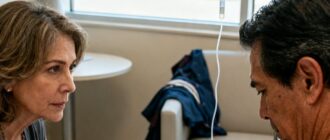
My mother’s voice cut through the ER like a wound—raw, ragged, begging anyone in scrubs to do something, *save her*—and then she saw me. The automatic doors hadn’t finished closing behind me. I was still moving, white coat open, trauma gown underneath, my name embroidered in navy thread over my left breast.
IRENE WULETTE, M.D.
Her mouth went slack. My father looked at me the way men look at something they were certain they’d buried—deep, permanent, gone. Monica was flat on the stretcher, blood matted into her hair, shards of safety glass glittering across her blouse like cheap jewelry. And the family that had spent five years pretending I didn’t exist had to stand there and watch me own the room.
“No.” My mother’s hand found my father’s arm and clamped down. His jaw tightened. “No. That cannot be right.”
But it was exactly right.
I was the attending on Monica’s case.
“Pressure’s falling,” a nurse said.
I snapped on gloves. “Two units standing by. Run a FAST. Get CT on the phone.”
My voice was level. My hands were steady. Five years earlier, those same hands had held a phone while my father told me—calmly, deliberately—not to call the house again until I was prepared to “tell the truth.” A truth my sister had engineered from nothing: forged screenshots, a performance of sisterly worry, and one surgical lie. That I had abandoned medical school. Run away with some man from the hospital. Incinerated my own future.
One night. That’s all it took.
They blocked my number before sunrise. Pulled the tuition support they had already promised. Took my photos off the walls. They weren’t there for my residency graduation. They weren’t there when I made my vows. My mother never saw the chapel. My father never heard my voice say *I do.* Monica got precisely what she had been angling for: the inconvenient daughter vanishing without so much as a funeral.
Now she was bleeding under trauma lights. And I was the one holding the chart.
My mother took a step toward me, eyes blown wide. “Irene—”
I didn’t lift my gaze from the page. “Please stay behind the line unless someone addresses you directly.”
The trauma shears cut a clean line through Monica’s designer sleeve. My father found something resembling a voice. “She told us you walked away. Said she had documentation.”
I looked at him for exactly one second. “She did have documentation. She built it herself.”
The silence landed harder than the monitor alarms.
Here is what no one in that room knew yet: I had never walked away from anything. I had taken a formally approved leave of absence to sit beside my best friend while she died. The dean signed off. The hospital signed off. My return was guaranteed in writing. Monica had known every detail because I had trusted her with them personally.
Seventy-two hours later, my parents called me a liar and cut me loose like a dead limb.
What they didn’t know—what Monica had never imagined—was that I kept everything.
The signed leave approval.
Every email.
Time-stamped enrollment records.
And one message Monica sent from the wrong account, late on the night she believed she had finally finished me.
Monica’s eyelids shivered. My mother’s face drained to the color of the walls. The attending resident passed me the intake bag from the ambulance: a phone, a wallet, a cosmetics case split down the seam.
Then the charge nurse spoke—clearly, deliberately, loud enough to reach both of my parents without effort.
“Doctor, security also recovered personal effects from the second vehicle. There’s a statement attached to the bag.”
My mother stopped breathing. I watched it happen.
Because the last time Monica constructed a lie, she took my entire family apart at the seams.
And from the expression settling across that nurse’s face, this accident had already begun ripping something else wide open.
The officer posted at the trauma bay door raised a sealed evidence sleeve.
My father’s hand started to shake.
The sleeve was clear plastic. Standard issue. Two inches wide, sealed at the top with a strip of orange evidence tape.
I didn’t reach for it.
“Bag it with her effects,” I said. “We’re treating the patient.”
The officer nodded and stepped back. My father’s hand stayed suspended for a moment, that tremor running through it like a current looking for ground, and then dropped to his side.
My mother was crying now. Not loudly—the big, ragged performance from the waiting room had collapsed into something smaller and more honest. She stood with both hands pressed flat against her sternum, watching me work on her other daughter, and I recognized the sound she was making. I had heard it once before, when I was seven and our dog was hit in the street. A grief that doesn’t know its own shape yet.
I kept my eyes on Monica.
“BP’s stabilizing,” the resident called out.
“Good. Keep the second unit on standby.” I leaned over the stretcher. Monica’s color was still wrong—chalky at the lips, a bruise spreading violet beneath her left eye like a storm moving in—but her breathing had steadied. The FAST scan was clean. No internal bleeding. The scalp laceration was significant, ugly, the kind that looked worse than it was because heads are dramatic and indiscriminate about blood.
She was going to survive.
I checked the laceration margins and felt nothing I could name.
—
The suture work took forty minutes.
My parents didn’t leave. I hadn’t expected them to. My father found a chair against the wall and lowered himself into it as though his knees had been quietly failing him for years and he was only now admitting it. My mother stood beside him. Neither of them spoke. They watched me close my sister’s wound in neat, even interrupted stitches, and I let them watch, because there was nothing in the procedure that wasn’t already on my face.
This was what I had become while they weren’t looking.
This was what they had missed.
When the last suture was tied, I stripped my gloves and turned to the charge nurse. “Admit her to neuro obs. Overnight minimum. Someone needs to check that eye socket in the morning.”
“Yes, Doctor.”
Then I turned to face them.
My father looked older than I had prepared myself for. Five years is long enough to move a man from one side of himself to another, apparently. His hair had gone fully white at the temples. The authority I had spent my childhood calibrating my behavior around had quietly evacuated his posture. He sat there looking at me with something that might have been shame if shame came in a quieter color.
“There’s a family room,” I said. “Down the hall, second left. I’ll be there in ten minutes.”
He nodded. One slow, complete nod. As though he no longer had the right to ask for more than that.
—
The evidence sleeve was already in my coat pocket.
The officer had caught me in the corridor and held it out without ceremony. *The detective asked that the attending be made aware of the contents.* I had signed the chain of custody form without reading it first, which I never do, which told me something about the state of my own composure.
I read it now, standing alone in the supply corridor with the fluorescent light buzzing one note above me like a held breath.
Monica had not been alone in the car.
The second vehicle the charge nurse had mentioned was not a second car involved in the collision. It was Monica’s car—or rather, the car that had been following Monica’s car, which had then struck it from behind on the on-ramp and fled the scene before the first responders arrived. A witness had gotten a partial plate. The detective’s preliminary note was clipped to a printed photograph, low-resolution, grainy, pulled from a gas station camera three blocks from the site.
I recognized the car.
I recognized it because it had been parked across the street from my hospital four times in the last two weeks. I had assumed it belonged to someone in the residential building. I had not written down the plate.
I pressed my back against the shelving unit and read the detective’s number twice.
Then I looked at what else was in the sleeve.
Monica’s phone had been unlocked by the impact—an old model, no face recognition, just a code. The detective had included a screenshot, taken as documentation before the phone was properly secured. Two lines of a text thread, visible on the shattered screen.
The sender’s name at the top of the thread was saved as a contact.
The contact was saved as *D.*
The last message, timestamped eleven minutes before the collision, read: *She’s going to show them everything. You have until she walks into that ER.*
I stood very still.
The supply corridor hummed.
*Until she walks into that ER.*
Meaning me.
Meaning someone had known I was the attending tonight. Had known which hospital. Which bay. And Monica had been on her way here—not brought by ambulance, but driving herself, erratically, at speed—
*She had been running.*
—
The family room had three chairs, a watercolor print of a lighthouse that someone had chosen for its neutrality and achieved only bleakness, and a window that looked out onto the parking structure. My parents were already inside. My father stood when I entered. He didn’t need to. I didn’t ask him to. He did it anyway, the way men of his generation stand for doctors and judges, and something about the gesture made my throat close briefly before I controlled it.
I shut the door.
I placed the printed screenshot on the table between us.
My mother looked down at it. My father looked down at it.
“Who is D?” I asked.
Silence.
“I am not asking as your daughter,” I said. “I’m asking because your daughter is currently in a hospital bed because someone ran her off the road to stop her from getting to me, and there is a detective downstairs who is going to ask you the same question in approximately thirty minutes. I am giving you the courtesy of asking first.”
My father’s jaw worked. The tremor was in both hands now. He pressed them flat on his thighs and looked at my mother, and what passed between them in that look was five years old and rotten all the way through.
“Derek,” my mother said. Her voice had no weight left in it at all. “Derek Hammill.”
I didn’t know the name.
But my father’s face told me I should have.
“He was Monica’s—” my mother stopped, started again. “She met him three years ago. We didn’t approve. He had—your father had business dealings that went wrong. There was money. Monica didn’t tell us she was still seeing him. We thought it was finished.”
“Business dealings,” I said.
“He helped us,” my father said. Quietly. Looking at the table. “After you left. After we—when we thought you had—” He stopped. Pressed his lips together. “We had financial difficulty. He offered assistance. It was a mistake. We have been trying to correct it for two years.”
I looked at him for a long moment.
*After you left.*
He still hadn’t said it. Still hadn’t looked up at me and said the actual words. *After Monica told us you left. After we believed her. After we chose, without asking, without a single phone call returned, to decide you were gone.*
I pulled up the chair and sat down across from them.
“Dad.” I waited until he raised his eyes. It took a moment. “I have the leave approval. I have enrollment records. I have every email. I have a message Monica sent five years ago from her work account by mistake, at two in the morning, to a friend of hers, describing exactly what she had done and why.” I paused. “I have had all of it for five years.”
My mother made a sound.
“I didn’t use it,” I said. “I didn’t send it to you. I built a life instead. I finished school. I finished residency. I got married. I became this.” I gestured, briefly, at the coat, the embroidery, the room we were sitting in. “And I decided that if you wanted to find me, you knew where medicine was.”
My father’s eyes were wet. He was not the kind of man who cried, which meant watching it happen was like watching load-bearing architecture shift.
“The evidence in that sleeve,” I said, “is going to implicate Monica in the accident. The detective will sort out to what degree. That is not my case—that goes to the police and to whatever lawyers you hire. What I need you to understand, right now, tonight, is that your daughter upstairs is going to be fine. She has a concussion and a laceration and a bruised orbital wall that needs imaging in the morning.” I stood. “And the attending who just saved her life graduated with honors and has been on staff here for three years.”
I picked up the screenshot. Not because I needed it, but because I needed to give my hands something to do that wasn’t shaking.
“I’ll send the detective in when he arrives,” I said.
—
Derek Hammill was arrested at a motel off the interstate at 2:17 in the morning, four hours after Monica’s ambulance had rolled through our bay doors. The partial plate had been enough, combined with a second camera at the on-ramp, combined with a phone that had pinged three towers between the crash site and the motel in a straight, panicked line. The detective called me at 2:40 to confirm. I was at the nurses’ station charting. I thanked him and hung up.
Monica was awake by then.
I know because the charge nurse came to find me and said she was asking for me.
I stood at the station for a long moment. The overnight ER moved around me in its quiet, particular rhythm—a child with an ear infection in bay two, a gentleman in his seventies who had fallen on his porch steps, a young couple in the waiting room holding hands over a cup of bad coffee. The ordinary suffering of an ordinary night.
I went.
—
The room was dim. My parents had gone to the waiting room at some point—or been asked to. Monica was propped against the pillow, the gauze white against her dark hair, her left eye swollen to a slit. She looked smaller than I remembered. Or maybe I had just spent five years rebuilding my sense of scale.
She looked at me.
I looked at her.
“They told me you were the doctor,” she said. Her voice was rough, abraded at the edges.
“I was.”
She looked at the ceiling for a moment. Then back at me.
“Irene—”
“You don’t have to,” I said.
“I need to.”
“I know you think you do.” I moved to the foot of the bed, not close, not far. “But tonight is not the night. You have a head injury and a police detective who’s going to need a statement in the morning, and what you say to me right now won’t be any use to either of us.”
Her mouth worked. The bruised eye was crying a little, just the one—trauma to the orbital tissue, involuntary tearing—and it made her look, absurdly, like a painting where only half the subject was in the rain.
“I didn’t know about the car,” she said. “Derek. I didn’t know what he was going to do.”
“I believe you,” I said.
I did, actually. That was the strange thing. I looked at her and I believed her and it didn’t change anything substantial, which was its own kind of information about how far I had traveled.
“But you knew what you did five years ago,” I said.
She closed her good eye. “Yes.”
“And you let it stand.”
“Yes.”
The monitor above her traced its patient green line. Outside in the corridor, a cart went by with its small, institutional rattle.
“Okay,” I said.
She opened her eye.
“That’s it?” she said.
“What did you expect?”
She didn’t have an answer. I wasn’t sure I did either. What I had expected, for years, in the versions I had run in the back of my mind during overnight shifts and long drives and the quiet minutes after my husband fell asleep—was something larger. Some scene with enough fire in it to equal what had been taken. I had imagined what I would say. I had imagined her face.
The face in front of me was just tired, and hurt, and smaller than the story.
“Get some sleep,” I said. “The neurologist rounds at seven.”
—
I found my father in the waiting room at 4 a.m.
My mother was asleep in the chair beside him, head tipped to his shoulder. He was awake, looking at his hands, doing whatever men do at four in the morning when everything they believed about their own judgment has been revised by fluorescent light and a plastic evidence sleeve.
He looked up when I came in.
I sat down across from him. Not beside him. Across.
“She’s stable,” I said. “Sleeping. The imaging tomorrow will be confirmatory but I don’t expect any surprises.”
He nodded.
I waited.
“I should have called,” he said. “When—I should have called you back. Even to argue. I should have—” He stopped. The architecture shifted again. “I’m sorry, Irene.”
Three words. Plainly said. No scaffolding around them.
I sat with them for a moment, turning them over, checking their weight.
“I know,” I said.
Not *it’s okay.* Not *I forgive you,* because forgiveness is a process and not a declaration and I had learned that during residency, in a grief counseling seminar I’d taken on a Thursday afternoon when I had ninety minutes free, never imagining I’d need it for something this specific.
But: *I know.* Which meant: I heard you. I am still here. We are both still in this room.
He exhaled slowly.
My mother slept on.
Outside the waiting room windows, the parking structure was beginning to lighten at its edges. The sky above the concrete did the slow, private thing it does before anyone is officially permitted to call it morning. Not dawn yet. Just the world deciding.
I had a patient in bay two with an ear infection. I had charts to finish. I had a husband asleep at home who would want to know how the night had gone, who had held my hand last week when I told him this family worked this particular hospital, just in case, just so he knew.
I stood.
My father stood too.
We looked at each other across the low table with its scattered magazines and the fake plant in the corner that no one had watered in years because it didn’t need it.
“I’ll be here until seven,” I said. “If anything changes, someone will come for you.”
He nodded. Carefully. Like a man accepting terms he hadn’t earned the right to dispute.
I walked back down the corridor, white coat open, the embroidery catching the light.
IRENE WULETTE, M.D.
The ER moved around me.
I moved through it.
That was enough. For now, at four in the morning, with the sky making up its mind outside—that was exactly enough.