I don’t remember much before the pain.
There was the warmth of the sun on a flat rock, the dry crackle of grasshoppers, and then—a blinding crack against my ribs. Something heavy. A shovel, maybe. The world flipped sideways, and all I could do was drag myself into the tall weeds, tasting dirt and my own blood. My body told me to coil, to strike, but my muscles just twitched. I could only wait for the end.
That’s when the small footsteps came.
I sensed her before I saw her: a vibration in the ground, lighter than a grown human’s. And then a shadow fell over me. I tried to raise my head, but the torn scales along my side burned like a bad molt times ten. The girl—I caught her scent, sweet like crushed clover and something powdery—stood there, not moving. I expected a rock, a stick, something. Humans always hurt what they don’t understand.
But she knelt. Not stomping. Not screaming. I felt the air shift as she set down a little pack and unzipped it. Then a trickle of cool water hit the wound, and I flinched so hard I almost blacked out. The pain was a sharp song, but after it came a stillness I hadn’t known in hours. She cleaned the gash with a brown bottle of hydrogen peroxide that stank like sting and bleach, then wrapped a strip of white cotton—soft from a hundred washes, maybe part of an old t-shirt—around my middle, gentle as a leaf falling. Every time her fingers brushed my scales, I froze—not from fear, but because nothing in my life had ever touched me without trying to crush me.
She murmured sounds I couldn’t decode, but her tone was low and steady. Not the barking that humans do when they’re angry. She slid a piece of cardboard under me, lifted me into a box, and the sky disappeared. I smelled fabric, dust bunnies, the faint rubber of a sneaker. The box had “Keds” in faded purple letters. Size 3. Then a rumble of voices somewhere above, but no footsteps near me. I was hidden.
Under the girl’s bed, I lay in the dark, breathing shallow. The cotton around my ribs itched, but the bleeding had stopped. She brought me a plastic lid from a margarine tub full of water that tasted of tap and old lemon. I drank. My instincts told me to flee, but my body was a stone. So I stayed, listening to the house settle around me: the creak of a floorboard, the distant hum of a TV in another room, the clatter of forks on plates. And her footsteps, always returning. She checked on me three times before the clock on her nightstand hit 11:17, then 1:32, each minute a grind.
The storm broke at 1:58 a.m. I know because the thunder crashed through the floorboards like a kick, and the digital clock blinked once before the power flickered. The bass shudder, the static snap in the air—I felt it on my tongue, every part of me electric. Then another vibration, this one wrong. Heavy. Too deliberate for wind. At 2:03 a.m., a metallic scrape: a screwdriver being worked into the front door frame. No familiar scent, just a sour tang of sweat and cheap deodorant that didn’t belong.
I uncoiled from the shoebox, the wound tugging like a hot wire. My ribs screamed with every inch I dragged myself forward. The floor was smooth, but my muscles couldn’t hold—I had to pause twice, tongue flickering, tasting the dust and my own fear-scent. I used my neck and the edges of my scales to push against the baseboard, my tail dragging behind me like dead weight. The hallway seemed a mile long. When I reached the corner near the front door, I coiled, lifted my head, and forced a hiss through my tired lungs. It came out thin, a leaky tire, but I pulled more air from my one good side and pushed it out again until the hiss filled the hall. Not fear. Territorial. This was my den now.
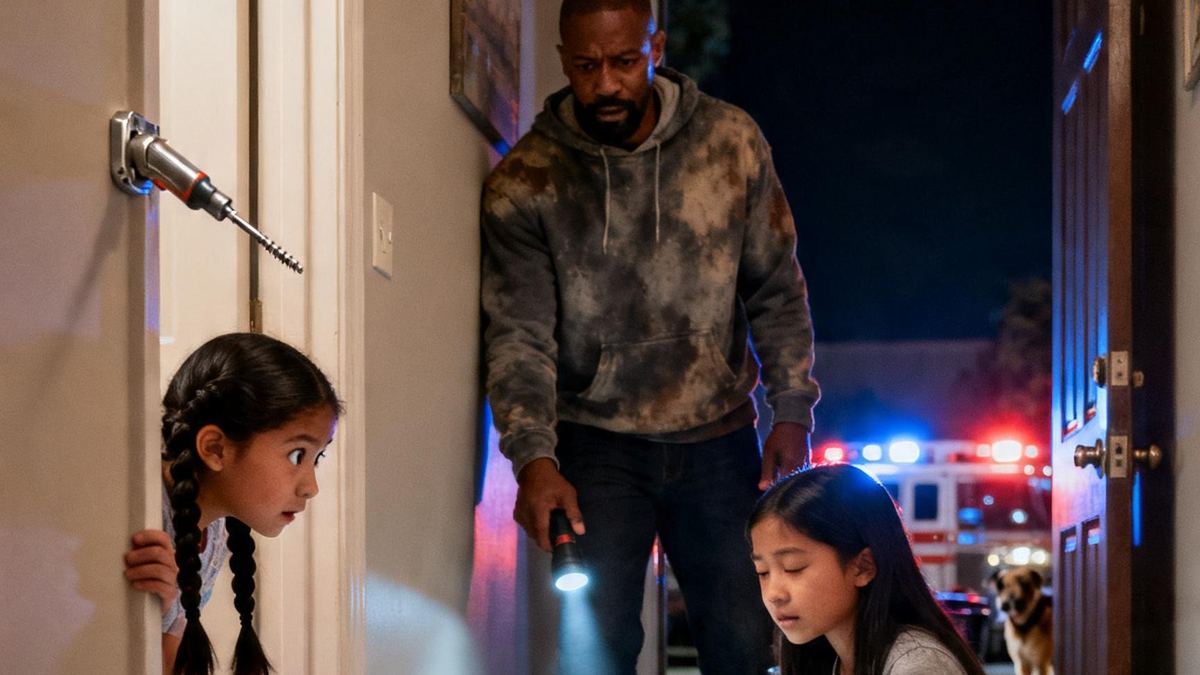
A door creaked open behind me. The father stepped out, a heavy black Maglite in one fist and his iPhone glowing in the other. He froze when the beam caught my coils. I tasted his fear-sweat, but his voice didn’t waver. “Maya, stay in your room. I’ve called 911.”
The burglar outside jammed the screwdriver again, a metallic shriek. The father shouted toward the door, “Cops are on the way! You hear that? Get the hell out!”
I hissed again, louder this time, and the scraping stopped. For two heartbeats, nothing. Then a curse, heavy footsteps pounding off the porch, a crash—a metal garbage can tipping over, I think—and a neighbor’s dog going berserk. Sirens rose in the distance, closing fast.
My head dropped to the floorboards. The hallway swam with patterns of heat, and my vision flickered. I didn’t move. Couldn’t. A few seconds later, more shouting outside—a scuffle, a cop’s voice barking “On the ground,” a thud. The front door opened, and cold rain air rushed in. I heard the father’s footsteps, low exchanges with another man, then the crackle of a radio.
Maya crept past her father and knelt where I lay, her cheeks slick with rain and tears. She said my name—not mine, not really—a string of sounds that meant something big to her, her voice cracking. I bobbed my head once, just exhaustion, and then I turned to the tear in the window screen, the one shaped like a moth’s wing. It took everything I had to haul myself onto the sill. The screen gave way, and I slid outside.
Rain fell in sheets. The grass was cold, each blade a shock against my wound, but I pushed on, one half-coiled lurch at a time. Behind me, the house filled with lights and muffled voices, a girl’s question rising and then a door closing.
I didn’t decipher any of it. I fixed on the one thing I understood: the scent of wet earth pulling me toward the creek. It took me until first gray light, but I found the hollow log. It smelled of dry rot and earthworms, and inside, the dark was patient and still. I crawled in, coiled my body around itself, and closed my eyes. The rain stopped a short while later, and I did not dream.