The Stars on the Sock
I thought it was a dead raccoon under the porch by the sound of it. That wet, dragging scrape against the floor joists, like something heavy pulling itself along. It was half past two in the morning and I’d been dreaming about a stripped bolt on the number-four lathe when the hissing cut through everything.
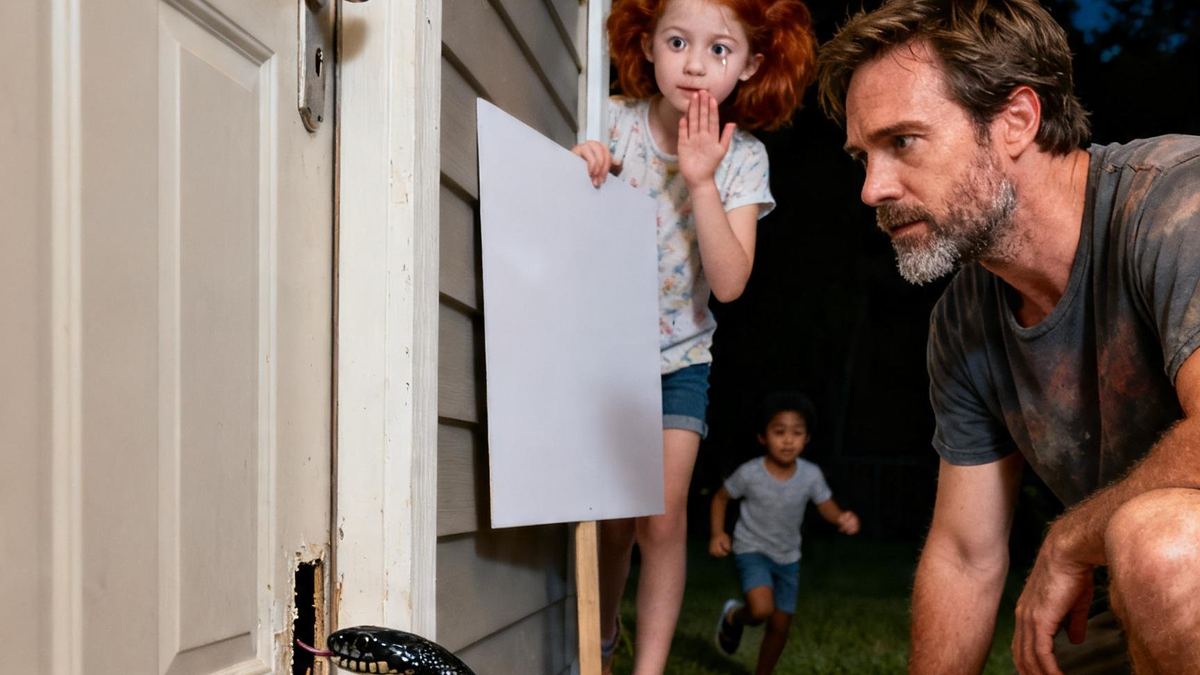
Emma’s door was cracked open, the way she always leaves it because she’s scared of the dark swallowing her whole. I didn’t turn the hallway light on—didn’t want to wake Karen. I just stepped out barefoot, and there it was: a snake as thick as my forearm, glossy black as fresh asphalt, stretched across the rug runner my grandmother hooked in 1972. The end of its tail still lay in the shadow under Emma’s door.
My hand went cold all the way up to the elbow. I’ve lived in Pike County my whole life. Rattlers, copperheads, milk snakes—I’m not squeamish. But a snake inside the house, this late, this big, and my eight-year-old daughter fifteen feet away with nothing between her and it but an open door? My brain yelled *shotgun* and my feet were already heading for the hall closet.
Then the thing lifted its head and hissed again, and I stopped. It wasn’t looking at me. Its head was turned toward the front door.
I saw its tongue flick twice, fast. A second later I heard it: the metallic grind of a pry bar slipping between the deadbolt plate and the doorframe. That sound has a specific pitch when you’ve hung a lot of doors. Someone was on the other side, working the lock with real force.
Karen called my name from the bedroom, voice thick with sleep. I waved a hand behind me without turning. The snake coiled, pulling its wound—I could see it now, a section of its body wrapped in something pale, a bandage or gauze, smudged with dirt—and lunged toward the door. Not at it, but at the gap where the cold air was whistling in. It hissed so loud I felt it in my chest.
The pry bar stopped. A man’s voice muttered something, then footsteps stumbled back off the porch steps. I was at the door in three strides, clicked the exterior lights on, and threw the bolt open just as a figure in a dark hoodie cleared the azalea bushes. He ran hard, hopping the split-rail fence and cutting toward Route 209.
By the time the phone was in my hand I already heard Chris Miller’s coonhound going crazy two properties over. Good. We’re a quarter mile from the river; there’s only one road out, and Chris doesn’t sleep much after his wife passed. He’d have eyes on him before 911 even picked up.
The state trooper who took my statement, a young guy named Fletcher who’d graduated with my nephew, told me the scumbag had hit five houses in Dingmans Ferry and Milford that month. Always came in through doors and windows people left unlocked or pried open while families slept. “You’re lucky you woke up,” he said.
I looked down at the snake, still on the rug, now lying flat. The bandage was a kid’s school sock, pink with little white stars, tied around its middle. Under it, a deep gash, maybe from a string trimmer or a fox, I don’t know. The sock was damp, like it had been changed recently.
Then I looked at Emma’s open door. At the little trail of dried grass leading from the hallway to the gap under her bed.
Karen had gone in to check on her, find out what she knew. I stayed in the hallway, listening to Emma’s small, hiccupping sobs, the kind she makes when she’s scared somebody’s going to be mad at her. “I just wanted to help her,” she kept saying. “She was hurt in the field by the creek. Daddy, I didn’t want her to die.”
Emma lost her pet rabbit, Oliver, last winter. A weasel got into the hutch. She cried for a week and drew pictures of him in heaven with a carrot farm. I should have remembered that. She’d been carrying the little first-aid kit from my truck in her backpack, the one I gave her for camping, just in case she found something else that needed fixing.
The snake lay still while the trooper photographed the doorframe and took a report of the attempted break-in. Nobody touched it. I knelt down, and I didn’t feel anything but tired. I could see the ridges of its spine under the shining scales.
“What do we do with it?” Karen asked.
I ran a hand over my jaw. “Get a towel. A clean one.”
We let Emma say goodbye. She crouched beside it, her hair a mess of tangles, and said, “Thank you for saving us. You can go back to the field now. I’ll leave water by the big rock.”
She kissed two fingers and touched them to the top of its head. The snake’s tongue tasted the air.
I carried it out on the towel, across the dewy yard and past the shed where my rusty mower sits under a tarp. At the edge of the woods the sun was just starting to light the tops of the sycamores. The snake unwound itself and slipped into the high grass without looking back. I watched the blades shiver a few seconds, then stilled. I never knew for certain why it came to that door. Maybe the cold draft from the gap as the pry bar wedged in had pulled it out of Emma’s room—a wounded snake hunting warmth. Or maybe the grinding metal just stirred it from the cardboard box under the bed. I stood there a minute, then went inside.
Back inside, Karen was making coffee. The rug runner was rolled up and leaning against the wall, ready to be washed or burned, I hadn’t decided. Through Emma’s doorway I could see the corner of the cardboard box she’d hidden under the bed. A little plastic dish of water. The smell of antiseptic from my truck’s kit.
I sat on her bed and watched her breathe for a while. Her hand was curled on the pillow, a piece of gauze still stuck to her thumb. I didn’t wake her. I stayed there until the coffee on the nightstand went cold. Then I got up, leaving the gauze where it was, and carried the rug runner to the laundry.