Maggie sat on the edge of the pull-out couch they’d called a bed for four years, her hands resting on her knees. She watched Chase plant his boots in the center of the tiny cabin’s floor like he was staking a claim. Outside, semis downshifted on the mountain pass, making the windowpanes buzz.
“I need two weeks,” she said. “Just two. To find a place, pack my things.”
“You serious?” He jabbed a finger at the knotty pine floor. “You file for divorce and then think you can keep squatting in *my* cabin?”
She didn’t flinch. “I know whose cabin it is. You’ve reminded me every day since I pulled my U-Haul into the driveway.”
Chase paced. Four strides to the woodstove, pivot, four strides back. He moved like a man striding through a forty-acre spread, not the scuffed rectangle of a 500-square-foot shack he’d inherited from an uncle. Outside, the traffic never stopped; inside, the fridge rattled every time the compressor kicked on.
“You got a lot of nerve,” he said. “Do you even know what property is worth up here? A place in town just sold for seven-fifty. Seven-fifty. And I’ve got mine free and clear.”
“You’ve told me. A hundred times, maybe.”
He stopped, hands on hips. “Because you don’t appreciate it. Never did.”
Maggie lifted her eyes. There was no anger in them—just the look you give the weather forecast when you already know it’s going to snow. “I’m not leaving because I don’t appreciate the cabin. I’m leaving because I can’t live with a man who only appreciates real estate.”
“Cute. Real cute.” He leaned down, face close. “I don’t care if you have nowhere to go, the cabin stays with me.”
That’s when it happened. Maggie blinked once, looked at him from his worn Carhartt collar to the frayed carpet, and a laugh bubbled up—not loud, not bitter, just the soft release of someone who’d suddenly read the last page of a bad book and was relieved it was over.
“What’s so funny?”
“Nothing at all.” She stood. “I’ll go.”
She grabbed a duffel from the closet and started packing. Chase propped himself against the doorframe, the smirk of a champion spreading across his face. She lifted the enameled cast-iron Dutch oven from the shelf above the stove.
“Hey. That’s my pot.”
“It’s mine. I brought it from my grandmother’s. The chip on the lid handle matches my initials in the will if you want to check.”
“Fine. Take your junk.”
She zipped the duffel, shrugged on a down jacket, and hoisted the bag. At the door she paused, not turning around. “You know, Chase, I spent four years hearing how lucky I was to live here—underneath the interstate noise, next to neighbors who scream through thin walls, breathing truck exhaust every morning. But you love it. So enjoy.”
The door clicked shut. He listened to her boots crunch down the gravel drive, then he turned to the empty room and said aloud, “Cabin’s a cabin.”
——
A week later, Chase was hauling a bag of rock salt out of the Ace Hardware when he spotted Jenna’s Subaru parked at the curb beside the climbing gym. The morning was sharp with cold, the air smelling of road salt and the store’s cedar mulch. Jenna stood by her open hatch, loading carabiners into a gear bin.
“Jenna,” he said, shifting the salt to his other hip.
She gave him a flat look and kept fastening a bungee. “Chase.”
“Maggie staying with you?”
“Nope.”
“Where is she, then?”
“Why?”
He set the salt bag on his tailgate. “She took my Dutch oven. The Le Creuset. That was my mom’s pot.” He’d practiced that line on the drive over, and it sounded almost true. Almost.
Jenna straightened, tugging her fleece sleeve over her wrist. “You tracked me down over a pot?”
“It’s a four-hundred-dollar pot.”
“Uh-huh.” She took out her phone, tapped the screen, and turned it so he could see the address on Google Maps. “Go get it, then. But it’s a drive.”
Chase squinted. The address was up on Forest Road 335, a switchback-laced dirt track that led toward the national forest, where the driveways were a quarter-mile long and the houses had names instead of numbers. “That’s not a rental. Where’s she getting that kind of money?”
Jenna pocketed the phone and gave him a long look. “Just go, Chase. You’ll see.”
——
He drove up the next morning in his F-150, the bed rattling with chains. The road climbed past aspen groves and frozen creeks until the sign for “Bristlecone Lodge” appeared, carved into a massive timber. He turned in and the tires crunched over fresh gravel. The place wasn’t a house. It was a compound—a sprawling log-and-stone mansion with a three-car garage, a guesthouse twice the size of his cabin, and a deck that wrapped around the whole thing like a wooden halo. Through the pines he could see the Continental Divide, jagged and white.
A woman he didn’t recognize opened the guesthouse door—mid-fifties, silver hair, fleece vest.
“You must be Chase. I’m Carol, the owner. Maggie’s just finishing up with the horses. Come on in.”
Chase stepped into a room with twenty-foot ceilings, a river-rock fireplace, and windows that framed a view that probably cost more than his entire property. The air smelled like cedar and fresh coffee. No traffic hum. No screaming neighbors. Just the crackle of the fire and the distant whinny of a mare.
He stood there, jaw working. Carol watched him with mild amusement.
“Maggie’s been a godsend,” she said. “Managing the rental side, looking after the animals while we’re in Scottsdale. We gave her the guesthouse as part of the deal. Smart girl.”
Chase didn’t answer. He was looking at the kitchen island, where a Le Creuset Dutch oven sat on a trivet, still warm.
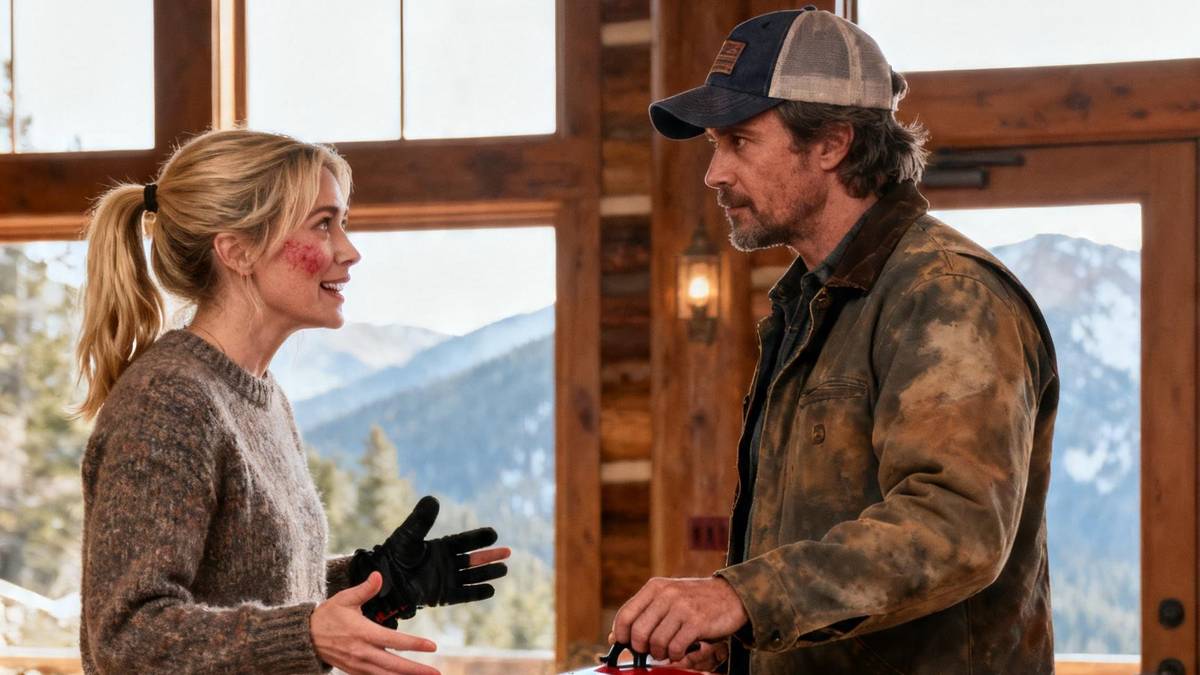
The back door opened and Maggie walked in, tugging off riding gloves, her cheeks flushed from cold. She saw him and stopped. For a beat, nobody said anything.
“You came for the pot,” she said. Not a question.
“You’re a caretaker?” His voice came out thinner than he meant.
“Started last Thursday. Reference from the feed store where I used to work.” She stripped off her other glove and set both on the counter. “Two weeks’ notice would’ve been nice, but you made it pretty clear I wasn’t a tenant.”
Carol slipped out the side door with a murmured, “I’ll let you two talk.”
Chase stood in that vast, silent room, small and rumpled in his stained jacket. He looked at the pot, then at her. “You always said you hated it here. The cold, the isolation.”
“I hated *your* version of it,” she said. “A shack on a highway where I couldn’t breathe. This…” She gestured around. “This has nothing to do with you.”
He took a step toward the island. “That pot’s still mine. My mom bought it.”
Maggie set her gloves on the counter, and there it was again—that soft release, a laugh that wasn’t a laugh, the expression of someone closing a book she knew was bad. “Your mom? Last week you were screaming that I stole your grandmother’s heirloom and you’d call the sheriff if I touched it. Now it’s your mom’s? You don’t even remember your own lies, Chase. It’s mine. I brought it from my grandmother’s. The chip on the lid matches the will. But it doesn’t matter. Take it.”
He blinked. “What?”
“Take it. Put it in your truck. Go home.”
He looked at the pot, then back at her, and something behind his eyes caved in. He knew—standing in a house he could never afford, on land that wasn’t his, across from a woman he’d kicked out like a stray cat—that the Dutch oven wasn’t what he’d driven up here for.
But he couldn’t say that. So he picked it up. It was heavier than he remembered.
Maggie walked ahead of him and pushed the front door open. Cold mountain air poured in. “Watch for ice on the switchbacks. Sun doesn’t hit them this time of year.”
He walked out, the pot clutched to his chest. She didn’t say goodbye. Just closed the door with the same soft click he’d heard the night she left his cabin, and through the window he saw her cross to the fireplace, pick up a split of juniper, and toss it into the flames.