She stood on his porch in a coat the color of dried mud, and Wade Hartley recognized her before she spoke. The eyes. Dark, set deep in a face thirty years older than the one he remembered, but the eyes were the same.
"Wade." Her voice cracked on the single syllable. "I know it's been—"
"Thirty-six years." He kept one hand on the door frame. "It's been thirty-six years, Connie."
She flinched at her first name. Not Mom. He'd dropped that word at fourteen, sitting in the back of a math class, when the teacher asked everyone to describe their family and he realized he could describe his in one word: absent.
The day she left him at the Red Bank Youth Home, a hard Tennessee rain came down heavy and then stopped, leaving the air thick as a wet blanket. He was seven. He'd ridden in the front seat of a burned-out Ford Escort, his sneakers not quite reaching the floor mats, while she kept both hands at ten and two and never spoke.
The building was cinderblock, painted gray, with a chain-link fence around the playground that had lost most of its coating to the humidity. Inside, the air was Pine-Sol and boiled cabbage and something metallic. He later figured out the metallic smell was fear.
A woman in a cardigan took his duffel bag. One change of clothes, a toothbrush still in the Dollar General packaging, a photograph he'd shoved in his pocket at the last second. Connie signed papers with a blue pen that kept running dry. She had to press hard, three times, before the ink caught.
"Be good," she said. That was it. Not "I love you." Not "I'll be back." Just "be good."
She walked out the front door. The door had a hydraulic closer that let it hiss shut. He watched through the safety-glass window as she got into the Escort. The car that burned oil and rattled at stops. She didn't turn around.
He never saw her again. Not for thirty-six years.
Red Bank Youth Home wasn't a home. It was a building with twenty-two boys and two adults who worked shifts and called it a job. He learned the schedule the way other kids learned multiplication tables: breakfast at 6:45, school at 8:00, rest hour at 1:00, chores at 4:00, lights out at 9:00. The food was measured in scoops and slices. The warmth was measured in nothing.
His tenth birthday, he waited by the front office window for four hours. One of the night staff, a man named Curtis who smelled of cigarettes and instant coffee, told him around 4:15: "She's not coming, buddy."
Wade didn't cry. He went back to his bunk and drew a picture of the Ford Escort driving away. He folded it until it was the size of a matchbook and shoved it between the mattress and the metal frame.
He kept it there for eight years.
He wasn't the toughest kid in the home, but he was the angriest. Not loud anger—that got you sent to the office. Wade's anger was a low current, like electricity in a wall. It powered everything.
He got up at 5:00 before anyone else to study. He skipped free time to work in the kitchen, earning forty bucks a week from the cook, a woman named Rita who liked him because he never complained about dish soap. He saved most of it. The rest went to deodorant, razors, socks—the things the state didn't provide.
At seventeen, he walked out of Red Bank with a diploma, a hundred seventeen dollars in a paper bank envelope, and the folded drawing of the Ford Escort.
He moved into a room above a hardware store on Rossville Boulevard. The room had a hot plate and a mini-fridge that buzzed all night. He worked construction, then appliance repair, then took a night class at Chattanooga State about small business management. The class cost three hundred. He paid in exact change—mostly fives and ones from his tips at a pizza place on Broad Street.
By twenty-five, he'd bought a used tow truck. By thirty, he had a transmission shop on Lee Highway. By thirty-eight, three more. He owned a house on Signal Mountain with a view of the river bend, a Chevy Silverado with leather seats, and a bank account that could've bought the Red Bank Youth Home twice over.
He didn't have a wife. Didn't have kids. He'd tried a relationship once, with a woman named Dana, but she told him he was "like a freezer—functional, but you can't live inside."
He agreed. It was the truest thing anyone had ever said about him.
And now, thirty-six years after the hydraulic door hissed shut, Connie stood on his porch on Signal Mountain.
She was shorter than he remembered. Hunched. Her hair had gone gray and stringy, pinned back with a clip that looked like it came from a gas station. Her coat was thin. The cuffs were shot.
"Why are you here?" he asked.
She shifted her weight. "I need help, Wade."
He didn't answer. Just stood there.
"My trailer," she said, then stopped. Swallowed. "The county's taking it. Tax auction. I owe forty-eight thousand."
"Forty-eight thousand in back taxes?"
She tensed. "It's a lot, I know. The roof gave out, the furnace quit, and I couldn't work after the hip surgery. It just piled up."
"What do you want from me?"
She looked at her hands. Cracked knuckles, short nails, a stain on one finger from what looked like tomato sauce. "I thought… you're doing well. Everybody knows. The shops, the house. I thought maybe you could…"
"Help you."
"Yes."
Wade stepped aside. "Come in."
She sat on the edge of a leather sofa that cost more than her trailer. She kept the coat on. He didn't offer coffee.
He walked to his office, came back with a folder. He sat in the chair across from her, opened the folder, took out a piece of paper.
"This is what the state paid for me," he said. "Ten years at Red Bank. Food, clothing, school, medical. I added it up."
He handed her the paper. She read it, her lips moving.
"Three hundred twenty-seven thousand four hundred and eighty dollars," he said. "That's what it cost to raise me after you left. No adjustments. Just the raw number."
Her face went pale. The paper trembled in her hand.
"I'm not asking you to pay it," he said. "That's not the point. The point is: you left me at that door and you didn't look back. Not once. I watched through that window for the car to slow down. It never did."
"I know." Her voice was barely there.
"Do you? Because I need you to say why. Not the trailer. Not the taxes. Why you left a seven-year-old at a cinderblock building and drove off in a car that burned oil."
Connie set the paper down on the couch cushion like it might cut her. Her hands went to the clasp of her coat, then dropped.
"Your father hit me," she said. "The last time, he broke three ribs. I went to the emergency room and told them I fell off a ladder. I had eleven dollars and a car that wouldn't pass inspection. I drove to Red Bank because it was the only place I knew that would take you and not ask why I couldn't."
Wade's jaw worked. "You could've told me that."
"You were seven. What was I supposed to say? That I was choosing between him killing me and leaving you with strangers?" Her voice rose, then cracked and came back down. "I called the home. Every year, on your birthday. They told me not to visit—said it upset the kids more, seeing parents who wouldn't take them home. I believed them because it let me off easy. That's the truth of it, Wade. I told myself I was doing right by you, and really I just couldn't stand what I'd see in your face."
"Curtis told me you weren't coming. On my tenth birthday. I sat by that window for four hours."
"I know." She pressed the back of her hand to her mouth. "I was in the parking lot that day. I sat in the car for twenty minutes and then I drove away. I told myself you'd be better off not seeing me like that—thin, scared, nothing to offer you. I was wrong. I know I was wrong. I've known it for thirty years and it didn't change anything, because knowing a thing and being able to fix it aren't the same."
The room went quiet except for the tick of the ceiling fan. Wade looked at the folder in his lap, at the number he'd added up over a weekend three years ago, alone in this house, for no one but himself.
"Why now," he said. "Why not five years ago. Ten."
"Because I've got maybe two years left before the arthritis puts me in a chair, and after that a home, and I didn't want to die owing the county money and owing you an apology I never worked up the nerve to give." She looked at him directly for the first time since she'd sat down. "I'm not dying, if that's what you're asking. I'm just old and broke and out of places to go."
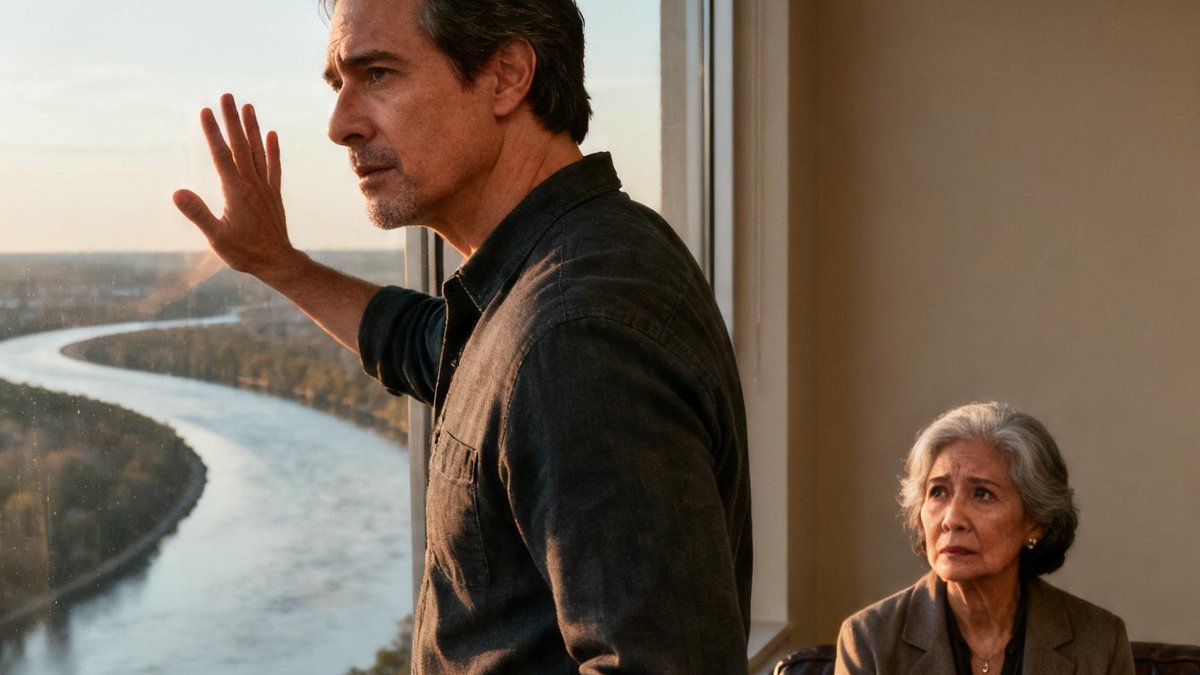
Wade stood. He walked to the window that looked out over the river bend, hands in his pockets. Behind him, he heard the leather creak as she shifted, bracing to leave.
"Sit still," he said, without turning around. "I didn't say go."
He reached into the folder again and pulled out a second piece of paper, folded into a small, soft square, worn along every crease. He'd carried it from the mattress at Red Bank to the room over the hardware store to every house he'd owned since. He unfolded it now—the crayon Ford Escort, back tires spinning off the page, a stick figure boy standing at a window that was just a rectangle with four lines through it.
He set it on the coffee table between them.
"I drew this the day I stopped waiting for you," he said. "I kept it because I wanted to remember exactly how much I hated you. Turns out that's not what it's for anymore."
Connie looked at the drawing, then at him, and didn't reach for it.
"I'm not paying off your trailer because you're my mother," Wade said. "I'm paying it off because I'm the only person alive who can, and because I'm tired of being the kind of man this drawing made me." He picked the paper with the three hundred twenty-seven thousand dollar figure off the couch, folded it once, and set it on top of the drawing. "That number stays what it is. Nobody owes it. I just needed to see it written down."
"Wade—"
"I'll call my accountant Monday. He'll handle the county directly, not you. And I want your number. Not for money. I want to know if you're sick, or if you need a ride, or if it's Thanksgiving and you're sitting alone in a trailer that isn't about to be repossessed."
Connie's mouth opened, closed. When she finally spoke, it wasn't thanks. "I don't know how to be somebody's mother now. I forgot how."
"Good," Wade said. "Because I don't need one. I need you to just show up. That's the whole job."
She nodded, and pulled a tissue from her coat pocket, and pressed it once beneath her eyes without ceremony, the way a person does a small practical thing in the middle of something enormous.
He walked her to the door. On the porch, the evening had gone the deep blue of early dark, and the ridge across the river was just a black line against it. She stopped on the top step.
"That drawing," she said. "Can I see it again sometime?"
"It's not going anywhere," Wade said. "Neither am I."
She went down the steps to a car that was newer than the Escort but not by much, and got in, and did not immediately drive off. Wade stood in the doorway and watched her sit there, hands on the wheel, the way she used to. Then the engine caught, and the car pulled out, taillights swinging red across the dark yard.
Behind him, the front door swung shut on its hydraulic closer, and hissed, slow and even, until the latch caught.