The number was thirty thousand. Blue ballpoint pen on a folded piece of notebook paper, under a quote from Keeney Heating and Air out of Elkhorn City. New furnace: $8,200. Roof patch: $4,300. Back taxes on the single-wide and the half acre in Possum Hollow: $17,500. She'd added the column herself, a little crooked.
Travis Whitfield set his coffee mug on the oak table. The mug said WMDJ 94.7, the country station out of Martin. He didn't touch the paper.
"Thirty thousand," he said.
"It's what they want," she said. Her coat was too big. Her hands were folded in her lap like a child in Sunday school.
He turned, bent to the safe in the corner of the study, and came up with three hundred hundred-dollar bills in a paper band. He set the stack on the table beside her paper. Then he took a second sheet from the leather folder and set it down next to the money. This one was typed. Itemized. At the bottom, in his own handwriting: $580,000.
She looked at it. Her mouth opened a fraction.
"The total," Travis said, "is five hundred eighty thousand dollars."
"What is this?"
"An invoice. For the last thirty years."
He sat back down. The grandfather clock in the hall kept ticking. The ice maker in the kitchen dropped a batch of cubes into the bin.
"The math is simple," he said. "I don't owe you thirty thousand. You owe me five fifty. After we settle, you can sign over the deed to the trailer and the half acre."
Her hand, which had been moving toward the stack of hundreds, stopped six inches from the money.
"You're not serious," she said.
"You came for money. I'm talking bookkeeping."
He was seven when she left him.
The bus ride—a Bluegrass Coach with torn vinyl seats and a driver who didn't say a word—took two hours and fifteen minutes. Fifty-two miles from the holler to the children's home in Pikeville. He kept his forehead against the cold glass and watched the world go by: blackened coal tipples, a Dairy Bar with a faded Pepsi sign, a dead dog at the side of the road.
The home was a two-story brick building on a rise outside town, with a chain-link fence and a sycamore by the gate. It smelled like boiled cabbage and lemon wax and something sharp underneath, the kind of floor cleaner they use in county buildings. A woman in a cardigan—Mrs. Boyd, thick glasses, a white bun—took his bag and wrote something in a ledger. She didn't ask his name.
"Well," his mother said. "I'd best go."
He didn't move.
"Will you come back?"
"Soon," she said.
She bent down and kissed him on the forehead, dry and brief, the way you press a stamp onto an envelope. Then she walked down the hallway. She didn't look back. The door swung shut. Her footsteps faded on the concrete steps.
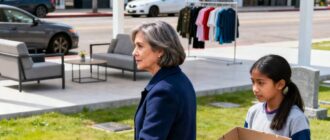
He went to the window. He watched her walk to the bus stop—a straight back, a gray cardigan, the same woman he'd lived with his whole seven years, getting smaller and smaller until the bus came and took her away.
The years in between weren't worth much description. They were just years. Wake-up at six, oatmeal three mornings a week, a caseworker named Dale Perkins who kept his file in a cardboard box, a foster placement in Belfry that lasted eleven months, another in Phelps that lasted four. At sixteen he got a job sweeping the floor at a body shop in Pikeville. At nineteen he was changing oil. At twenty-three he owned the place. By thirty-eight he owned eleven of them, stretched from Prestonsburg to Bristol, and a construction outfit besides. Nobody had come back for him. Not soon. Not ever, until this morning, when a woman he hadn't laid eyes on in thirty-one years knocked on the glass door of his office holding a folded piece of notebook paper.
Back at the oak table, she was still staring at the $580,000, and her hand had drawn all the way back into her lap.
"You think you can put a number on it," she said. Her voice had gone thin.
"You put a number on it first. Thirty thousand. I just did the same math you did, further back."
"I was twenty-two years old, Travis. I had you and no husband and no people who'd take either one of us in. Your daddy was gone to West Virginia and he wasn't sending a dime. I signed you into that home because I couldn't feed you, and I told myself I'd come back when I had something."
"You had thirty-one years."
"I had shame." She said it flat, the way you'd read a line off a form. "I got married again, down in Tennessee. I told him I didn't have children. By the time I worked up the nerve to tell the truth, we had two kids of our own and I didn't know how to explain the first one. Every year that went by made it harder to knock on a door. So I quit trying. That's not an excuse. It's just what happened."
Travis picked up the stack of hundreds and turned it over once in his hand, feeling the weight of it, the paper band biting into his palm.
"I used to stand at that window," he said, "and watch the road for a Bluegrass bus. Every week, for about two years, I thought maybe you'd be on it. Mrs. Boyd used to catch me there and pull me away for supper."
"I didn't know that."
"No. You wouldn't."
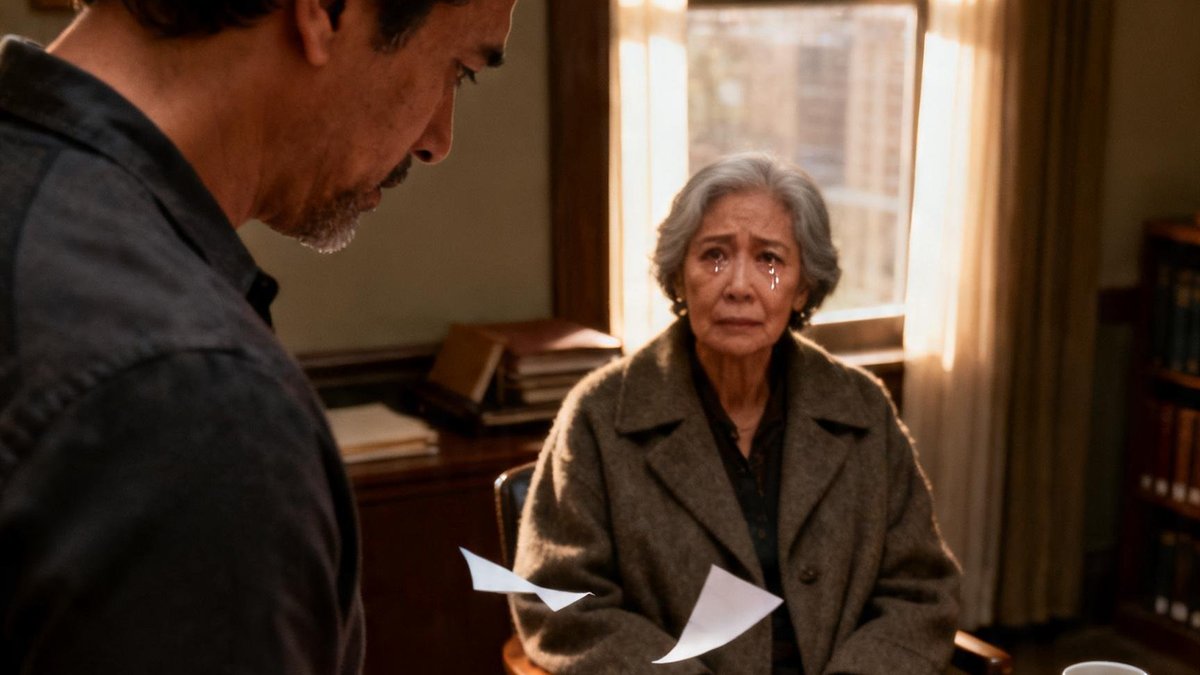
He set the money back down, squared it against the edge of the table, lined it up next to the typed invoice like two exhibits in a courtroom. Then he picked up the invoice instead, held it in both hands, and tore it once, straight down the middle, and once more across. He didn't do it fast. He let her watch it happen, the paper giving in clean lines, and he set the four pieces in a small stack next to her folded notebook page.
"I'm not selling you a debt," he said. "You don't owe me five hundred eighty thousand dollars. Nobody could pay that. I wrote that number so you'd have to sit here and look at it. So you'd know I counted every year, even if you didn't."
"Travis—"
"I'm not finished." He pushed the stack of hundreds two inches toward her, not all the way, just enough that it crossed the middle of the table. "This isn't the thirty thousand you asked for, either. It's forty. Furnace, roof, taxes, and enough left over that you're not back here in April asking again. You'll get a cashier's check Monday, made out to Keeney Heating and Air and to Pike County Treasurer directly. I'm not putting cash in your hand for you to explain to a husband who still doesn't know he married a woman with three children instead of two."
Her face did something complicated—relief and shame crossing each other, neither one winning. "Why would you do that. After what I just told you."
"Because I'm not doing the math you think I'm doing," he said. "I stopped needing you to come back a long time ago. I built eleven shops so I'd never again stand at a window waiting on anybody. This isn't about you. It's about me deciding I'm not the kind of man who lets an old woman lose her house over thirty thousand dollars, even if that woman is you."
She was crying now, quietly, no sound to it, just water finding the lines in her face that thirty-one years had put there. She didn't reach for a tissue. She let it run.
"I don't expect you to call me anything," she said. "I don't expect Sunday dinners."
"Good. Because you're not going to get them." He stood, walked to the safe, closed it, and spun the dial. "I'll have my office call you Monday about the check. After that, we're square."
She gathered her coat, though she was still wearing it, an old habit of hands with nothing else to do. At the door of the study, she stopped and turned back, and for a moment she looked exactly like she had from behind on that concrete walk outside the children's home, thirty-one years younger, gray cardigan, straight back, growing smaller as the distance opened up.
"Thank you," she said.
He didn't answer that either. He watched her walk down the hall the way he'd once watched her walk to a bus stop in Pikeville, except this time he was the one standing still and she was the one leaving, and this time he knew exactly where she was going and that she wasn't coming back to this table again. The front door closed with the same dry click as every door in that house. Travis picked up his coffee mug, found it had gone cold, and poured it out in the kitchen sink, watching the four scraps of the $580,000 invoice sitting on the oak table through the doorway until the ice maker dropped another batch of cubes and covered the sound of his own breathing.