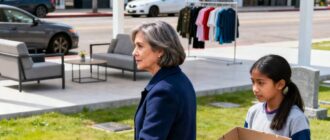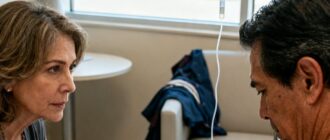
I have been a nun for twenty-three years. My name is Sister Marion, and I stopped believing long ago that a child could catch me off guard. But Daria did.
I first saw her in March, when the caseworkers brought Wanda's four kids in from Miller's Creek, out past Berea, Kentucky. I don't remember if it was snowing or just cold. I remember the smell. Woodsmoke, mildew, something sweet and rotten that clung to their clothes and wouldn't wash out. Daria was the oldest — nine years old. She held the youngest one's hand, and the other two hid behind her like frightened kittens.
The director called me into the hallway.
"Sister, these children need baths. And delousing. Twice."
I nodded. In the bathroom I bagged their filthy clothes in trash bags — to throw away, not to wash. Daria's back had old marks from beatings, thin white lines like dried-up creek beds. She didn't flinch. She just gripped a piece of bread in her fist and wouldn't let go.
Later, in the dining hall, I gave the kids warm stew. Little Sam ate his with a spoon he held in both hands like a shovel. Daria didn't eat. She slipped bites into the pocket of her new pajamas — automatically, like it was nothing. I had to explain there was food here every single day. She didn't believe me. I got the feeling she was listening the way you listen to a grown-up talking nonsense.
Time passed. Daria learned to read fast — the letters seemed to climb into her on their own. At the elementary school in town, her teacher, Mrs. Coleman, told me:
"That girl is the smartest I've seen in ten years. But she never smiles."
"Her smile is on the inside," I answered, because I didn't know what else to say.
Actually, Daria did smile. It was like a sunbeam cutting through fog — rare and very brief. I only saw it in chapel, when she sang. She sang quietly, as if praying to someone we weren't meant to see.
Her mother, Wanda, came exactly once. She was drunk. She stood at the gate shouting something about "her kids," about "blood being thicker than water." The children watched her from the window. Sam cried. Ellen, the middle one, clutched the curtain.
Daria didn't look. She stood in the corner of the dormitory writing in a notebook — slowly, head bent. She didn't cry. She didn't ask why her mother was like that. She just wrote something and closed the notebook.
I didn't know then what she'd written. I know now.
The years passed. I grew old in the shadows of the convent, and Daria grew up. After high school she went to Lexington — a state scholarship, a dorm room, a night job at a gas station off New Circle Road. Then college. Then a job at some corporate office. I mailed her care packages at Easter; she'd text back short messages: "I'm okay, Sister. Thank you."
Then came the big news: a wedding. Down in Myrtle Beach. She sent a photo — a long white dress, a man beside her, smiling, in a thin tie. Daria looked beautiful. Not like a girl off a movie poster, but like someone who'd managed to put herself back together.
"Will you come?" she asked on the phone.
"I can't, honey. Things here won't let me get away."
That wasn't true. I was just afraid of seeing Wanda among the guests. The mother was alive, had sobered up for a stretch, and tended to show up wherever there was cake and an open bar.
Daria said she understood.
A month later Ellen wrote to me: "Sister, I'm coming to see you. I need to tell you something."
She came on a Saturday. We sat in the convent courtyard, under the old walnut tree. Ellen had grown into a woman — calm, wearing plain gold earrings. But her eyes were red.
"Daria's drinking," she said, no preamble. "It started at the wedding. Champagne. Then on the honeymoon in Cancún — every day. Now… Sister, she drinks like our mother did."
I said nothing. Wind stirred the branches above us; an acorn dropped into the grass.
"Her husband threw her out," Ellen went on. "She moved back into her apartment, the one she'd bought with her own money. I was living with her while I finished school in Lexington. But I couldn't watch it anymore. Men coming and going. One night I found a stranger in my bathroom, Sister. My bathroom. And Daria was passed out on the couch. She'd signed something with him — some kind of loan, against the apartment."
"What did you do?"
"I moved out. Left her a note and left. I couldn't stay."
Ellen kept talking, and I remembered that first evening. The bread crushed in her fist. The marks on her back. The notebook I never read.
"She'd show up at my place," Ellen said. "Filthy, teeth rotting, smelling like gasoline and sweat. She'd shower, sleep for two days, then disappear again. One day she took a hundred and forty dollars out of my wallet. That's when I knew I had to stop letting her in."
"And now?"
"Now she's gone. Three months. Vanished. Someone sold the apartment — a man showed up with a notary and it was all legal. Daria had signed power of attorney a year before. I knew she was sick. I'd known for a long time. But I couldn't stop her."
Ellen looked at me, waiting for me to say something.
"What about the others?" I asked.
"Sam's working construction in Ohio. Jake's a mechanic down in Knoxville. Neither one drinks. Not a drop. Sam told me once: 'We're the children of alcohol. We don't want to find out if we'd like it too.'"
She went quiet. Then added:
"Our mother told Daria, back when she was little: 'You're my daughter, you're just like me.' And Daria believed her."
That's when I understood. I never knew exactly what Daria had written in that notebook, but now I could see the words plainly. She'd written down what a mother is supposed to say to her child. She'd written the opposite: "I will not become her." And in the end, she'd given up.
I went to my room. On my desk sits an old wooden icon of the Virgin Mary I inherited from my father. I opened the drawer. There, in a small plastic bag, I kept something I'd taken from that first night — the piece of bread Daria had gripped in her fist. It was hard as a stone. Still is.
I took the bag. I took my notebook too — the one where I write grocery lists for the kitchen. I tore out a blank page. At the top I wrote: "For Daria. The last thing that was hers. To be kept at the church."
I put the bag with the bread inside. Folded the page and tied it with white thread.
Then I called a woman I know from the parish. She works in the county records office.
"I need to find a girl," I said. "Daria. Father unknown. Mother — Wanda, from up around Miller's Creek. Date of birth: October 4, 1984."
She didn't ask why. She just said:
"I checked. There's a record. That same woman died two months ago. Found in an abandoned building near the rail yard. Cause — cardiac failure, complicated by hypothermia. Buried unidentified."
"Where?"
"County cemetery. Section 12."
I thanked her. Hung up. My window looked out on the courtyard, where Ellen still sat. I watched her tug at one sleeve. Then she sat down on the bench. She didn't cry.
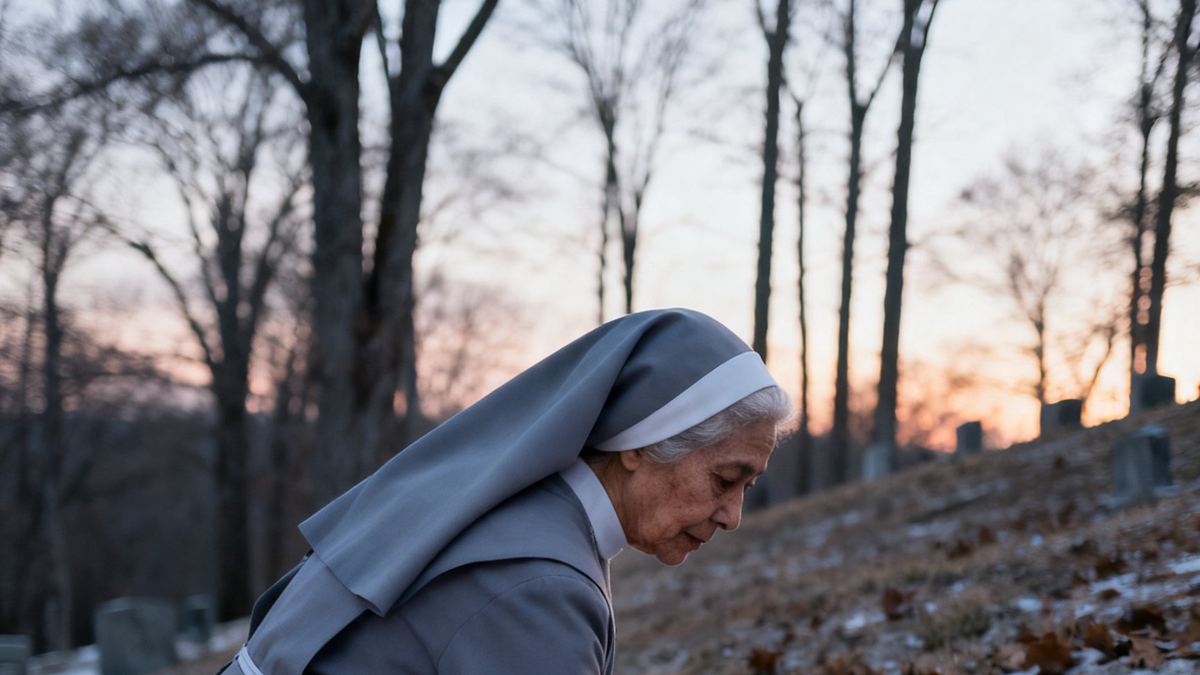
I went to the cemetery the next day. Walked through the iron gate that creaks. Found Section 12 — a row of small stone markers, no photographs. One was newer than the rest. No name. Just a number.
I knelt on the frozen ground. Opened the bag. Took out the piece of bread. It had started to crumble. I left it on the grave.
I stayed there a long time. I thought about that first evening, the bathroom, the filthy clothes in trash bags. I thought about how Daria sang in chapel. And how once, on Holy Saturday, she asked me:
"Sister, do you think God hears the kids from Miller's Creek too?"
"Yes, honey," I said. "He hears everyone."
She didn't answer.
Now I stood over her grave.
"Forgive me, Lord," I said out loud. "I'm too late."
Wind swept across the hill, pulled a few dry leaves off the ground, and dragged them down toward the convent. In the distance, through the haze, I could see the rooftops of town. Somewhere among them lived Ellen. And in my refrigerator, for tomorrow's service, I'd left the communion bread rising.
I passed the convent gate and stopped. I dropped five dollars into the candle box. Lit one. And wrote in pen, on the inside cover of the prayer book, after all the other names:
"Daria. October 4, 1984 — January 12, 2023."
Short. Like a memory that fits on a single line.
That evening I skipped dinner. I sat in the kitchen and watched Sister Ruth baking bread for tomorrow's distribution. She asked me:
"Who's this one for, Sister?"
"For a girl," I said. "Who used to eat bread with both hands."
She didn't ask anything else. She just reached for the next loaf.
I got up and went to close the window facing the courtyard. Outside it smelled like smoke — someone burning dry leaves in the woods. The same smell as that first day. That smell never washes out of clothes. Or out of memory.
I didn't turn on the light. I just stood there in the dark.