I heard the garage door groan open a little after six.
I was at the kitchen island, pulling cold cuts from the deli paper. Roast beef I’d sliced myself, Swiss cheese, a jar of spicy mustard. The Cape Cod potato chips were already in a bowl. Friday night ritual: submarine sandwiches and a movie with my son Leo, if he made it back from his mother’s in time. The money from the auto shop had paid for this kitchen reno two years back — quartz counters, a faucet that turned on if you waved at it, the works. A $48,000 kitchen, and three-quarters of the time I ate alone at the island.
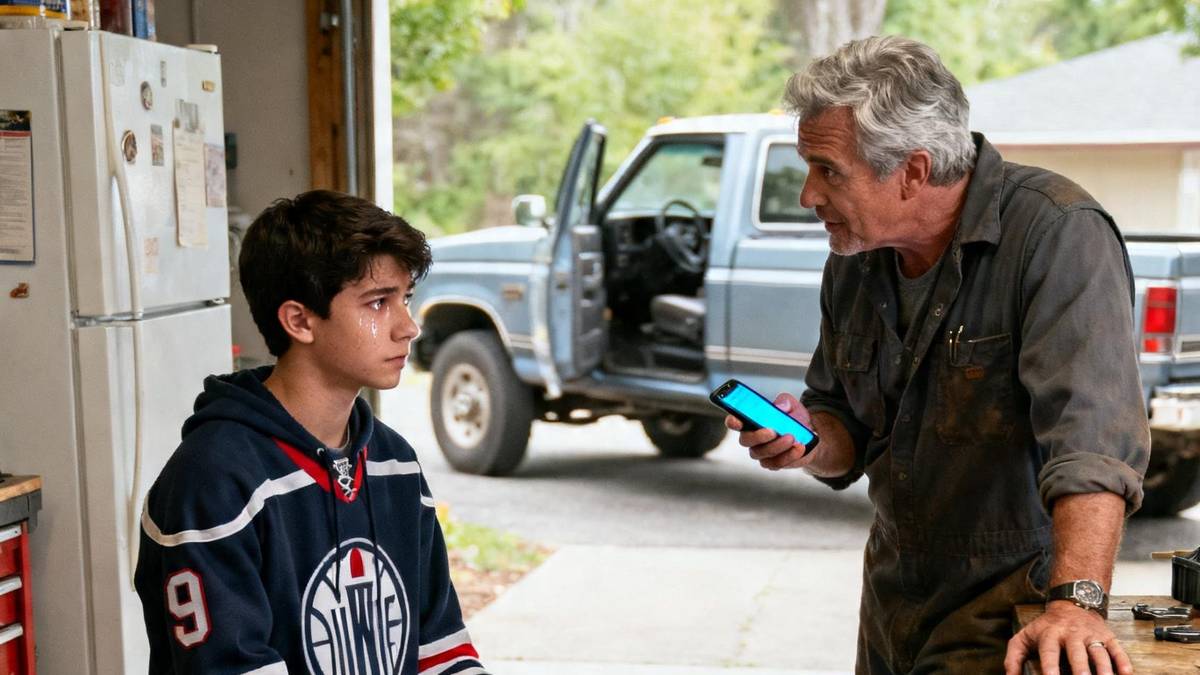
Leo didn’t come into the kitchen. He dropped his hockey bag by the mudroom door, kicked off his boots. One thumped against the dryer. I heard him drag a stool from the workbench over to the window near the fuse box.
I put the mustard down and walked past the bag. It smelled like rink ice and damp socks. He had his phone out, staring at a text thread.
“She’s got me sharing with her cousin’s kid next week,” he said, not looking up. “Ten years old. Wets the bed, apparently. Hannah said she’d put a plastic sheet down for me.”
Hannah. My ex-wife. We’d been divorced since Leo was eight. He was sixteen now. After the papers were signed in a lawyer’s office off I-91 in Springfield, I’d moved into this place in Montpelier. Smaller, older, but mine. Leo came over every other weekend and Wednesdays. That was the deal. I hadn’t missed a Wednesday in eight years.
“They’re moving you out of your room for a ten-year-old,” I said.
“He’s got ‘anxiety.’ Needs the bigger closet for his nightlight collection.” Leo put his phone on the windowsill. “It’s fine.”
The window over the workbench looks out onto the Winooski River. In November, it’s just a strip of gray between bare trees. A crow was working on something dead on the far bank. I’d watched that same crow every morning for a month after I moved in. Back then, I was still trying to figure out how a marriage that started with a road trip to Acadia and a Minor League game in Portland ended with a text message from another man on a phone I wasn’t supposed to see. That was eight years ago. You’d think I’d be over the crow.
Leo pulled a folded piece of stationery from his back pocket. Thick cream paper, the kind Hannah ordered from Crane & Co. back when she still sent handwritten thank-you notes.
“What’s that?”
“My speech. For Saturday.”
Saturday. The wedding. Hannah and Craig. A Christmas wedding at the Barn at Boyden Farm, with fairy lights and hot cider and a string quartet that cost more than my first truck. Leo was supposed to be a groomsman. I’d gotten the invitation four months ago and stuck it in the drawer with the takeout menus. It was still there.
I unfolded the paper. Hannah’s handwriting, tight little loops: *“Leo — talk about how happy you are that Mom found someone who makes her smile. Mention the trip to Lake Champlain last summer. Say Craig is the dad you never had. Keep it light. Keep it short. Don’t make it weird.”*
Below that, in Leo’s cramped block letters, three words scratched out so hard the pen had torn through: *He already wasn’t.*
I looked at my son. He had my father’s jaw, my lousy posture, a constellation of acne across his forehead. The Vikes hockey hoodie he’d worn for two weeks straight.
“What do you want to say up there?” I asked.
He didn’t answer right away. He was staring at the crow on the riverbank, or maybe at nothing at all.
“I want to ask him why he told her I was the reason they had to move. I want to ask why there wasn’t room for me at the lake house for the fourth of July but there were three of her Pilates friends. I want to ask why he bought me a new hockey stick last month and then had her call and say it was an ‘accident’ and could I please bring it back.” He swallowed. “But if I say any of that, she’ll tell everyone I’ve ‘got issues’ and he’ll back her up. Same as always.”
My jaw was tight. I made myself unclench it.
“You know she called me last week,” Leo said, quieter now. “She said after the wedding maybe I should ‘take a break’ from coming over. Until things settle. Craig thinks it’ll be easier for me to adjust if I’m not bouncing back and forth so much.”
I had a knife in my hand. A Wüsthof, eight-inch chef’s. I put it down on the cutting board and looked at my reflection in the blade. My father’s face now, too. Graying at the temples, lines around the mouth that hadn’t been there in my wedding photos.
“How long is a break?” I asked.
“She didn’t say.”
The wall clock in the living room ticked. Quarter past six. I’d been supposed to pick Leo up at five. She’d dropped him off early. No explanation. Now I knew why: she wanted him to tell me himself, so she wouldn’t have to hear the silence I’d give her on the phone.
I thought about the small room upstairs that I’d painted blue when Leo was nine. The bunk bed he never used because he preferred the bottom. The way he’d leave his retainer on the bathroom counter every single time and I’d move it to his nightstand so I wouldn’t knock it in the trash. The way the house sounded when he wasn’t in it: the furnace kicking on, the ice maker dropping cubes, nothing else.
“Dad,” Leo said, “what do I do?”
I walked over and stood next to him at the window. The crow was gone. The river was flat and gray. On the other side of town, in the kitchen of the house I’d helped pay for and hadn’t set foot in since the day I picked up the last box of my books, Hannah was probably ordering centerpieces and checking her seating chart. Craig was probably opening a bottle of something expensive, telling her not to worry about the kid, the kid would be fine, the kid just needed boundaries.
I thought about the fifty-seven times I’d bitten my tongue in the last eight years. Every Wednesday drop-off where I smiled and waved. Every canceled vacation I’d rebooked without a word. Every time Leo had come home quiet and I’d told myself: *don’t make it harder for him, don’t put him in the middle, be the bigger man.*
Fifty-seven times. I had a ledger in my head. I knew the exact number.
“Can I see that speech again?” I asked.
Leo handed it over. I looked at the cream paper, the neat handwriting, the scratched-out line underneath. And then I set it down on the workbench, next to a half-empty can of WD-40 and a socket wrench I’d left out from replacing the garbage disposal.
“What if you don’t read it at all?” I said.
Leo turned away from the window. “They’ll lose it. Hannah will say I ruined her day. Craig will say this is exactly what he was talking about.”
“Probably.”
“And you’ll be the one they blame. For ‘poisoning me against them.’”
“Also probably.”
Leo looked at me. Really looked, the way he used to when he was small and checking to see if I meant something.
“You’d be okay with that?” he asked.
Boone, my neighbor’s black Lab, started barking two houses down. Same bark every evening when the newspaper hit the driveway. A sound so regular you could set your watch by it.
I pulled the stool over and sat down. My knee cracked. The same knee I’d blown out playing rec-league hockey with Leo’s team at the rink off Pioneer Street. I could still feel the pop when the weather turned.
“You know what I did for a living before I opened the shop?” I said.
Leo shook his head. I’d never told him this part.
“I sold life insurance. Fifteen years. I was good at it. Top ten in the state, three years running.” I picked up the socket wrench and turned it over in my hands. “You know how you sell life insurance? You look a person in the eye and you tell them to imagine the worst day of their family’s life. The day they’re not there anymore. And then you tell them that for sixty-eight dollars a month, they can protect the people they love from the fallout. People bought it because they were terrified of what would happen if they weren’t around to fix things.”
Leo was still watching me.
“That’s what I’ve been doing with you and Hannah. Paying premiums. Smiling at drop-off. Never saying a word. Thinking if I just kept my mouth shut, you’d be safe from the fallout.” I put the wrench down. “But the worst day already happened. It happened eight years ago. And I’m still paying premiums like it hasn’t.”
I reached into my pocket and pulled out my wallet. Behind my driver’s license, I had a photo of Leo at five years old, holding up a smallmouth bass he’d caught at the reservoir. His front tooth was missing. He was smiling like he’d just won the lottery.
I pulled the photo out and set it on top of the speech.
“This Saturday,” I said, “you’re going to be standing in front of a hundred and forty people who think they know your story. They’re going to clink their glasses and wait for you to say something charming so they can go back to the open bar.” I tapped the photo. “You can read Hannah’s lines. Or you can tell them about the tooth. About the summer I taught you to cast. About how that fish flopped onto the dock and you yelled ‘we did it’ like we were a team. Which we were.”
Leo picked up the photo. His thumb brushed over his own five-year-old face.
“They’ll hate it,” he said.
“Some of them will. The bridesmaids from her spin class who’ve never asked you a single question about your life. Craig’s brothers from Boston who think you’re ‘a lot.’ Yeah, they’ll hate it.”
“Hannah will say I did it to hurt her.”
“Hannah will say whatever lets her sleep at night. Same as always.”
Leo was quiet. Then, very slowly, he pulled his phone out again. He didn’t unlock it. He just held it, black screen up, like it was a rock he was about to skip across the river.
“I had a whole other speech,” he said. “I wrote it two weeks ago, on my notes app. I deleted it because I thought you’d tell me to take the high road.”
“What did it say?”
Leo’s jaw worked. He was clenching and unclenching, same as I’d done a minute before. I recognized the rhythm. It was mine.
“It said: *Craig, you’re a nice guy, but you told Mom I was ‘too much’ before we even met. You told her this summer that I’d be better off somewhere else. You’ve been in my life for three years and you’ve never asked me a single question about hockey, or school, or what I think about anything. I don’t know what you’re afraid of, but whatever it is, it probably has nothing to do with me. And Dad*—” his voice cracked, a thin line in the middle of the word, “*Dad never missed a game. Even when I sat on the bench. Even when we lost by six.*”
The furnace kicked on. Warm air pushed through the vent by my feet. The toast crumbs on the counter from breakfast were still there. I hadn’t wiped them up. I never wiped them up until Sunday.
“Don’t delete that one,” I said.
“Mom will lose her mind.”
“Let her lose it. She’s been storing it up for years. Might as well get it over with.”
Leo almost smiled. Almost.
“What about after?” he said. “When she says I can’t come here anymore?”
I walked to the fridge. Behind the electric bill and the reminder card for Leo’s dental cleaning, I had a magnet from the auto shop — a little tow truck with my name on it. I’d had it made when I opened the place, five years ago, fresh out of the divorce and terrified of going under. I’d built that shop from a two-bay garage with a leaky roof to a six-bay business with four employees and a waiting room that didn’t smell like oil. I’d done it alone. While paying child support. While smiling at drop-off.
I pulled the magnet off the fridge and held it up.
“You see this?”
Leo nodded.
“This is what I built when I stopped paying premiums. It’s not a kitchen with a touchless faucet. But it’s mine. And if she wants a fight, we’ll fight. We’ll get a lawyer. We’ll get a custody order that isn’t just her making up the rules as she goes.” I put the magnet back. “But first, you’re going to stand up at that wedding and you’re going to say what you need to say. Not what Hannah wrote. Not what Craig wants to hear. What you need to say. Because this is your family. You have a place in it. And that place is not a plastic sheet on a bed that isn’t yours.”
Leo looked at the speech on the workbench. The cream paper, the neat handwriting, the three scratched-out words. Then he reached past it and picked up the socket wrench instead.
“Can you teach me how to fix something?” he asked. “Right now.”
“What?”
“Anything. The disposal. The dryer. I don’t care. I just want to know how to fix something before Saturday.”
I looked at him. Sixteen years old, my father’s jaw, my lousy posture. Standing in my mudroom asking me to teach him something I knew how to do.
“Yeah,” I said. “I can do that.”
We walked to the kitchen sink. The disposal had been grinding wrong for a week. I pulled the wrench from his hand and showed him the release point underneath.
Saturday night came with two inches of fresh snow and a temperature that didn’t crack twenty. The barn was lit up like a postcard — white lights strung from the rafters, candles on every table, the string quartet sawing through Pachelbel in an endless loop. I parked the truck at the edge of the lot and shut off the engine.
I wasn’t going inside. I wasn’t invited. But I wanted to be close enough that Leo could see the headlights through the barn windows when he walked to the mic. A signal. I’m here. I’m always here.
I thought about the speech on his phone. The one I’d helped him pull out of the notes app and reshape into something that would land like a punch but sound like a eulogy for the family he should have had. Not angry. Just true. The kind of true that sits in a room and refuses to leave.
The barn doors were closed. Through the slats, I could see figures moving. A woman in a green dress, laughing. A man refilling his glass. Craig probably. I’d met him once, at a hockey awards dinner, before I knew who he was. He’d shaken my hand and said “nice program you got here.” I’d said thanks. That was the whole exchange.
A server came out the side door, smoking a cigarette and shivering. She looked at my truck but didn’t say anything. The quartet stopped. I heard the clink of a knife against a glass.
The speeches were starting.
I turned off the headlights so no one would think I was casing the place. In the dark, with the snow piling up on the windshield, I could see the whole barn like a stage set. Warm light. Happy people. My son, somewhere in there, holding a phone with sixty-three words that might change everything.
My own phone buzzed in the cupholder. A text from Boone’s owner: *Your dog is in my yard again.* I’d forgotten to latch the gate.
I typed: *Sorry. Be home soon. Leave him. He’s fine in the snow.*
Inside the barn, someone tapped a microphone. The feedback whined and then settled.
Leo’s voice came through clear. Steady. Not rushing.
“Hi everyone. I’m Leo. I’m the son.”
A pause. Murmuring. A nervous laugh from someone near the back.
“Hannah asked me to read something tonight. About how happy I am. About how Craig makes her smile.”
Another pause. Longer. I could picture the room leaning forward.
“But I didn’t write that speech. And I’m not going to read it. Instead I want to tell you about something that happened when I was five.”
I put my hand on the steering wheel and didn’t move.
He told them about the bass. The dock. The missing tooth. The “we did it” that I’d carried in my chest for eleven years. Then he told them about the summer he wasn’t invited to the lake house, and the hockey stick that was a mistake, and the room that wasn’t his. He didn’t raise his voice. He didn’t cry. He just listed the facts, one after another, the way you’d read an invoice.
By the time he got to the last line — *I know Craig is your new family, Mom, but I’m still here* — the barn had gone dead quiet. No clinking glasses. No shuffling feet. Just the hum of the space heaters and the wind through the rafters.
I exhaled. My breath fogged the windshield.
The barn door opened. One person, then two, stepping out into the snow. A woman in a long coat, bare arms, no regard for the cold. Hannah. Even from forty yards, I knew the shape of her. She was holding her heels in one hand and walking toward the parking lot.
Behind her, Craig appeared in the doorway, calling her name. She didn’t turn around. He stood there in his vest and tie, his arms at his sides, and then he went back inside. The door swung shut.
Hannah kept walking. Past the valet stand. Past the cars. She stopped about twenty feet from my truck and just stood there, in the snow, in her bare feet, staring up at the sky. The flakes were catching in her hair and melting on her shoulders.
I thought about rolling down the window. Saying something. *I’m sorry.* Or *I’m not.* I couldn’t decide which was true.
Then the side door opened again and Leo came out. He was wearing his blazer and his dress shoes and he walked straight past his mother without seeing her. He walked toward my truck.
I flicked the headlights on. Just for a second. So he’d know.
He saw them. He broke into a jog through the snow, slipping a little in his slick-soled shoes, his breath puffing in white clouds.
When he got to the passenger door, I unlocked it. He climbed in, shaking the snow from his hair. His face was flushed, his eyes a little too bright.
We sat there for a moment. The heater was blowing cold air that hadn’t warmed up yet. The barn was still glowing behind us.
“They’re mad,” Leo said.
“Yeah.”
“Grandma Alice left. She said I ‘ruined a perfectly lovely evening.’ Actually yelled it across the table.”
“She’ll get over it.”
“She won’t.” He said it almost cheerfully. “And I don’t care.”
I put the truck in reverse. Through the windshield, I could see Hannah still standing in the snow, watching us. She hadn’t moved. The snow was up to her ankles now.
As I pulled out of the lot, Leo leaned over and turned on the radio. Christmas music. Some syrupy version of “Have Yourself a Merry Little Christmas.” He didn’t change the station.
I drove east toward Montpelier, past the darkened houses and the snow-covered fields and the single streetlight at the turn for the quarry. Boone would still be waiting in the neighbor’s yard. The disposal was still broken. The toast crumbs were still on the counter.
But my son was in the passenger seat and his phone was on the dash and his speech was in the air behind us, settling over that barn like the snow.
Every single word of it true.