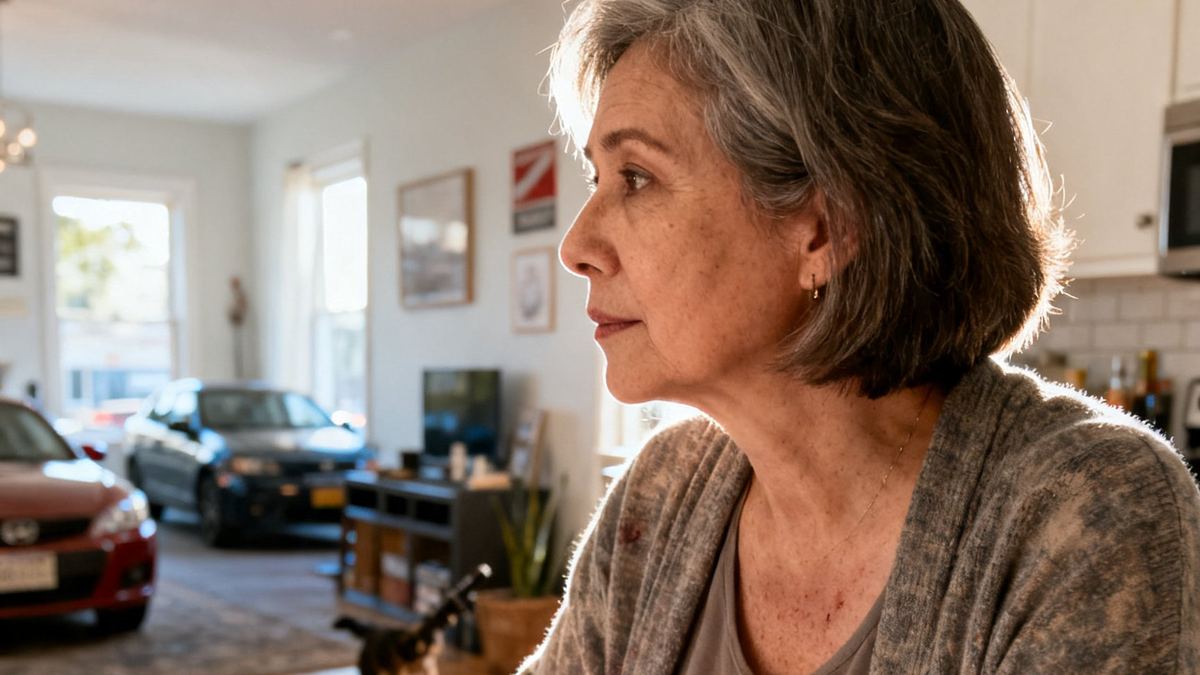
I keep the notebook in the kitchen drawer, next to the takeout menus, where I can reach it without looking. Ruled paper, spiral binding, coffee ring on the cover. Inside: two hundred and eleven days of numbers. Insulin units. Blood sugar readings. What she ate at noon. Whether she slept.
My mother, Diane Kowalski, died on a Tuesday in March, in the back bedroom of the house on Cypress Street in Tulsa, with the window cracked because she liked to hear the mockingbirds even in winter. I was thirty-four. I'd moved back from Denver eleven months earlier, given up an apartment and a job managing a call center, to take care of her through the last stretch of pancreatic cancer. My brother Curtis stayed in Phoenix. He sent two hundred dollars a month and called on Sundays, mostly to ask how she was doing so he wouldn't have to ask me how I was doing.
The house wasn't much — a three-bedroom rancher my parents bought in 1987, worth maybe a hundred and forty thousand now, mortgage paid off since Dad died. But it was hers, and everyone assumed, in the vague way families assume things, that it would go to whoever'd been there at the end. That was me.
Curtis showed up nine days before the funeral, driving a leased Ford Explorer, wearing a blazer he probably bought specifically for this. He hugged me at the door like we hadn't spoken in years instead of every Sunday for almost a year. He walked through the house running his hand along the hallway wall, and I noticed he stopped in front of the china cabinet a beat too long.
At the reception after the service, in the fellowship hall of St. Boniface, over sheet cake and church-basement coffee, he found me by the coat rack.
"We should talk about the house," he said. "Before things get complicated."
"Things are already complicated, Curtis. Mom's been dead four days."
"I'm not trying to—look. Half of it's mine. Legally. You know that."
I did know that. Intestate succession in Oklahoma splits it between surviving children. What I didn't expect was for him to say it standing six feet from the casket flowers, still smelling like the rental car's new-car spray.
"She wanted me to have it," I said. "She told me in February."
"Did she put that in writing?"
She hadn't. That was the whole problem, the one I'd been too exhausted and too grieving to think through while I was measuring out morphine drops and washing sheets at 3 a.m.
Three weeks later, a letter arrived from a lawyer in Broken Arrow, on Curtis's behalf, formally requesting the house be listed for sale and proceeds split per Oklahoma law. My name was on the deed as co-owner — Mom had added me back in 2019 for some tax reason neither of us fully understood — but co-ownership cuts both ways. He could force a partition sale. His lawyer's letter used the phrase "expeditious liquidation of the asset," like the house was a stock position and not the room where I'd held a damp washcloth to my mother's forehead while she asked me, half-lucid, whether the mockingbirds had come back yet.
I sat with that letter for two days. Then I called Rosalind Ferreira, a woman I'd met at the hospice's caregiver support group — she'd lost her husband the year before, and she'd mentioned once, almost offhand, that she did estate paralegal work downtown. She wasn't a lawyer, but she knew where lawyers kept their files, and more importantly, she knew what questions to ask.
"Do you have anything from your mother," Rosalind asked me over coffee at a diner on 15th Street, "in her own hand, about her wishes? Even something that's not a will."
I thought about the notebook. And then I remembered something else — a spiral notebook, not the medical one, but her own. She'd kept a little book of her own during those last months, mostly grocery lists and Bible verses and, near the back, three pages where she'd started writing things down "in case." I hadn't been able to read past the first line since she died. It was in the drawer under the medical notebook.
I opened it that night at the kitchen table. Her handwriting had gotten shaky by February, but it was legible. *House goes to Angela. She stayed. Curtis knows where the silver is if he wants that instead.* Dated, signed, not witnessed, not notarized. Not a will. But it was something.
Rosalind told me what it could and couldn't do: it wasn't binding on its own, but combined with evidence of undue burden — the eleven months of caregiving, the fact that I'd quit my job, the medical logs, home health records, the pharmacy receipts — it gave me grounds to petition the probate court for an unequal distribution, or at minimum, leverage to negotiate instead of getting steamrolled into a forced sale.
I didn't want a war. I called Curtis and asked him to come to the house — not a lawyer's office, the house, the kitchen table where we'd eaten cereal as kids — and look at what I had. He came reluctantly, still in the blazer, like armor.
I laid it out. The medical notebook. Mom's own notebook, open to that page. A folder of home-health-aide invoices I'd paid out of my own dwindling savings because Medicaid didn't cover everything. My old lease termination notice from the Denver apartment, dated the week I'd moved.
"I'm not trying to cut you out," I told him. "I'm not selling the china cabinet Grandma left you, and I'm not touching the coin collection in the garage — that's yours, I know it's yours. But I'm not selling this house out from under myself nine months after burying her, either."
Curtis read the page in Mom's handwriting twice. He didn't say anything for a while. Somewhere down the block, a lawnmower started up, one of those early-spring first mows of the season, and the smell of cut grass came through the cracked kitchen window — the same window she used to leave open for the birds.
"I need money, Angie," he finally admitted. "Not — I'm not trying to screw you. Priya and I are underwater on the house in Phoenix. I thought this would fix it."
"It's not going to fix it by taking mine," I said. "But I can do this: I'll refinance, buy out your half at fair market value, seventy thousand, paid over eighteen months. You get a note, I get the house. Real paperwork this time. Notarized."
He didn't like it — he wanted it faster, wanted cash now — but he signed. Rosalind connected me with an actual real estate attorney, Marcus Whitfield, who drew up the buyout agreement and recorded it at the Tulsa County Clerk's office that April. I took out a home equity loan against the property to cover the first payment. The rest I've been sending in twelve-hundred-dollar installments on the first of every month, a standing transfer set up through my bank, visible right there on my phone screen if I open the app — balance ticking down, forty-one thousand left as of last month.
The notebook still lives in the kitchen drawer. I haven't thrown it out. Some nights I still crack the window in the back bedroom, even in September, even though nobody sleeps there now but me when I can't sleep in my own room, and I listen for the mockingbirds, and I think about the version of this story where love doesn't need a ledger to survive — and then I close the drawer, and go check that the transfer went through.