My sister-in-law, Claire, ruined our home with a throwaway line over chardonnay.
“You ever notice how Lily’s hair catches the light? That copper sheen? Megan had a friend in college—real close—redhead. Kind of funny, isn’t it?” She took a sip, her pinky tapping the glass rim twice. Not a question. A push.
Megan was in the kitchen, the faucet running, clinking ice into a pitcher. She hadn’t heard. I was on our lumpy IKEA sofa, the one we’d fought about for three weekends because the instructions were in pictograms nobody understood. The baby monitor sat on the armrest, its little green lights flickering with Lily’s breathing.
“Claire, what the hell does that mean?” I said, my voice catching in a register I barely recognized.
She shrugged and set her glass on a coaster—the same coaster set Megan had bought at a flea market in Andersonville for $3.50 apiece. Claire had mocked those coasters the day we brought Lily home from the hospital. *Who even uses coasters with a newborn?* But she used one now, slow and deliberate, like she was marking territory.
“I’m just saying, David. I’m the one who spent a whole semester with that guy. He was… around. A lot. Right before the wedding.” She paused. “Look, I love my sister. But I love you too, and you deserve to know.”
Know. That word stuck in my brain like a popcorn kernel between teeth. I dug at it for weeks.
The next morning, Claire sent me a text at 7:14 a.m.—while I was warming a bottle, running the tap on my wrist to get the temperature right. **Hereditary traits are real. Just google the odds of two brown-haired parents producing a redhead. I’m only thinking of Lily.** Our dog, a rescue mutt with one ear that flopped sideways, whined by the fridge. The bottle got too hot. I dumped it and started over, my hands not quite steady.
By Thursday, I was staying late at the architecture firm, pulling up old Facebook photos of Megan’s college friends. By the following Monday, I’d memorized the exact strawberry-blond tint of a man named Greg I’d never met, a man who’d liked my wife’s posts from 2012. Claire would drop by unannounced—with a casserole in a Pyrex dish, with a bag of used baby clothes from a consignment shop—and each time she’d plant something new. “Has Megan mentioned Greg lately?” “I hope you and Lily got to bond while Megan was at that conference.” “You know, Mom always said Megan had a wild streak.”
Our bedroom became a fridge. Cold, well-lit, and full of things neither of us wanted to eat. Megan would roll toward me in bed, and I’d feel the exact millimeter of space between our shoulders. Once, she reached out and touched my jaw, and I twitched like I’d been shocked. She didn’t ask. She just turned over and faced the wall, where a streetlamp from Oakdale Avenue threw a rectangle of orange light above the crib.
I started noticing things that weren’t things: the way the baby scrunched her nose when she laughed—did I do that? The shape of her ears. Whether her fingers were long like mine or short like Megan’s. Claire’s voice had become a second pulse in my skull. *Paternity tests are just a cheek swab these days. Peace of mind, David. That’s all it is.*
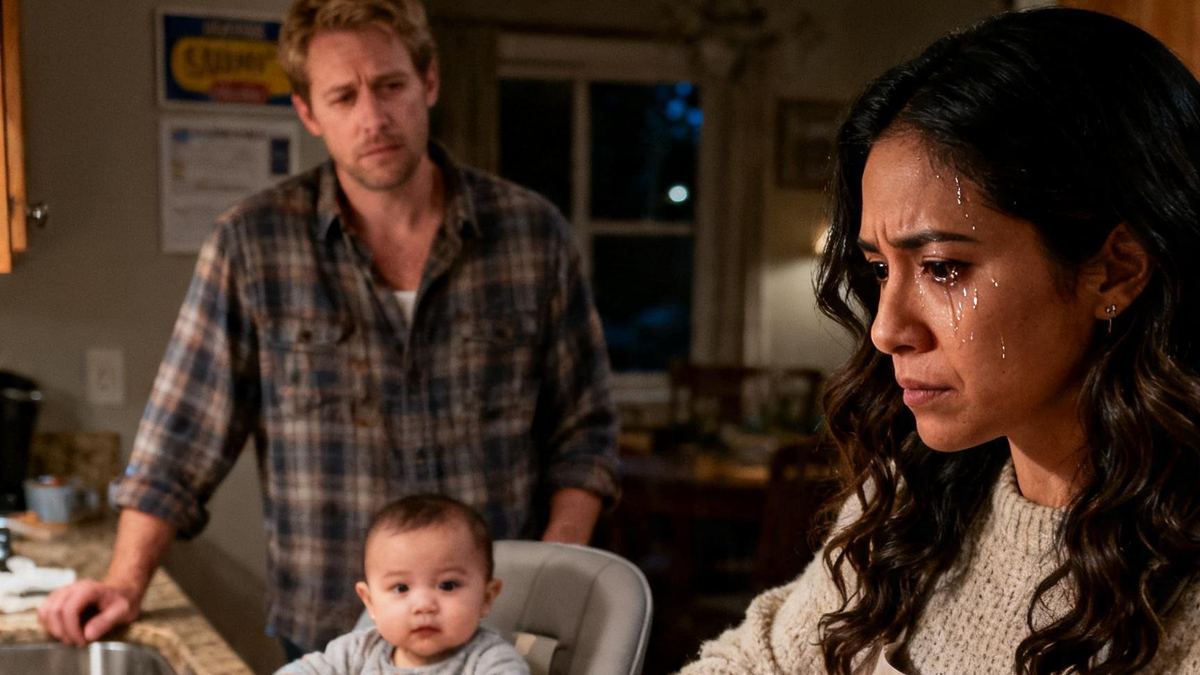
The night I finally choked it out, we were standing in the kitchen. A pot of water was boiling over on the stove—Megan was making pasta, penne, the box from Trader Joe’s wedged by the microwave. The dog was underfoot. Lily was in her high chair, smearing sweet potato puree onto the tray with both palms.
“I need to know,” I said. “About that guy. Greg.”
Megan set down the wooden spoon. She didn’t turn around. “You need to know what.”
“If she’s mine.”
The sentence landed like a brick on tile. The water hissed over the burner. For a full ten seconds, neither of us moved. Then Megan lifted the pot and dumped the pasta into the sink, scalding water and all, and the crash of it against the stainless steel made the dog bolt out of the room.
“You have been listening to my sister,” she said, her back still to me. “You have let that woman live in your head rent-free while I have been bleeding and nursing and not sleeping for seven months. And you’re asking me that.”
“She wouldn’t say it if there wasn’t something.”
Megan turned. Tears were already cutting lines through a smudge of flour on her cheek, but her voice came out flat. “Fine. Swab her cheek. Swab mine. Swab the damn dog while you’re at it. But David—the day you open that envelope, whatever it says, you don’t get to undo it. You don’t get to say *I was confused* and climb back in. You hear me?”
I heard her. I ordered the kit online at 3:12 a.m., sitting in the nursery with my laptop screen the only light. The confirmation email dinged with a price of $149 plus shipping. The lab was in Columbus, Ohio.
Three cotton swabs per person. A padded envelope. A mailbox on the corner of School Street, right next to a fire hydrant that dogs had been using as a urinal for years. I dropped it in on a Tuesday, and the handle clanged shut with a sound that traveled up my arm.
The waiting was five business days. Claire called every evening, always after Megan’s phone had been plugged in for the night. “No matter what, you’re a good father.” “You can still be in her life.” “Mom and I will support you.” She was so sure, so calm, that I almost threw up on the front lawn while walking the dog.
On the sixth day, a USPS truck rattled down Oakdale at 10:47 a.m. I met the carrier at the door. The envelope was thinner than I’d imagined—just a regular white business envelope with a clear window, the kind you’d get a credit card offer in. I tore it open right there on the welcome mat, my bare feet freezing on the concrete because it was late November in Illinois and the wind off the lake didn’t care about paternity tests.
Probability of paternity: 99.999%.
The paper trembled in my grip, but the number didn’t change. Lily was mine. Megan had never lied. And I had torched four months of trust over a sister-in-law’s barstool psychology.
Megan was in the living room, sitting cross-legged on the floor, building a tower of stacking cups with Lily. She didn’t look up when I walked in. I placed the paper on the carpet between us, right next to a green cup that wobbled.
She didn’t pick it up. She kept her eyes on the tower.
“You got your answer,” she said.
“Megan, I’m so—”
“Don’t.” She placed a blue cup on top, and the whole thing collapsed, plastic clattering. Lily squealed and started chewing on a yellow one. “You’re sorry. I know. But sorry doesn’t make me forget that you thought I was capable of that. It doesn’t make me un-hear you asking if our daughter was yours while she was sitting in a high chair two feet away.”
I had no reply.
The doorbell rang at 12:30. Claire had brought a lemon drizzle cake from the Jewel-Osco on Ashland, the one with the squeaky cart wheels. She swept in with that tight, practiced smile, already saying something about a new recipe and how Mom used to make it for birthdays, and then she stopped.
She saw the envelope on the coffee table. She saw Megan, still on the floor, who hadn’t moved except to wipe sweet potato off her jeans. She saw me standing by the window, my arms crossed too tight.
“I think you should leave now,” I said. The dog slunk under the sofa.
“David, I was only trying to—”
“You were trying to burn this house down. You almost did. Get out.”
Claire’s smile didn’t so much fall as twist. “You’re being dramatic. I was protecting my family.”
“This is my family.” I pointed at the baby, who had a stacking cup on her head. “She is my family. And you don’t get to be in the same room with her. Not today, not next Christmas, not ever, until I am dead and somebody else makes that call.”
She left with the cake. I found it later that evening on the front step, the plastic lid fogged with condensation, ants already discovering the drizzle.
The lab report stayed on the coffee table for three days because nobody moved it. Megan stopped sleeping in our bed by the end of the week; she said the guest room was quieter, that Lily’s 4 a.m. feedings were easier from there. I didn’t argue. I had lost the right to argue.
Now, when I lift Lily out of her crib, I catch that same rust-colored gleam in her hair, a shade that came from somewhere on Megan’s father’s side, it turns out. A great-grandmother who’d come over from Cork. Claire had known that. She’d known it and said nothing.
The trust in our house is like windblown glass. We’re still married. We still say “love you” before hanging up the phone. But every time Megan looks at me for a beat too long, I know she’s back in that kitchen with the boiling pot, and I’m the one who made her feel like a stranger holding her own child. The crack is there. It’s invisible most days, but when the light hits from a certain angle—late afternoon in October, say, when the sun slants through the front window—I can see it glittering between us, waiting.





