I gave up my chair at the head of the table without a word. That's the part nobody expects—that the quietest moment of my life happened while a woman I'd known for eleven years told me to get out of a home I'd been paying for since before her grandson could walk.
Let me back up.
My name's Sarah Whitfield. I'm forty-one, a pharmacist by training, though these days I run the compounding lab at a specialty pharmacy outside Providence, Rhode Island—the kind of job where you get paged at 2 a.m. because a hospice patient needs a custom dosage before sunrise, and you go, because that's the job. I married Daniel Merrick when I was twenty-nine. He had a son, Cole, from his first marriage—seven years old at the time, missing a front tooth, obsessed with a stuffed raccoon he refused to wash. Daniel's mother, Roberta, never once called me by name in the first year. It was always "Daniel's wife," said the way you'd say "the dry cleaner" or "the mailman."
We lived in a brownstone unit on the East Side of Providence, three blocks from Brown University, the kind of place with a working fireplace and a landlord who still answered the phone himself. Roberta lived with us. That was the arrangement from the start—Daniel's father had passed years before I came into the picture, and nobody questioned that Roberta would have a room, a seat at dinner, a say in things.
For a long time, I told myself that was fine.
It wasn't fine the day she told me I'd never given Daniel a child of his own, and that raising Cole for nine years didn't count for much since "blood is blood." It wasn't fine the dozens of times she steered him away from me at the dinner table, telling him quietly that his real mother would never have let him stay up late doing homework alone in his room. I found out years later she'd told him I resented him—that I saw him as the reason Daniel and I fought. None of it was true. I'd spent nine years loving that boy without asking for credit, because I understood, even then, that love doesn't need a witness.
Then, three weeks ago, on a Tuesday evening in late August, with the windows open and the smell of somebody's grill drifting up from the street below, Roberta set down her wine glass and told me I had until Friday to be out.
"Cole's expecting a baby," she said, like she was announcing the dessert. "Priya's due in October. This house needs to be a real home for a real family now, Sarah. Not a place for—" she paused, searching for a word that wouldn't sound as cruel as she meant it—"for whatever this has been."
Cole was thirty now. Married to a woman named Priya I liked genuinely, no performance required. I'd sat with her at Christmas and asked about her residency program, and she'd asked about mine, back when I still did rotations. None of that mattered to Roberta in that moment.
"You want me gone," I said. Not a question, really.
"I want the house to belong to the people who'll fill it," she said. "Daniel's tired, Sarah. Tired of carrying you. Maybe he's finally found someone who makes him feel like a man again instead of a disappointment."
That sentence did something the rest hadn't. It clicked a hundred loose pieces into place—the sudden work trips to Hartford that never showed up on his calendar, the phone he started sleeping with face-down on the nightstand, a bar of unfamiliar soap smell on his collar that I'd chalked up to a new laundry detergent because the alternative was too exhausting to consider. Roberta's newly tender voice whenever she mentioned a woman named Marisol from Daniel's office.
I didn't cry. I didn't raise my voice. I picked up my keys off the counter and said, "Fine. I'll be out tomorrow."
Roberta looked triumphant, chin up, like she'd just won something. She had no idea what she'd actually just done, because Roberta had never once, in eleven years, asked how the mortgage got paid.
Here's the detail nobody in that house bothered to learn: Daniel's contracting business had been bleeding money for three years. I was the one covering the $9,800 monthly payment on that brownstone—not rent, a mortgage, because I'd bought in as co-owner five years earlier when Daniel's credit couldn't qualify him alone. My name was on the deed. Daniel paid the smaller stuff—the electric bill, the grocery run, the things visible enough to let him keep believing he was still the provider. I let him believe it, because protecting a man's pride felt, at the time, like a form of love. I know better now.
The next morning, I called two people. First, my attorney, a sharp woman named Denise Okafor who'd handled the property purchase five years back and still had every document on file. Second, a moving company out of Pawtucket that could be there by 8 a.m.
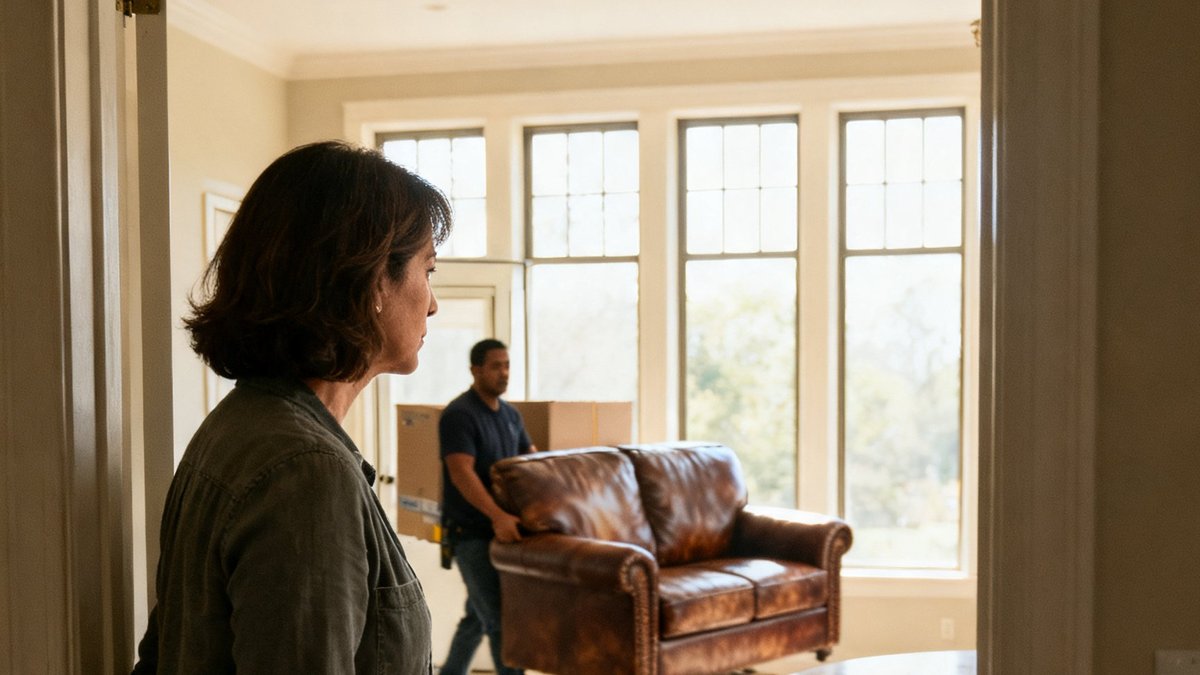
By nine, the crew was carrying out the leather sectional I'd bought at the West Elm outlet in Warwick. By ten, the dining table, the flat-screens, the Cuisinart range Roberta bragged about to her book club. Room by room, the house that had been "a real home for a real family" emptied out onto a truck idling on the street, exhaust curling into the August heat while a neighbor's dog barked itself hoarse two doors down.
I watched Roberta's face lose its certainty piece by piece as each room echoed a little more.
But the thing that actually broke her composure wasn't the furniture. It was the envelope I left on the bare dining room floor, Daniel's name written across the front in my own handwriting, sitting there like it had nowhere else to be.
Roberta picked it up before Daniel even got home from work. I know because Denise had a courier drop a second copy at Daniel's office that same afternoon—I wasn't about to let a piece of paper wander through Roberta's hands first and get "misplaced." Inside was the deed, showing my name as sixty percent owner, a payment history from Fidelity Bank going back five years showing every mortgage transfer, and a formal notice: as of that date, I was terminating my financial contribution to the property. If Daniel and Roberta wanted to remain in the house, the $9,800 monthly payment—now, technically, rent on my equity share—was theirs to cover, in full, starting the first of September.
Daniel called me eleven times that evening. I let it ring. Around nine, he showed up at the extended-stay hotel off Route 95 where I was staying, still in his work boots, and stood in the parking lot under a flickering sodium light saying my name like it was an apology.
"Sarah, come on. Nobody's really moving Marisol in. It's not—it's not what you think."
"I don't think anything, Daniel," I said. "I know. Your mother told me herself, sitting at that table, smiling."
He didn't have an answer for that. Men rarely do when their mothers have already said the quiet part out loud.
I didn't go back. Denise filed for a legal separation two weeks later, with the marital property division already mapped out in black and white, because I'd never let my name come off that deed no matter how many times Daniel joked I was being "paranoid." Roberta and Daniel stayed in the brownstone exactly nine more days before the first mortgage notice came due and neither of them could cover it. Cole, for what it's worth, texted me the week after everything came out. Just three words: *I know, Sarah.* Then a second message: *Thank you for staying as long as you did.* I read that one twice, standing in a Providence parking lot holding a box of my own kitchen knives, and put my phone back in my coat pocket without answering right away.
I closed on a two-bedroom condo near Fox Point in October, paid in full from money I'd quietly kept in a separate account for four years, ever since the first time Roberta told me I'd never really be part of this family. Priya sends me pictures of the baby now, a girl named Asha, born the first week of November. Roberta isn't in any of them. I didn't ask why, and Priya didn't offer.
The dining table's still empty in that Providence brownstone, last I heard from a neighbor who kept in touch. Nobody's replaced it. I think about that sometimes—not with satisfaction, just as a fact, the way you'd note that a light stayed on in a house long after everyone left. I bought a new table for my own place instead. Round, seats four, room enough to grow if it ever needs to.





