The antiseptic sting of the hospital room always hit her first, cutting right through the fog of medication. Chloe stared at a water stain on the ceiling tile, shaped vaguely like Florida. Her phone buzzed against the plastic tray table, rattling the little paper cup of lukewarm apple juice.
Patricia.
Chloe’s fingers, still bruised from the IV, fumbled for the phone. She swiped to answer.
“Oh, so you are alive,” her mother’s voice sliced through the speaker, loud enough to make the woman in the next bed stir. “I’ve called three times. I was about to send your brother over with a spare key and a bad attitude.”
“Mom, I texted Brandon to tell you. I’m in the hospital. It’s a post-op infection. They’re worried about sepsis.”
Silence for a beat. Then a sharp, dismissive laugh.
“Sepsis. Please.” Chloe could picture her mother in the kitchen of that big, dusty house in Mesa, probably polishing the same silverware she’d polished for thirty years, as if a single water spot would unravel the universe. “On a scale of one to your drama queen phase, this is a ten. You picked a hell of a weekend to take a vacation. Do you know how many people are coming to the Founder’s Day barbecue? Forty-seven. I’ve got forty-seven confirmed RSVPs and the brisket isn’t going to smoke itself.”
“Mom, listen to me.” Chloe’s voice was a raw whisper. “I have a drainage tube in my side. There’s a literal tube draining fluid from my abdomen.”
“I did not raise a quitter. Your brother drove in from Tucson. Your sister-in-law is already here peeling potatoes with a hangnail. Get yourself discharged and get here. You can rest on the guest bed. I’ll put the good sheets down. The ones with the embroidery.” Her tone shifted, dripping with that familiar, sweet venom. “Family helps family, Chloe. Or have you finally decided you’re too good for us?”
The line went dead. Chloe let the phone slip onto the thin hospital blanket. She looked at the bag hanging next to her bed, the translucent tube snaking under her gown, and felt a single, hot tear trace a path into her ear.
The next morning, the hospital room filled with the low rumble of her husband Brandon’s voice. He handed a sippy cup to their four-year-old, Leo, while their two-year-old, Maya, was strapped to his chest in a carrier, drooling on his shoulder. He looked like a man who’d fought a small, adorable war and lost.
His phone rang. Chloe saw the caller ID. Patricia.
“Don’t answer it,” she croaked.
“I have to.” He set Leo down and stepped toward the window. “Hello, Mrs. Vance… Yes, she’s stable. The doctor said—”
Brandon listened, his jaw tightening. He had the patience of a granite cliff, this man. He’d once spent six hours untangling a knot in a gold chain for her without a single sigh. But even cliffs cracked.
“No, I can’t leave them,” he said, his voice low but firm. “Leo has a double ear infection now, and I’m not putting a toddler and an infant in a car for four hours while Chloe’s on a vancomycin drip.”
His mother-in-law’s voice was a frantic buzz in the receiver.
“I have an idea,” Brandon said, running a free hand through his unwashed hair. “What if you come here? You can watch the kids in the waiting room, or hell, I’ll get you a hotel suite with a pool. Something with a concierge. I’ll drive to Mesa myself, fire up your smoker, and cook the brisket for your guests. All of it. You just have to sit with the kids. Two hours. Three, tops.”
He looked at Chloe, offering a tiny, hopeful shrug.
The buzz in the receiver turned sharp. Chloe could hear every poisonous syllable.
“So you want me,” Patricia’s voice echoed in the sterile room, “to sit in a waiting room with sick children so you can play hero and burn my meat? I am the host, Brandon. This is my house. These are my friends. I am not a babysitter. That is not my job. My job is to make sure this event happens. And your job is to chop ten pounds of coleslaw before noon on Saturday. Understand? Or don’t bother coming ever again. And you can tell my daughter she can pay full price for the holiday tamales. Fifteen dollars a dozen. I’m not running a charity.”
Brandon opened his mouth, but the call had already ended.
Chloe watched the color drain from his face. The man had offered to drive two hundred miles to cook a brisket for forty-seven strangers while his wife lay in a hospital bed, and he’d been called a failure for not bringing a coleslaw knife.
Something inside Chloe’s chest, something deeper and harder than a surgical wound, shifted permanently.
Discharge day was a Tuesday. The Arizona sun was a cruel, white hammer. Chloe emerged from the hospital in a wheelchair, her body thirty pounds lighter and her spirit stripped of every illusion she’d ever nursed about maternal unconditional love. Brandon got the kids settled with a neighbor—a retired nurse with a gentle laugh and a yappy Dachshund named Peanut—and they drove home in a silence that wasn’t awkward, but transactional. Processing.
Two days later, Patricia called.
“I’ve finalized the numbers,” her mother announced, as if discussing a hostile corporate merger. “The brisket was a disaster, by the way. I had to serve pulled pork. But the tamales. I posted the price on the family group chat. Since you two didn’t chip in, you can place your order for the holidays now. I’m freezing them. It’s first come, first served.”
Chloe sat in her own kitchen, a cool, quiet space she’d painted a pale sage green to exorcise the ghosts of her childhood. Her mother’s house had a yellow kitchen. Cracked linoleum. The smell of Pine-Sol and fury. Sometimes, late at night, Chloe remembered her father standing in that kitchen doorway, keys in hand, looking at Patricia with an expression she hadn’t understood until she was thirty—the slack face of a man who’d stopped hoping for a different wife. He’d left when Chloe was twelve, and the only thing he’d taken was his toolbox and the photograph of Chloe on her first bicycle. She hadn’t blamed him then. She understood him now.
She took a sip of herbal tea, feeling the heat soothe her throat. “Mom,” she said, and her voice sounded like a stranger’s. Calm. Solid. “I’m not buying your tamales.”
A pause. “What do you mean you’re not buying them? What are you going to eat, takeout? You can’t feed my grandchildren garbage.”
“We ordered from Lupita’s Cantina. The place on Dobson Road? She’s doing a catering pack for us. Tamales, enchiladas, pozole. All of it. It cost me less than what you’re charging, and she didn’t once ask me to chop an onion while I had a fever.”
“How dare you,” Patricia hissed. “After all those summers I spent canning salsa. After the hundreds of dollars I spent on your quinceañera dress!”
“You’re right,” Chloe said. “You did those things. And you’ve been leveraging them for twenty years. This is your final payment. I’m emotionally paid in full.” She didn’t slam the phone down. She pressed the red button gently, as if laying a sleeping infant in a crib.
The spring that followed was a quiet, careful reconstruction. The silence from her mother was a kind of brutal gift. Without the crushing, obligatory weekends at the Mesa house—painting the porch, weeding the gravel, repairing the swamp cooler for the fifth time—Brandon and Chloe thrived. He finished his master electrician certification. Chloe, who had always quilted to quiet her mind, started an Etsy shop that turned into a full-blown studio in their basement.
Five years can change your breath. It changes how you wake up in the morning. The Vance family sold their starter home and used the equity to buy a small plot of land near Sedona. Brandon built a workshop with a view of the red rocks. Chloe planted a garden that was pure vanity—lavender, sunflowers, a climbing rose bush she’d bought as a bare-root stick and nursed through three brutal summers. It finally rewarded her with five blooms the fourth year. No vegetables. No crops. Just beauty.
They heard the stories through the grapevine. Her sister-in-law had stopped visiting after an incident involving a ruined Christmas ham and a screaming match in the driveway. The helpers Patricia recruited from her church group lasted a single season before they fled from the micromanaging tyranny. Her house had fallen into disrepair, the swamp cooler finally giving out for good.
It was a brilliant October Sunday when they heard the knocking on their new front door. A frantic, imperious clattering.
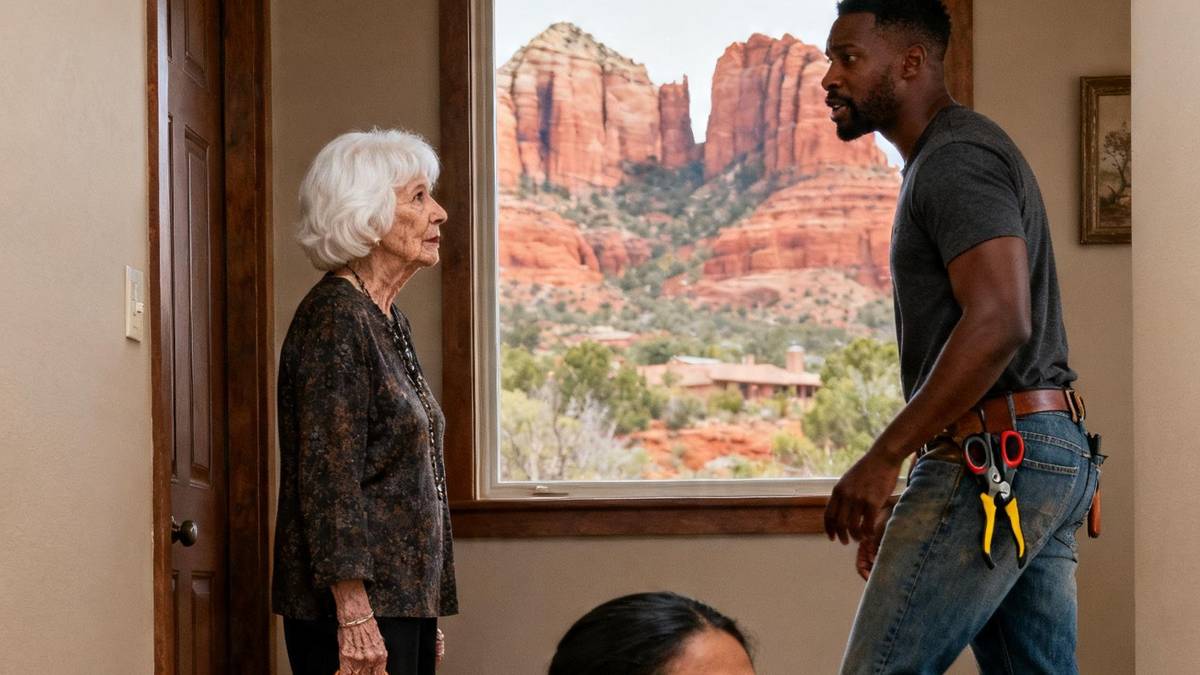
Brandon opened it. Patricia stood on the welcome mat, thinner, the skin on her arms loose. She had aged sharply—her hair a stark white, her knuckles knobbed and arthritic. Her eyes scanned the foyer over his shoulder like a building inspector from hell. She pushed past him without a word.
“Oak floors,” she muttered. “High ceilings. You’ve done very well for a couple who forgot they had a mother.” Her eyes landed on Chloe, who had come down the stairs in paint-splattered overalls. “I’m here to do my inventory. The guest room with the red rock view—is that the one on the left? I’ll need new blackout curtains. My eyes are sensitive now.”
“What inventory, Mom?” Chloe’s voice was calm, but her hand tightened on the wooden banister.
“For my things. I can’t live in that house anymore. It’s a tomb. The swamp cooler gave out for good last summer, and I won’t spend another August in a hundred-and-ten-degree kitchen.” Patricia’s gaze swept the high ceilings again, and for a fraction of a second, something flickered behind the command—a tremor, almost a flinch. She recovered instantly. “I’m moving in here. The ground floor is too drafty. I’ll take the suite upstairs. Brandon can carry my cedar chest up by tonight. We’ll discuss a monthly allowance for my medications and a little thank-you money. I gave you my best years.”
Brandon stepped back, looking from his wife to his mother-in-law. He’d been trimming dead canes off the rose bush before the knock; he still had the pruning shears hooked on his belt. He set them on the entryway table.
“Mom,” Chloe said, and she didn’t move from the stairs. “You are not stepping foot into another room of this house.”
Patricia’s eyes narrowed. “I am your mother. I raised you. You owe me dignity and shelter in my old age.”
Chloe walked down the last two steps until she stood face-to-face with the woman who had once told her to walk off a broken wrist.
“You called me a liar when I had poison running through my blood,” Chloe said, her voice as low and steady as a heartbeat. “You tried to sell me holiday food while I was in recovery. You called my husband a failure for not abandoning his sick children to chop your vegetables. That was the moment I stopped being your daughter. I just didn’t know the word for it yet.”
Patricia’s mouth fell open, aghast. “I will call the church. I will tell everyone… I will tell them you put your mother on the street!”
“Tell them whatever you want,” Chloe said. “You’re not coming in.”
“Brandon! Do something! She’s hysterical.” Patricia’s voice cracked, rising to a desperate trill. But beneath the outrage, a thread of something smaller—bewilderment, maybe, or the slow-motion recognition that the lever she’d pulled for forty years had finally snapped clean.
Brandon looked at Chloe, then back at Patricia. He shook his head. “I’m chopping vegetables at my own table tonight, Mrs. Vance. The door is behind you.”
Patricia stood frozen for three heartbeats, and in that gap her face did something Chloe had never witnessed before: it went blank. Not furious. Not scheming. Just empty, as if the machinery inside had seized. She spoke without the edge, almost to herself. “I don’t understand you. I really don’t.”
Then the mask snapped back. She spun on her heel, cursing them, cursing the house, cursing the red rocks in the distance. She slammed the car door so hard the sound echoed off the canyon wall, and the old sedan’s engine whined as she disappeared down the gravel road, leaving a ghost of red dust hanging in the air.
Chloe walked onto the porch, the planks still warm from the sun. She didn’t watch the car retreat. Instead, she leaned on the railing and let the silence settle. The rose bush stood to her left—five blooms, deep crimson, the petals edged with a faint brown curl from the dry heat. She’d need to water it tonight.
Brandon came up beside her, his pruning shears back in hand. “You okay?”
She didn’t answer right away. She was thinking about yellow kitchens and Pine-Sol and the sound of her father’s truck pulling out of the gravel drive all those years ago. Then she looked at the sage green wall visible through the living room window, the quilt studio door propped open downstairs, the sound of Leo’s bare feet padding across the oak floor.
“Yeah,” she said. “I think I am.”





