The day I bought my house in Albuquerque, the first thing I noticed was the dirt. Not the cracked driveway or the porch light dangling by one wire. The dirt. It was the color of a paper bag left in the sun too long, and nothing lived in it except a single tumbleweed wedged against the back fence like it had given up halfway through an escape. I stood there in 103-degree heat, holding the keys the realtor had handed me twenty minutes earlier, and thought: I’m going to plant something stupid.
Not vegetables. Not a responsible xeriscape with decorative gravel. Something ridiculous. Something that had no business surviving in high desert clay.
Sunflowers.
The seed packet at the hardware store cost two dollars and showed a bloom the size of a dinner plate. The cashier, a woman named Gloria with turquoise rings on every finger, rang it up and said, “You know those get fifteen feet tall.”
“Good,” I said. I had just turned forty-seven. My ex-husband had taken the house in Santa Fe, the good car, and the dog. I got the Albuquerque fixer-upper and whatever I decided to plant in it.
I dug a trench along the back fence in April, which in New Mexico means the ground fights back. The shovel bounced off caliche—that cement-like layer of calcium carbonate that sits under topsoil out here waiting to ruin your afternoon. I had to soak the dirt with a hose for an hour before I could break through. My new neighbor, Mrs. Delgado, watched from her patio with an iced tea in hand.
“You’re either very optimistic or you’re from somewhere else,” she called over.
“Oklahoma originally.”
“That explains it. You still believe in rain.”
The sprouts appeared two weeks later, pale green and fragile. I checked them every morning before work like a nervous parent. I talked to them, which I’m embarrassed to admit, but my therapist had said I needed something to care about that wasn’t my divorce decree. One stalk. Three stalks. Then the whole row.
By June they’d cleared the fence. By July they were taller than me, thick as baseball bats, with heads the color of egg yolks beginning to unfurl.
The first strangers to stop were twin boys on scooters. They hit their brakes so hard one of them nearly went over the handlebars.
“Whoa,” the taller one said. “Are those real?”
I was in the front yard wrestling with a sprinkler head. “Last I checked.”
“They’re bigger than our trampoline.”
Their mom caught up, pushing a jogging stroller, out of breath. She looked at the flowers, then at me. “My mother used to grow these. Back in Chihuahua. She’d roast the seeds with salt and lime.” Her voice cracked a little. “I haven’t thought about that in years.”
I cut one for her with my pocket knife. She carried it home like it was made of glass.
That evening I found a grocery bag tied to my front gate. Inside: a jar of roasted sunflower seeds with lime and chile, still warm, and a note: *Gracias. Mamá would’ve loved your fence.*
—
The notes started showing up after that. Tucked under the windshield wiper of my truck. Wedged into the mailbox. Once, someone had written *Your flowers stopped my panic attack on Tuesday* on a receipt and left it under a rock by the sidewalk. I kept every single one in a shoebox under my bed. I don’t know why. It felt like evidence of something.
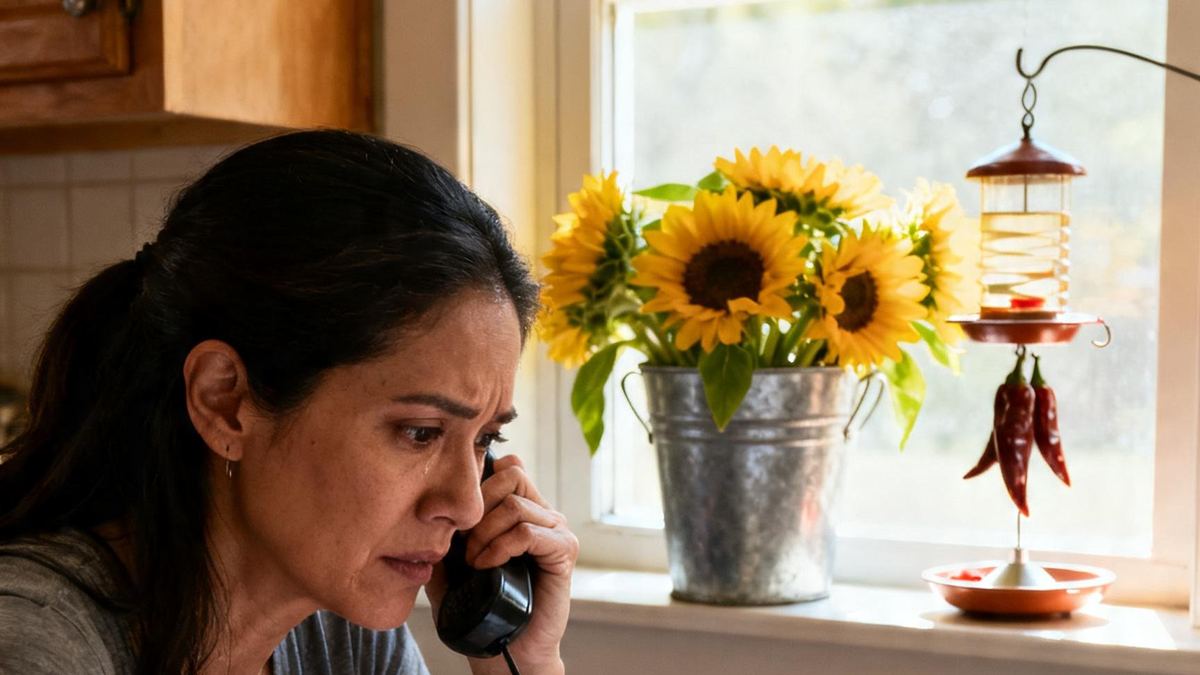
Mrs. Delgado contributed a hummingbird feeder shaped like a chili pepper. “Found it at a yard sale,” she said, handing it over the fence. “Figured if we’re doing this, we’re doing it right.”
Within days the yard was full of movement. Goldfinches. Sphinx moths the size of my thumb. Bees working the blooms so methodically you could almost hear them humming along to some internal radio. My ex-husband had hated mess. He edged the lawn with a ruler. He measured the hedge with a level. This—the chaos of living things doing whatever they wanted—would have driven him nuts. I liked that more than I cared to admit.
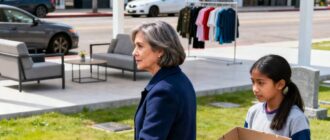
By late July I started setting out a galvanized bucket of cut sunflowers on Saturday mornings with a piece of cardboard that said: *FREE. TAKE ONE. OR DON’T. I’M NOT YOUR MOM.*
A teenager in a Smith’s uniform grabbed one before his shift. A mail carrier tucked one into the side pocket of her bag. An elderly man in a bolo tie selected the smallest bloom, nodded at me once, and walked away without a word. The bucket emptied within hours, every time.
Then the seeds appeared.
Someone left three packets of blue cornflower seeds in the empty bucket. Then a plastic baggie of hollyhock seeds with a rubber band around it. Then an entire unopened bag of potting soil. A terra cotta pot. A trowel. A handwritten note: *Thought we could help more gardens grow. –The Martinez Family, three doors down.*
I didn’t know the Martinezes. I’d lived here six months and still didn’t know half the street. But I put out a second bucket with a fresh sign: *SEED SWAP. LEAVE SOME, TAKE SOME. NO RULES.*
Two days later, Mrs. Delgado knocked on my door holding a squash the size of a newborn baby.
“From Rosa across the street,” she said. “She used your zucchini seeds.”
“I didn’t give her zucchini seeds.”
“Someone did. Now she wants to know if you like calabacitas.”
By August the block had changed. Lawns I’d never seen anyone use suddenly had tomato cages. The duplex on the corner sprouted a window box of marigolds. The retired firefighter three houses down built a raised bed out of old railroad ties and filled it with sunflowers of his own—shorter, stockier, a different variety, but still yellow.
Late in the month the neighborhood association announced a garden walk. I almost didn’t go. My yard was just dirt and giant flowers and a bucket I’d found at a garage sale. No landscaping. No design. Half my drip line was held together with duct tape. But Mrs. Delgado showed up at my door in a sundress and said, “They’re coming to see the sunflowers. Put on something that isn’t covered in dirt.”
Fifty people walked through the neighborhood that Saturday. Some yards were meticulous—gravel paths raked into patterns, native cacti arranged by height, a koi pond that probably cost more than my truck. When they got to my place, a woman in a wide-brimmed hat stopped dead in the middle of the sidewalk.
“This is it,” she said. “This is the one from the posts.”
“Posts?”
“People put pictures online. The bucket, the seeds, all of it.”
I didn’t know about the posts. I don’t have social media.
At the end of the walk, the organizers handed out little paper certificates made from craft-store cardstock. They weren’t serious awards. COOLEST CACTUS. MOST CREATIVE TRELLIS. NEIGHBORHOOD HEART AWARD.
Mine said: THE SUNSHINE BLOCK.
I squinted at it. “This isn’t an award. This is just a description of a block.”
The organizer, a woman named Irene who ran the book club on Thayer Street, shrugged. “We ran out of categories. But every person who stopped here smiled. That counts for something.”
I taped it to the refrigerator anyway.
—
Now here’s where I need to tell you about something less pleasant.
My ex-husband, Dan, heard about the flowers from his sister, who still lives in town and apparently drives past my house on her way to work. Dan and I hadn’t spoken in eight months. The divorce was final. The paperwork was done. I thought we were through.
The email arrived on a Tuesday morning in September. Subject line: *Property improvement.*
The gist was this: since the sunflowers had increased the “curb appeal” of the house—his words—and since I’d made “unauthorized aesthetic improvements” during the divorce proceedings, he felt entitled to a reassessment of the settlement. He’d run the numbers. The original appraisal was $215,000. A comparable property two streets over had just sold for $237,000. He attributed the entire difference to my sunflowers and was formally requesting a $11,000 adjustment.
Eleven thousand dollars. Because I’d planted seeds.
I read the email sitting at my kitchen table, the bucket of cut sunflowers visible through the window, a goldfinch balanced on the bird feeder Mrs. Delgado had given me. I read it three times. Then I called my lawyer.
My lawyer is a woman named Patricia Okonkwo who does not waste words. She listened to me explain the situation. There was a long pause.
“So he wants you to pay him for flowers you planted with your own hands on your own property after the divorce was final.”
“That’s what he’s arguing.”
Another pause. I could hear her tapping a pen. “This is the man who kept the Subaru.”
“Yes.”
“And the Labrador.”
“Yes.”
“Eleven thousand dollars,” she said, not as a question.
“Yes.”
“I’ll draft a response. Don’t reply to him. Don’t call him. Do not, under any circumstances, say anything.”
I didn’t. I sat in my kitchen, furious and terrified, because Dan had always been good at this—at finding the one thing I cared about and turning it into a weapon. He’d done it with my pottery when we were married, suggesting I “focus my energy on something more practical.” He’d done it with my friends, slowly convincing me they weren’t good for me. He’d done it with my confidence, one small cut at a time, until I didn’t recognize myself.
And now he was doing it with my sunflowers.
That Saturday, I didn’t put out the bucket.
Sunday, Mrs. Delgado texted: *You okay? No flowers this weekend.*
I didn’t answer.
Monday, the little twins on scooters stopped in front of my house. The shorter one cupped his hands around his mouth. “Hey, Sunflower Lady! You out of flowers?”
I waved from the window and didn’t go outside.
Tuesday, Irene from the neighborhood association left a voicemail. A local news station wanted to do a segment on the seed exchange. The community garden at the elementary school had been inspired by it. The teachers were calling it the Sunflower Project.
I listened to the message three times. Then I called Patricia.
“Is he going to win this?”
“He has no case,” she said. “But he can make it expensive to fight.”
“How expensive?”
“A few thousand in legal fees, maybe more if he drags it out. He’s betting you’ll settle to avoid the cost.”
I looked out the window. The sunflowers were starting to fade. Petals drooped, brown at the edges. The seed heads were heavy, bending the stalks toward the ground. Birds pecked at them, scattering hulls onto the dirt.
“Let him drag it out,” I said.
—
The hearing was in October. Dan showed up in the suit I’d bought him for his brother’s wedding, the charcoal one with the subtle stripe. He’d lost weight. Or maybe I was just seeing him differently. He smiled at me in the hallway outside the conference room—that same smile he used to give me when he was about to explain why I was wrong about something.
“This doesn’t have to be difficult,” he said.
I walked past him without answering.
Patricia had prepared a binder. I’d never seen a binder that thick for a settlement dispute. Inside: photographs of the yard before I’d planted anything, dated from the inspection report. Photographs after. Receipts for seed packets—forty-seven dollars total over six months, including the cornflowers and the hollyhocks I never planted because someone else took them home. Statements from neighbors. Screenshots of the online posts I’d never seen. The certificate from the garden walk that said THE SUNSHINE BLOCK.
And documentation of the seed exchange. Not my documentation—theirs. The Martinez family had kept a log. Forty-three families had participated. Over two hundred seed packets had changed hands. The elementary school garden had produced enough vegetables to donate eighty pounds of produce to the Roadrunner Food Bank.
Patricia laid all of this out for the mediator, a tired-looking woman in her sixties who’d clearly seen every version of post-divorce pettiness the state of New Mexico could produce.
“My client planted sunflowers,” Patricia said. “Her neighbors, independently and without her direction, began a community seed exchange. The increase in neighborhood property values—if any—cannot be attributed solely to my client’s actions, nor can my client be penalized for the spontaneous goodwill of other people.”
Dan’s lawyer, a young man with an expensive haircut and a weak argument, tried to pivot. “The fact remains that the property is demonstrably more valuable now than at the time of the divorce settlement.”
“Correct,” Patricia said. “And that value was created by my client’s labor *after* the divorce was final. If Mr. Reeves wishes to claim a share of post-divorce labor, we’re happy to discuss his share of the mortgage payments my client has made alone, the cost of the roof repair she funded in May, or the four thousand dollars she spent replacing the water heater he left her with.”
Dan’s lawyer didn’t have a response to that.
The mediator closed her folder. “I’m going to recommend the petition be dismissed. Mr. Reeves, I understand tensions run high during these proceedings, but this is not what the court is for.”
Dan’s smile was gone. He looked at me across the table, and for the first time since I’d known him, he had nothing to say.
I didn’t smile back. I didn’t need to. I just picked up my purse, nodded at Patricia, and walked out into the Albuquerque sun.
—
That Saturday, I put the bucket back out.
Not just the bucket. I’d spent Friday night packaging every sunflower seed I’d harvested from the dried heads—hundreds of them—into little brown envelopes. On each one I wrote: *See you in the spring. Plant them somewhere that needs yellow.*
By noon the bucket was empty. By evening, Mrs. Delgado had hung a string of solar lights along our shared fence. Rosa from across the street brought over a pan of calabacitas, finally. The twins on scooters stopped by to ask if they could help plant next year.
“You’ll have to come early,” I told them. “I start in April.”
“We’ll be here,” the taller one said. “We’re professionals now.”
In November, Dan emailed once more. Short. *Fine. Keep the flowers.* I forwarded it to Patricia, who replied with a single word: *Frameworthy.*
I didn’t frame it. I put it in the shoebox with all the notes from strangers—the one about the panic attack, the one from the woman who missed her mother’s garden in Chihuahua, the one from the kid who carried a sunflower “all the way home.” That felt like the right place for it. One more small thing that had tried to stop something larger and failed.
The following April, the first sprouts appeared. Mine, along the back fence, pale green pushing through the caliche I’d learned how to work. But also: the Martinezes’ front yard. The retired firefighter’s raised bed. The duplex on the corner. Three pots on the elementary school playground. A narrow strip beside the bus stop on Central Avenue. A planter box outside the Smith’s where the teenager in uniform still worked.
By July the whole neighborhood was yellow. Not just my block. The next block over. And the one after that. Someone had started calling it the Sunflower District on the online posts I still didn’t read. Irene from the association told me about it while we stood in my yard, watching goldfinches work the new blooms.
“You know Dan lives in a gated community now,” she said. “Santa Fe. Very strict HOA. They don’t allow anything over four feet tall.”
I looked at my sunflowers—fourteen feet if they were an inch, swaying in the hot desert breeze, full of birds and bees and the noise of living things.
“That’s a shame,” I said.