It was exactly 7:14 a.m. when the pain tore through Lila’s side so hard she nearly bit through her lip. She was thirty-four weeks pregnant, alone in a two-story rental on the outskirts of Flagstaff, Arizona, and for a split second the world reduced to a white-hot cramp that bent her over the kitchen counter. Her husband Jake had flown to Portland the night before for a supplier summit. The only other living thing in the house—a three-year-old Doberman named Diesel—shot up from his spot on the tile, toenails clicking fast. The oatmeal Lila had been stirring was now boiling over, the lid rattling, a milky puddle spreading onto the burner.
Diesel had been her shadow for the entire pregnancy. He’d abandoned his own dog bed months ago to sleep on the unforgiving floor beside her side of the mattress, and every time the baby kicked, his stub of a tail went into overdrive. Now, as Lila gasped and grabbed the edge of the sink, he pressed his lean body against her legs and let out a low, worried whine. The cuffs of Jake’s old NAU sweatshirt—the one she’d stolen five years ago and never given back—were frayed against her knuckles.
She fumbled her phone, thumb slipping on a hairline crack that ran across the screen from a drop in the driveway, and called 911. *Please don’t be born in a kitchen. Please don’t be born with oatmeal all over the floor.* The dispatcher asked if she could walk; she laughed, a strangled sound, and said, “I can’t even stand.” Then she dropped the phone on the counter and it almost slid into the oatmeal puddle, and she thought, *Jake better be watching some stupid in-flight movie about a talking car while I’m about to have this kid in an ambulance.* The ambulance arrived eleven minutes later. Diesel blocked the doorway, ears flat, hind legs rigid, watching the two paramedics as if they were breaking and entering. The lead medic—a broad man with an eagle tattoo on his forearm—took one look and said, “That dog’s wound tight. He can ride with us if he lets us through.”
And so Diesel rode in the back of the ambulance, his muzzle resting on the edge of the gurney, his dark eyes never leaving her face. Out the small window, the San Francisco Peaks still carried a dusting of late-autumn snow. Lila’s mind kept snagging on the oatmeal. *It’ll be charcoal by the time Jake gets back. The whole house is going to smell like a burned-down bakery, and I’ll have to scrape the pot for a week.* The pain came in waves, and between them she almost wanted to laugh at how mundane things like a ruined breakfast could still wedge themselves in.
At Flagstaff Medical Center, a whiteboard near the nurses’ station read OLSEN, L. — 34 WKS when they wheeled her into a room on the third floor. A monitor beeped in a steady rhythm. A nurse with a lanyard full of tiny enamel cat pins hung an IV, drew three vials of blood, and attached a fetal monitor. The sharp cramps had dulled, leaving an ache that settled deep and low and made her grip the bed rail until her knuckles went white. She asked if Diesel could stay, at least until the test results came back. The nurse bit her lip, eyeing the dog who stood rigid as poured concrete, and said, “Fifteen minutes. He so much as snags a cord, he’s out.”
Diesel settled onto the cold floor next to the bed like a statue. Only his nostrils moved, flaring with every new scent that drifted through the ventilation. Lila ran a hand over his head and thought, *This dog is better at his job than I am at mine, and I don’t even know what my job is right now except not panicking.* She was acutely aware of the seventy-pound animal, of the way every muscle in his body seemed to be listening.
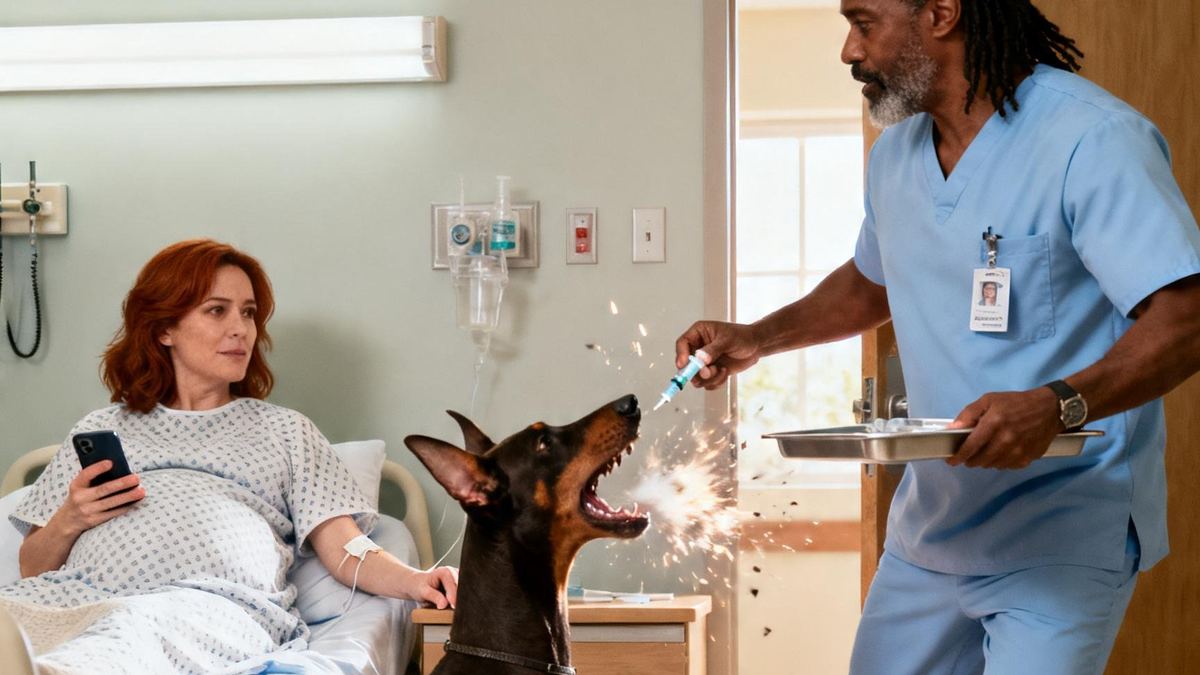
Around nine-thirty, the door swung open without a knock. A man in pale blue scrubs walked in holding a stainless-steel tray with a syringe, a small vial, and an alcohol swab. His hair was too long for regulation, and the badge clipped to his pocket was flipped backward so the name and photo were hidden.
“Mrs. Olsen, I’m Dr. Bantam. We’re going to give you something to calm the uterine muscle. Should take the edge off. Just a small injection.”
He set the tray on the side table. The second his fingers left it, Diesel’s head came up. No growl—just a sudden stillness, ears swiveling forward, tracking the man’s every breath. Lila noticed and pressed her palm against the dog’s neck. “Hey, easy. It’s okay.”
Diesel ignored her completely.
The man uncapped the syringe. A thin bead of liquid glistened at the tip. He reached for the IV port, and that’s when Diesel exploded. He didn’t bark once as a warning—he launched himself from a flat-footed sit straight at the man’s chest, front paws driving into the scrub shirt as a barrage of snarling, full-throated barks seemed to shake the window. The tray skidded, the vial rolled and shattered on the linoleum, and the syringe spun under the bed.
“Get him off!” The man stumbled backward, hands up. His voice cracked—not the controlled tone of a startled doctor, but something thinner, wilder.
Two nurses burst in. One grabbed Diesel’s collar, but the Doberman had already dropped back to all fours, teeth bared, a continuous rumble rolling in his chest. He planted himself between the bed and the man and wouldn’t budge an inch. Lila’s heart hammered against the monitor straps; for an absurd instant she pictured a lawsuit, a news headline, *Flagstaff Woman’s Dog Mauls Doctor.* The baby kicked—hard, frantic jabs—and she had to bite down on her tongue to keep from shouting.
The nurse with the cat pins squinted at the man’s flipped badge. She tore it off his pocket, turned it over. The photo didn’t match. The name read “Carter, Terry — Facilities.” Her face went slack.
“Security. Right now.”
The man’s eyes darted to the door, and for three full seconds nobody breathed. The monitor kept beeping, oblivious. What followed was a scramble of Code Gray announcements and a hospital-wide lockdown. Two security officers pinned the man to the wall. The real OB on call—a grey-haired woman who had been in the middle of a C-section—arrived breathless and immediately ordered a tox screen on the syringe’s contents. The residue tested positive for succinylcholine, a paralytic agent that would have stopped Lila’s breathing within minutes. An anesthesia cart two doors away was found with its lock snapped. A 10-milliliter vial of succinylcholine was missing from its tray; the lot number matched the residue.
Lila lay there, shaking so hard the bed rails vibrated, and did the math in her head: ambulance, tox screen, probably an extra night on the monitor—the bill was going to be north of thirty grand, and a Doberman who charged a fake doctor definitely wasn’t covered by her insurance. She almost laughed. *Worth every penny.*
Later, the nurse with the cat pins came back to check her vitals and, while reattaching a lead, said in a low voice, “That man wasn’t a doctor. He’s a psych patient—walked off the ward three hours ago during the shift change. My supervisor just told me he’s got a fixation on childbirth. Last week he cornered a pregnant woman in the Safeway parking lot off Milton, screaming he needed to ‘save the baby.’ They committed him then, and this morning he just put on scrubs and wandered up here.” She shook her head, and one of the little enamel cats clinked against another. “Your dog probably saved your life.”
Lila couldn’t stop looking at Diesel, who had resumed his position on the floor, chin on his paws, as if he hadn’t just launched himself at a human being. The memory of those thirty seconds looped in her mind—seventy pounds of muscle and a wall of noise, and behind it, nothing but her own clammy hands and a baby battering against her ribs.
She stayed two more nights under observation. The pain turned out to be a false alarm—an irritable uterus, nothing dangerous. Jake arrived the next morning, his rental car still smelling of airport coffee, and she told him through tears that felt three days old. His face went grey. He didn’t say much, but when he saw Diesel he crouched down and pressed his forehead against the dog’s and didn’t move for a full minute. The hospital statement came a month later: $34,715.32. The line item for canine intervention, Lila noted, was nowhere to be found.
Six weeks later, on a snowy Tuesday afternoon, she gave birth to a boy they named Leo. Diesel sat outside the delivery room the entire time, and when Jake carried the baby out, the Doberman stretched his neck, sniffed the bundle once, twice, then lowered himself onto the floor, chin on his paws, tail sweeping the linoleum. Jake crouched, one hand on the baby carrier, the other finding the thick fur behind Diesel’s ears.
“You know,” he said, “I priced out those guard dog training courses last week. Three grand. I think we can skip it.”
Lila laughed, and the baby started in his carrier. As the orderly wheeled her toward the elevator, Diesel walked alongside, and when the doors slid open he stepped in first, turned around, and sat facing the opening like a sentry. The orderly, a lanky guy with a name badge that said “Dominguez,” tilted his head. “In fifteen years I’ve seen a lot of things on this floor, but a dog with a tactical formation? That’s a first.” He hit the button for the ground floor, and the elevator descended with a low hum, the three of them—four, counting Leo—and a Doberman who had apparently already clocked out for the day.