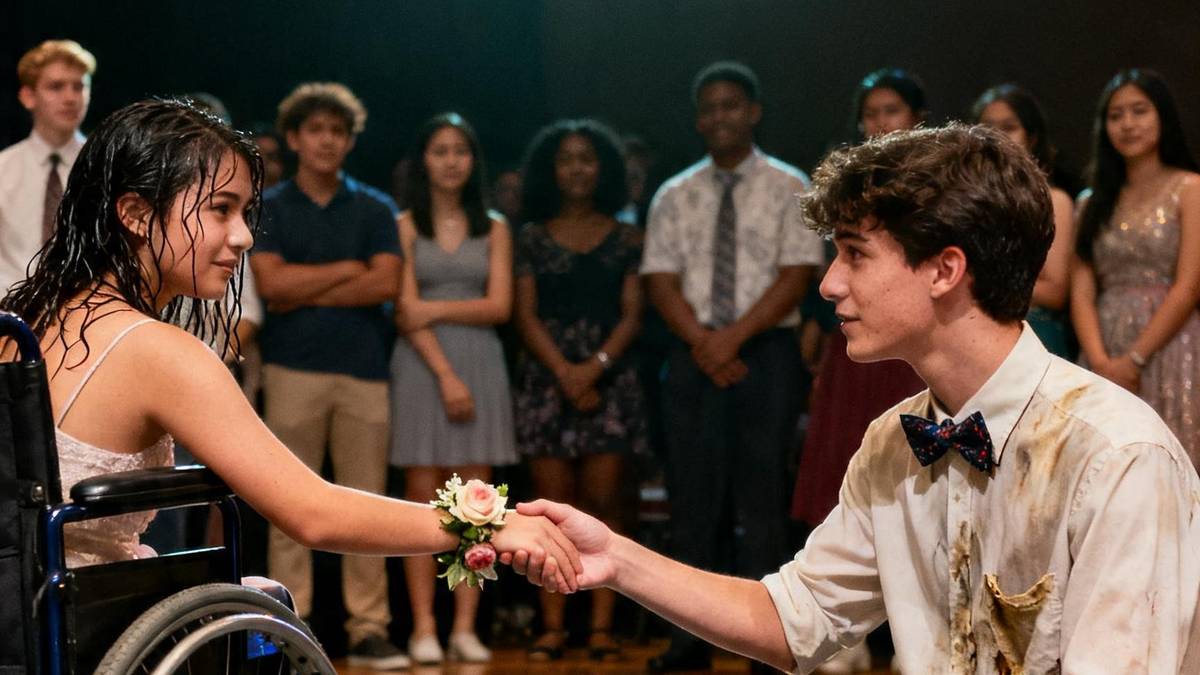
I got ninety dollars to run the follow spot at Telfair High's junior-senior prom. That's the only reason I was in the booth of the old railroad depot on River Street that Saturday night: ninety dollars, cash, no questions about why I knew how to wire a quad-box. I wasn't part of the drama. I wasn't even friends with any of the girls on court. But the booth sat right above the gift table and the side hallway, and a follow spot operator spends four hours watching every corner of a room whether he wants to or not. That's how I saw most of what happened. The rest got told to me straight, by people who were there.
I watched Payton Harwell's mother shove a cocktail napkin into Payton's hand behind the gift table. It had an address written in blue ballpoint. I recognized it: the old Dairy Queen on Ogeechee Road, windows boarded up, the ghost of a soft-serve swirl still fading on the sign. Eleven minutes past the Publix, past the house with the busted birdbath and the live oaks heavy with moss. I didn't think much of it. I had a light cue coming up and a niece's birthday party I'd skipped for this job.
Willa Reed should've been there by six. She was the reason Mr. Castor had the custodians lay a wide strip of silver gaffer tape straight through the middle of the dance floor — a clear lane for a wheelchair. She'd spent the spring in one after a wreck on I-16 in February. A jackknifed semi, a guardrail, six broken bones, and a spinal cord that didn't fully come back. At school she rolled into physics with a GoPro on the back of her chair and a mouth like she'd been born with coffee in her hand.
Emmett Cole was the reason she was supposed to dance. He'd said it in front of half the cafeteria, flat out: "I'm not walking across that floor with Payton. I asked Willa. I'll push her chair myself if I have to." Principal Hines said prom would be fully inclusive. The group number had been reblocked twice so no one would get hidden in the back. Emmett didn't flinch.
That made Payton flinch. She'd planned her whole spring around being on the court with Emmett — matching bow tie to her sequined dress, a mother who ran the PTA like a casino pit boss. I'd heard Krista Harwell in the parking lot after rehearsal, hauling a fog machine to the loading dock at the time: "You're the one who should be queen, not that girl." I should've said something. But again, ninety dollars.
By seven-forty, Willa still wasn't there. Emmett stood by the entrance with his phone out, thumb moving over the glass. He'd texted her nine times. The ninth one he showed to the DJ, who was already three sweet-tea-and-vodka cups deep. "She's not answering," Emmett said. "She told me she was leaving at five."
Prom went on like it was supposed to. The junior class took the floor for the group number, and the silver lane stayed empty. Everyone pretended not to see it. I kept the light on that empty space a little too long, enough that a woman from the school board looked up at the booth like I'd messed up on purpose.
At ten-thirteen, the music cut for the crowning. Payton got called first, and she took the steps in clear heels like she'd practiced in her bedroom mirror for weeks. Then Emmett's name. He walked up because he's not the type to ruin a party, but he kept looking at the front doors. Payton leaned into the microphone and said, right into the feedback: "I guess some people's mamas can't read a map." A few kids laughed. Most didn't.
Then the doors blew open.
Willa came in with her hair stuck to her neck, the blue hydrangea corsage on her wrist already wilted. Her mother followed, one hand on the back of the chair, the other gripping a cracked flip phone. They'd driven to the old Dairy Queen on Ogeechee, found nothing but a palmetto bug crawling across the rusted sign, and had to loop all the way back over the river behind a funeral procession. I was close enough to catch part of what Willa's mother said to Emmett: "Somebody gave me a bad address. It came in a text, said to meet round back by a blue door. There is no blue door out there."
Emmett's face changed in a way I can't describe. He didn't yell. He just reached up, took the gold-painted cardboard crown off his head, and tossed it to the runner-up, Marcus Okafor. Then he said into the mic: "That doesn't belong to me. The girl I asked just spent two hours in a shut-down Dairy Queen parking lot because somebody in this room thinks a wheelchair means she's invisible."
I didn't have to move the light. Every eye went on its own.
Payton's mother tried to ease toward the side exit. The emergency door had a brass strip along the bottom, and her left heel caught it. She tripped, kicked off the shoe, and left it there. Payton stood on stage with her mouth open, crown in her hands, while Marcus put on the one Emmett had thrown.
Emmett crossed the floor. The crowd split. He stopped in front of Willa, went down on one knee, and reached out his hand. "You still owe me a dance."
Willa didn't cry. She reached up and took his hand. "I don't owe you anything, Cole. But I've got nine texts that say you're a mess."
He stood and put one hand on the back of her chair. They moved to the center of the dance floor, where the DJ put on Etta James. The circle closed around them. It wasn't a show. It was the only honest thing that happened all night.
While they danced, Willa's mother caught up with Dr. Hines near the stage. She held out the flip phone, the message already up on the small gray screen. "It came from Krista Harwell's number," she said. "Look — it says come to the blue door out back, that she'd be watching. Sent at four thirty-two."
Dr. Hines took the phone and read it twice. Then he asked Willa's mother to wait right there and walked straight to where Payton still stood holding the crown. He held up the flip phone next to the napkin Payton was still gripping in her other hand — the one with the same Ogeechee Road address written in blue ballpoint, the one I'd watched Krista pass her hours earlier. Same address, two ways of sending it: one on paper for Payton to find, one by text to send the Reeds somewhere they'd never come back from in time.
He didn't wait for Monday. He called over the school resource officer, who was standing near the north door with a plate of shrimp and grits. He pointed at the side exit. Krista hadn't made it out. She was standing by the hydrangea buckets, barefoot, one shoe still on the floor.
That was the end of Payton's moment. She didn't get to keep the crown for long — Dr. Hines had the yearbook photographer pull the crowning shots from the school camera, not that it mattered. Forty-three seniors had already posted videos. Payton kept the title on paper, but her mother was off the PTA by Tuesday, and her prom committee badge got cut up in front of the front office desk.
Emmett and Willa danced for about four minutes. Then the floor filled up again. I killed the spotlight and ran the house lights at one in the morning.
I got home at two, peeled off my sneakers, and checked Venmo. Willa had sent me the ninety dollars I would've earned — with a note that said, "For letting me not be a story."
I sent it back.
Eleven years later, she and Emmett got married under those same live oaks by the river. She didn't carry a bouquet. She kept one hand resting on his forearm as he pushed her chair down the grass aisle, and they took their first dance with her wheel tracing a slow circle on the wooden platform the caterers had laid over the lawn just for that. The Harwells weren't on the guest list. Krista parked across the street anyway, and nobody went out to invite her in.