I've worked postpartum at a hospital in Tulsa, Oklahoma, for nine years, and I've stopped believing anyone who says a C-section is the easy way out. I clocked in that Tuesday at 6:45, grabbed my coffee from the break room where somebody had left a half-eaten box of Krispy Kreme donuts on the counter, and picked up my assignment sheet. Room 214, Dana Whitfield, thirty-one, emergency cesarean after eighteen hours of labor that went nowhere.
Her husband, Marcus, was asleep sideways in the vinyl recliner when I walked in, still wearing the hospital scrub top they hand out to partners, one sock on and one sock off. Dana was awake, propped at an angle that looked like it hurt just to look at, her hand resting flat on the incision like she was holding something in place.
"How's the pain, one to ten?"
"Six," she said. Then, quieter, "Maybe seven when I try to sit up."
I've learned to distrust that number by about two points. Moms downplay it because somebody told them, somewhere along the way, that a vaginal birth is the "real" one and a C-section is a shortcut, and now they feel like they don't get to complain. I've had women apologize to me for asking for more oxycodone. Apologize. For major abdominal surgery.
Her mother-in-law showed up at nine sharp, a woman named Pat in a Sooners sweatshirt, carrying a diaper bag she'd clearly already packed herself. She didn't hug Dana. She went straight to the bassinet, cooed at the baby, and said, over her shoulder, "You'll want to get up and walk today. My daughter did laps around the floor six hours after her C-section, she said it helped so much."
Dana's jaw tightened. She didn't argue. She just looked at the ceiling tile with the water stain shaped like Florida.
I've seen this exact scene maybe two hundred times with two hundred different mother-in-laws, and it's always dressed up as helpful advice. It's never actually about the baby. It's a scoreboard.
Around eleven, I came back to check the incision dressing and found Dana crying — not sobbing, just leaking, silent, one tear tracking sideways into her ear because she wouldn't turn her head to wipe it. Marcus was down the hall getting formula samples from the lactation cart. Pat had taken the baby to "give her a break," which meant Dana was alone in a bed with a six-inch staple line, no baby to hold, and nobody asking how she actually felt.
"Talk to me," I said, and pulled the blood pressure cuff off her arm slower than I needed to, buying us both a minute.
She told me the surgery had been forty minutes of the surgeon's hands inside her, moving her organs to get the baby out, and that nobody had prepared her for what it would feel like to be cut open and stitched shut in layers — fascia, muscle, skin — and then handed a form asking her to rate her pain on a scale that didn't have a number high enough. She told me Pat had said, in the hallway, loud enough to carry, that "real labor builds character a C-section skips."
I didn't say anything wise. I'm not there to fix families. I checked her dressing, I counted her pad output, I told her the incision looked clean and was healing exactly the way it should, and I left the room so she could have five minutes without an audience.
Two days later I had Dana again for my shift — a low-grade fever the first night had kept her admitted longer than average — and I was at her bedside doing the wound check myself when the rest of it happened right in front of me.
Pat came in that afternoon with the baby, and Marcus was already in the room, parked in the recliner with his laptop. Dana asked Pat to sit down. Not yelled. Just asked. I kept my eyes on the incision, counting staples, giving them the illusion of privacy that a shared hospital room never really provides.
"You can't keep coming Mondays and Thursdays," Dana said. "The overnight thing. It's off."
Pat's mouth opened. "I already told my book club I wouldn't be there Monday nights for—"
"Six weeks." Dana's voice cracked on the number, and she swallowed and said it again, flatter. "Six weeks. No visits after eight. That's — that's what he said." She meant the surgeon, and didn't bother finishing the sentence.
"I raised three children, I think I know—"
"You didn't have this." Dana's hand came off the blanket and pressed flat against her own gown, right over the dressing I was taping down. "You didn't have — Pat, I have a hole in my stomach. An actual hole. Somebody's hands were inside me. So the laps thing, the bouncing back thing — I don't want to hear it. Not till you've had one of these." She tapped her own belly, twice, hard enough that I almost told her to stop.
Pat looked at Marcus like she expected him to step in and soften it. He didn't look up from the diaper he was changing on the foot of the bed. "That's the plan, Mom."
I finished my count — staples intact, no drainage, site clean — and reached for my chart, more slowly than I needed to.
Dana held her hand out for Marcus's phone. He gave it to her without a word, and she pulled up something on the screen, typed for a second, thumb shaking a little, and passed it back to him. "Send her the after-visit summary. The screenshot. All of it — the lifting thing, the six weeks, all of it."
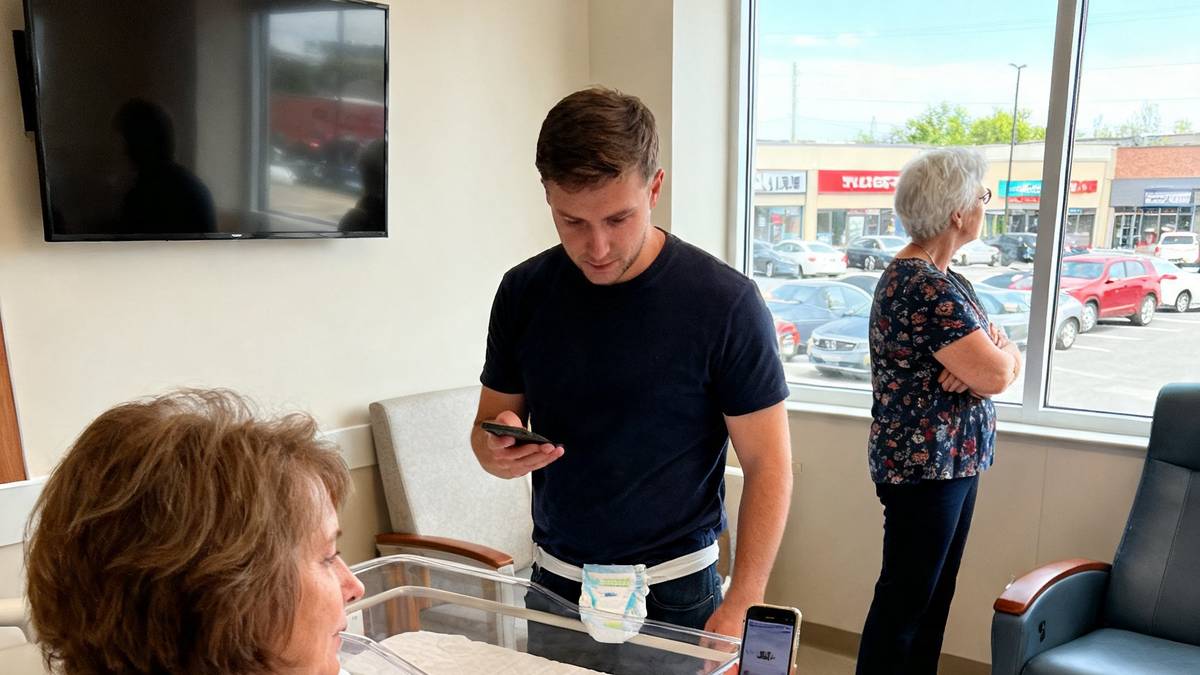
I watched Pat's phone buzz in the diaper bag pocket where she'd tucked it. She didn't take it out. She stood by the window with her arms crossed, looking at the parking lot, and after a minute she picked up her purse and said she had to get back, she had things to do, and left without touching the baby again.
I don't think she came back for a couple of days. I had three other rooms that shift and a chart to finish before lunch, so I didn't stay to see what happened after the door closed.
Two days after that I discharged Dana myself. Her incision was closed and dry, her fever long gone, and Marcus fought the car seat buckle three times in the hallway before it finally clicked.