The morning after my mother’s funeral, I found myself in the snow behind her house with a plastic container of beef stew going cold in my hands.
The shelter was still there—a rusted Airstream from the 1970s, its door hanging by one hinge. I’d grown up hating that trailer and the man who lived in it. My mother had fed him for twenty years, every single day, even when our own fridge held nothing but a half-gallon of milk and a bag of discount carrots. The biggest portion always went into a Tupperware box. Not to me, not to my sister. To him.
His name was Jasper. To me, he was just the hobo out back.
The snow had crusted over my boots. I didn’t knock because the door was open. Jasper stood by a black Chevy Tahoe that hadn’t been there three days ago. His gray beard was trimmed. His coat was clean wool, not the trash-bag poncho I remembered. In his hand he held a woman’s sapphire ring—my mother’s ring, the one she swore she’d lost when I was eight.
“Where did you get that?” I asked.
He didn’t look at me at first. He closed his fist around the ring, then opened it, as if checking it was still real.
“I gave it to her,” he said. “Years ago. When you were little. So she’d remember she wasn’t alone.”
I wanted to call him a liar. But my mother had written about that ring in her letters—the ones I’d found in a blue shoebox under her bed two nights ago. Letters I hadn’t finished reading because the funeral home had called about the flowers.
I followed Jasper into the trailer. It smelled of canned soup and kerosene. On a crate by the bed there was a photograph of my mother at nineteen, laughing, wearing the ring. On the back, in her handwriting: *My brother. The only one who never left me.*
I sat down on a milk crate. The plastic container of stew went onto the floor.
“You’re her brother,” I said.
“She never told you.”
“She told me you were dead.”
Jasper pulled a wool blanket over his knees. Not pulled—dragged, no. He adjusted it. The words came slow, like he was paying out rope.
“I made it easy for her to say that. Twenty years ago, I tried to sell our cousin’s bracelet. Not for me. For your mother and her sisters. It was a bad winter, 1998, and the heat had been shut off in their rental. I wanted to buy blankets.” He paused. “Uncle Daryl caught me at the pawn shop. He said I’d been stealing. Told the whole family. He had money, he had lawyers. He said if your mother ever let me near you, he’d have social services take you away. Call her an unfit mother. He said that, to a widow with a five-year-old.”
I put my hands between my knees. The cold from the floor came up through my boots.
“So she made a deal,” I said. “She kept you out of the house. But she fed you.”
“Every day. Rain, snow, that ice storm in ’09. She’d leave the food behind the woodpile if I was ashamed to face her.” Jasper’s hands went flat on his thighs. “I never took a dollar from her. Not one. The trailer is mine. I worked odd jobs under the table. The Tahoe is a rental. I drove up for the funeral. Nobody recognized me.”
I wanted to say something sharp, the way I used to when I was eleven and my shoes were taped together. Instead I looked around that trailer again. A hot plate with one burner. A stack of books from the county library. A rosary hanging from a nail. And on the windowsill, six Tupperware boxes, washed and stacked, waiting to be returned.
I left the stew with him and drove home.
Daryl lived in a gated community twenty minutes away, in a house with a three-car garage and a lawn like a golf course. My mother had cleaned his office for eleven years. She never said a word against him. The letters said enough.
I spent that night reading every page. Not in order—Gloria from next door kept calling about the casserole dish, and the furnace kicked on and off. But by two in the morning I had the shape of it.
When my mother was nineteen, Daryl had stolen the family business from Jasper. The hardware store on Niagara Street. Their father had left it to both sons, fifty-fifty. Daryl forged Jasper’s signature on a buyout agreement. Jasper was nineteen and had no money for a lawyer. The bracelet incident gave Daryl the excuse he needed. He told everyone Jasper had a drug problem. He told social services the truth about the heat being shut off, then offered to pay my mother’s bills if she signed a paper saying she would never allow her brother near me.
She didn’t sign it. She lit it on fire in the kitchen sink. But she believed him when he said he’d take me anyway. She believed the courts would side with a man like Daryl.
So Jasper moved into the trailer. And my mother cooked three portions instead of two.
The next day, I drove to Daryl’s house with the blue shoebox on the passenger seat.
His wife, Eleanor, opened the door. She had that look I’d seen at the funeral—pressed slacks, pearl earrings, eyes that didn’t quite focus on faces. She let me in, offered me coffee, asked if I’d eaten.
Daryl came down the stairs in a sweater vest. He saw the shoebox.
“What’s that?”
I set it on the marble island in their kitchen. I opened the lid.
“Letters,” I said. “From Mom. To Jasper. And his letters to her. They wrote every week for twenty years. She hid them under the loose floorboard in the pantry.”
Daryl’s face went slack. He reached for the box.
I put my hand flat on the stack of envelopes.
“I’m here because you’re going to hear what’s in them,” I said. “Not because I want to fight. Because Mom can’t say it anymore.”
I pulled out one letter. Not randomly. The one I’d read three times, the one where she wrote: *I still feel him standing in the yard on Christmas Eve, holding a bag of oranges for the kids. I couldn’t let him in. Daryl drove by twice. I wanted to set the whole house on fire and disappear.*
Eleanor walked around the island and looked at Daryl. Her earrings swayed.
“Is that true?” She didn’t ask me. She asked him.
“It’s a lie,” Daryl said. “She was a sick woman. And that brother of hers—he stole from my family.”
“He stole a bracelet,” I said. “To buy blankets for his sisters. You stole a business and held a five-year-old over my mother’s head for two decades. You threatened to have me taken away if she let her own brother through the door.”
I took out a second letter. The one from 2015, where my mother wrote: *Daryl called today. He heard you were still living behind the house. He said if I didn’t stop feeding you, he’d call social services again. Annabel is fourteen now. He could still do it. I told him to go to hell. Then I hung up and made your favorite—chicken paprikash. It’s in the usual place. I love you. I’m sorry.*
I put the letter on the island. The page shook.
Daryl grabbed the box. He got it halfway across the kitchen. Eleanor stepped in front of him.
“Give me the box,” she said.
“Eleanor, you don’t understand.”
“I understand what I just heard.” Her voice had no softness left. “You used that child. You used her mother. You took your own brother’s store. And you let him live in a trailer behind the house for twenty years.”
She held out her hand.
Daryl didn’t move.
Eleanor turned to the counter, picked up her car keys, and walked to the garage door. She stopped, put the keys down, turned back, and took her wedding ring off her finger. She set it on the stack of letters.
“Mail it to me,” she said. Then she hit the button on the wall, and the garage door began to open.
Daryl stood there with the blue box in both hands, like a man holding a bomb with the fuse already lit.
“You don’t get to keep those,” I said. “They’re not yours.”
He looked at me. For a second, I saw the same look he’d probably given my mother a hundred times—that cold, shiny look of someone who believes the rules don’t apply to him.
“Then take me to court,” he said.
I didn’t move. I pulled out my phone. Not to call a lawyer. I opened the voice memo app and pressed record.
“Say that again,” I said. “Say it on the record. You just tried to take a box of personal letters from my mother’s home. You admitted my mother’s twenty-year arrangement. Then you told me to take you to court. Go ahead, Daryl. Say it.”
He looked at the phone. Then at the box. Then at the garage door, where Eleanor’s car was backing out.
He set the box down on the island.
“This isn’t over,” he said.
“It is for me,” I said. “I’m not afraid of you anymore. And I’m not here to ask your permission.”
I took the box, slid Eleanor’s ring into my coat pocket, and walked out past the garage. Daryl didn’t follow.
That evening, Jasper came to the house.
I’d left the back door unlocked. He pushed it open and stood on the mat, exactly where my mother had never been able to let him stand. The light from the kitchen caught the edges of his beard.
“I don’t want to track snow in,” he said.
“Then take off your boots.”
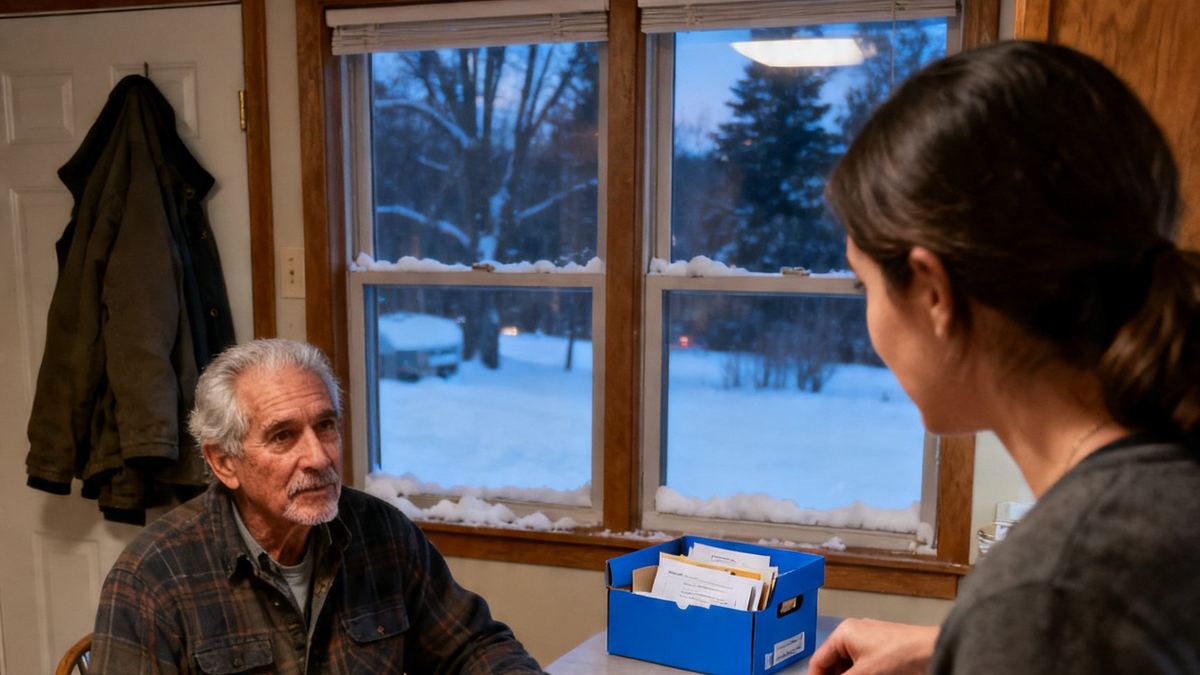
He did. He hung his coat on the hook. I went to the stove and poured the last of my mother’s beef stew into a pot. Jasper sat at the table.
I set two bowls down. His first, then mine.
Then I took the blue shoebox and put it on the chair next to him.
“Those are yours too,” I said. “Half of them are from you.”
He opened the lid, but he didn’t read anything. He just touched the top envelope, the way you’d touch a photograph.
We ate. The clock over the sink said 6:42. The neighbor’s dog barked at the plow going by. Jasper picked up his spoon and dipped it into the bowl.
For the first time in twenty-three years, my uncle ate at my mother’s table.
I didn’t say that out loud. I just watched the steam rise and disappear.