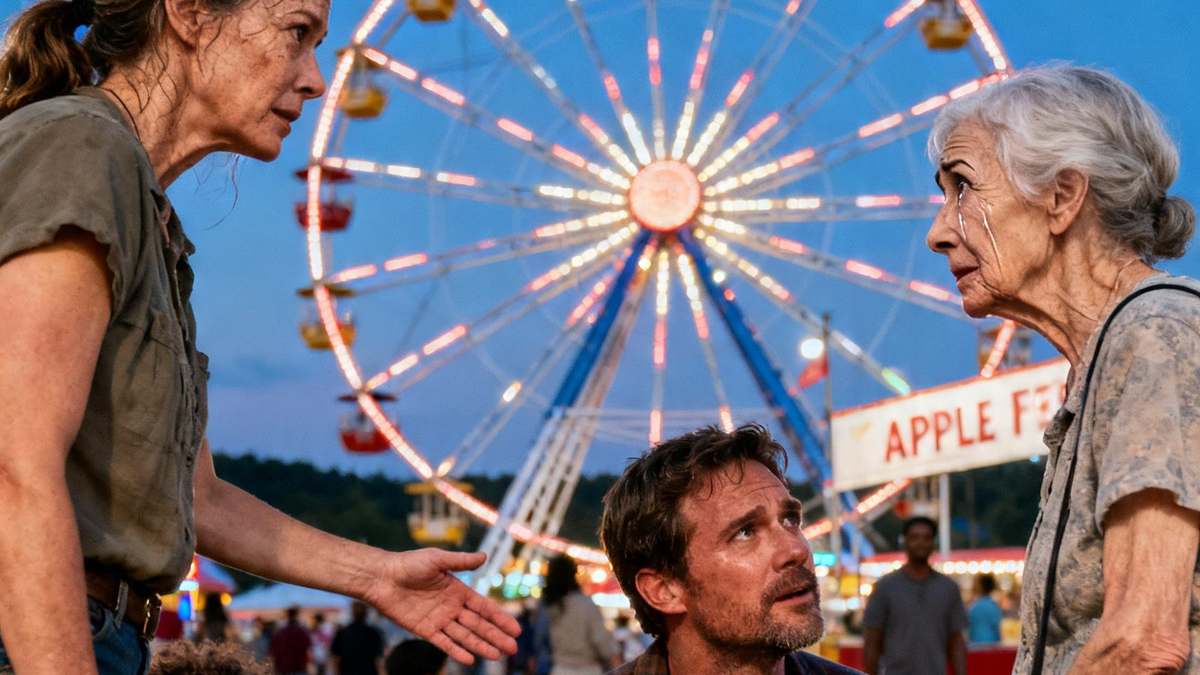
I saw her first at the Henderson County Apple Festival. She was shuffling past the kettle corn tent, her spine curved like a question mark, a quilted handbag hanging from a bone-thin arm. The crowd pushed around her, and she looked so small—nothing like the woman who had once stood in the middle of a rented barn and called me a stray dog. Ben was lifting our daughter, Lily, onto his shoulders so she could see the bluegrass band on the main stage. The music covered everything for a few seconds, and then the fiddles died down, and I heard her voice, thin as onion skin, trying to say his name.
“Benjamin… is that really you, son?”
Ben turned, his hands still cupping Lily’s sneakers. He didn’t flinch. I saw the grease under his nails, the same kind that had been there the day we got married at the old Jenkins barn off Highway 26. He lowered Lily to the ground, and she hid behind his leg, peering out at the stranger with the wobbly lipstick.
“Mrs. Holloway,” Ben said, the way you address a substitute teacher you don’t remember.
That was five years after our wedding, five years after she had launched a word at me that still stung like a splinter you can’t dig out.
We don’t have a fancy story. Ben and I grew up two ridges over from each other, in a place where the morning fog settles so thick you can’t see your mailbox. My dad drove a septic truck; his mama cleaned cabins up at Wolf Laurel. We weren’t the kind of people who registered for china. When Ben asked me to marry him, we were sitting on the tailgate of his ’87 F-150, splitting a lukewarm Cheerwine and a bag of pork rinds. I said yes and kissed his cheek, and his face broke into that crooked grin I’d loved since tenth grade.
His grandmother—Patricia Holloway—did not approve. She had spent thirty years as the office manager for a periodontist in Asheville, and somewhere along the line she convinced herself she was different from the rest of the valley folks. She started tracing her family tree and latched onto some second cousin who had been a delegate at the 1920 Democratic convention, and she called that “stock.” My stock, by comparison, was a mutt—a, quote, “stray that won’t ever whelp a purebred grandbaby.” I heard that line the first time standing right in front of her, at the barn where we had our reception, my dress still smelling of the dye from the discount rack at JCPenney.
She had waited until the toasts were done and the DJ was switching from Dolly Parton to Prince. She rapped a fork against her water glass, and the whole place hushed. “I just want to say,” she declared, her voice ringing off the rafters, “that I cannot in good conscience bless a union that waters down the Holloway line with whatever crawled out of the Dillsboro trailer park.”
My dad’s hand froze on the table. Ben’s jaw tightened like a vise. He set down his bottle of Bud Light, walked over to his grandmother, and took the fork out of her hand. “Mrs. Holloway,” he said, very calmly, “you can see yourself out.” She puffed up like a wet hen, gathered her embroidered shawl, and marched into the October night. The barn door creaked shut behind her. The deejay threw on a line dance, and we all pretended it hadn’t happened.
What followed was a life built on pancake breakfasts and midnight oil changes. We rented a two-bedroom cabin on a dirt road, the kind where the floor slopes three inches toward the porch, and you can hear the mice holding conventions in the walls. Ben took a job at a garage in Flat Rock, working on Chevy pickups and Subaru Outbacks. I got a shift at the Apple Barn bakery, rolling out pie dough at four in the morning. The kitchen always smelled of cinnamon, burnt sugar, and the wax paper I used to wrap day-olds for the church food pantry.
Patricia stayed away, but her words traveled. A friend from church told my mother that she’d heard Patricia say at the discount grocery that I was probably “breeding already, and it won’t be Ben’s.” I cried into a batch of biscuit dough that evening, the flour caking in the tear tracks on my cheeks. Ben came home that night with a set of socket wrenches he’d found at a yard sale, and he saw my face. He didn’t say anything except, “Baby, I’d marry you again next Saturday if the transmission ain’t dropped out by then.”
I got pregnant in the second winter, when the road iced over and the power went out for four days. We didn’t have a doctor’s appointment right away—the nearest clinic was in Brevard, and the van was running rough. But one morning I fainted right into a tray of fried apple pies, and the owner’s wife drove me to the ER. Ben met us there, still in coveralls, smelling of brake fluid. The doctor—an old man with a ponytail and a faded Grateful Dead lanyard—told us we were going to be parents. Ben sat down on the linoleum floor and wept into his hands, and the nurse handed him a box of scratchy hospital tissues.
We named her Lily after my mama’s favorite flower, and she came into the world at six in the morning on a Tuesday, howling so loud the Appalachians could’ve heard her. The first thing Ben did was cradle her against his chest and murmur, “Hey there, sweet potato.” He had three days off work, and he spent every one of them sitting by my hospital bed, learning to fold diapers from a YouTube video on a phone with a cracked screen.
We raised Lily in that crooked cabin, with no Pinterest nursery and no trust fund. Ben cut a pine bough to make her a mobile, and I sang her the same old mountain ballads my granny sang to me. We pinched pennies, swapped babysitting with neighbors, and Ben turned a toolshed into a little auto shop so he could work closer to home. The sign he painted on a scrap of plywood said “Holloway Auto, No Job Too Small,” and the apostrophe was crooked, but people came.
Lily was born with Ben’s chin and my hazel eyes, and by the time she turned five, she could identify a catalytic converter from twenty paces and was on a first-name basis with the goats down the road. She was no purebred, not in Patricia’s world, but she was fierce and kind and would eat an entire jar of pickled okra if you didn’t watch her.
We didn’t see Patricia for years. We heard she’d retired, sold the condo in Asheville, and moved into a seniors’ apartment near the old mill. I thought about her sometimes when I’d knead bread in the early dark, my hands working dough the way my mama taught me. I didn’t hate her, exactly. But the word “stray” had carved a little groove in my heart, and the groove never quite filled in.
Then came the Apple Festival. When Ben looked at her and said “Mrs. Holloway,” I saw her face collapse in on itself, like a cake that’s been taken from the oven too soon. She lifted a trembling hand toward Lily, who was now peeking around Ben’s hip.
“This is… is this my great-grandbaby?”
Lily looked up at Ben, then at me, and in a small voice said, “Mama, is that lady gonna cry?”
Ben knelt down to Lily’s level, his knee pressing into the crushed peanut shells on the ground. “Lily girl, this is your daddy’s grandmother. But she’s not a part of our lives.” He straightened up and fixed his eyes on Patricia. “You made sure of that a long time ago.”
A tear slipped out of Patricia’s eye and carved a path through her face powder. “I was wrong, Benjamin. I’ve been alone for five years, and I see it now—nobody comes to visit, nobody calls. I threw away my whole family over a word. Please… please let me know her.” She looked at me. “Jenna, you’re a good woman. A good mother. I was a fool.”
I wanted to feel something soft, something that would let me step forward and offer her my hand like a hallmark movie. But all I could feel was the memory of my dad’s grip on a paper napkin, the cold barn door closing, the endless hum of gossip that had followed me like a mosquito. I looked at Ben, and he looked at me, and I knew.
“I—I reckon I know you’re sorry,” I said, my voice catching. “But we’ve scraped and saved to build a life where Lily feels safe. She don’t need somebody showing up now and confusing her. You had your chance years ago, and that door closed. I ain’t opening it again. I can’t let you mess with her head.”
Ben reached into his pocket and took out a five-dollar bill. He handed it to Lily. “Go get yourself a funnel cake, baby. We’ll be right here.” Lily took off toward the stand, her rubber boots slapping the dirt. Then he turned back to his grandmother.
“I don’t wish you any harm,” he said, his voice even as a ruler. “But I don’t owe you any welcome. You stopped being my family the second you called my wife a stray. Now, if you’ll excuse us, we’ve got a little girl who wants to ride the Ferris wheel.”
He took my hand, and we walked away. I heard a tiny sob behind us, then the shuffle of feet heading in the other direction. I didn’t look back.
We found Lily at the funnel cake stand, powdered sugar already dusted across her nose. Ben swung her up onto his hip, and we headed toward the Ferris wheel line. The sky was turning that deep mountain blue that only happens when the sun drops behind Cold Mountain. Lily asked if we could go up high, and Ben said, “Higher than a cat on a hot tin roof,” which made her giggle.
While we waited, Ben cupped the back of my neck with his free hand. His palm was rough as sandpaper, and I could feel a new cut across his knuckle—probably from a busted alternator. He leaned close and said, “Best twenty-three bucks I ever spent on a barn rental, know that?”
“Twenty-five,” I corrected. “You forgot the extra two for the folding chairs.”
He laughed, that same crooked smile I’d known forever, and kissed my forehead. The Ferris wheel car rocked as we climbed in, Lily squished between us, and the whole fairground spread out below—cotton candy pink and mustard yellow, the tiny figures of the goat-petting pen, the distant ridges layered like blue quilts. Lily pointed at the sky and said it matched Ben’s truck, which it kind of did.
When we got home that night, the cabin was dark except for the porch light, and the bullfrogs were croaking in the creek. I tucked Lily into her quilt, and she mumbled, “Mama, that lady smelled like mothballs.” I kissed her hair, which smelled of sugar and hay.
In the kitchen, Ben cracked open a cold can of ginger ale—our champagne—and we sat on the back steps looking at the stars. The air was crisp, the woodpile leaned just so, and somewhere down the valley a dog was barking. Ben put his arm around me, his hand resting on the sleeve of my flour-dusted shirt.
“You know,” he said, “I don’t think I’ve ever seen anything more perfect than that beat-up old truck you drove to church this morning.”
“The transmission whines in second gear,” I said.
“Yeah,” he said, and kissed my temple. “But she’s got heart.”
I leaned my head on his shoulder, and we listened to the bullfrogs down at the creek, the distant bark of that hound.