The first one showed up on a Tuesday in January, a black-and-white tom with a left ear that looked like it had gone through a paper shredder. He pressed himself against the radiator in the stairwell of the Merriman Arms, and I set down half a can of chicken from the Kroger on Warsaw Avenue. The next night there were four. By the end of the month, I had two dogs and three cats sleeping on old blankets between the mailboxes and the boiler door, and half the building wanted me dead.
I live in 1A. I’m sixty-one, retired from the county recorder’s office, and I know what a lease violation looks like. I also know what hypothermia looks like. The wind comes off the Mill Creek in January and cuts through Price Hill like a box cutter. The strays didn’t ask to be born behind the abandoned White Castle on Glenway.
The trouble had a name: Arnie Slocum, 2A, and his two grown sons, Tyler and Brent. They were big. Arnie ran a tow truck company and kept a pit mix on a chain in his backyard that he said made the neighbors polite. He told me at the mailboxes one night that if I let one more animal into the stairwell, he would “educate” me. He used his finger like a key, twisting it near my face. I went home and ordered a camera disguised as a smoke detector for one hundred ninety-three dollars with tax. I put it on the ledge above the radiator, behind a ceramic Scottie dog with a chipped ear that somebody left in 1987. I didn’t tell anyone. I didn’t call the police. I just kept feeding the animals and checking the lock on my door.
The night it happened, a Wednesday, the wind was peeling the plastic off the windows in the stairwell. I had laid down three blankets and was opening a can of dog food with the bend of a church key. The black-and-white tom, Biscuit, came up and pressed his nose to my shin. The little one with the raccoon tail, Squirrel, sat by the boiler door and whined. The other dog, a brindle with a missing back leg, was already asleep.
I heard the stairwell door on the second floor open. Three sets of boots. No words. Then Arnie’s voice came from above, not loud, not a shout, just a man explaining how things were going to go: “You were told, old lady.”
I stood up with the can-opener still in my right hand. I wasn’t brave. I put my body between them and the animals because that was the only thing in front of me. “Touch me,” I said, “and every camera phone on this block will see it.” A lie. But my voice didn’t crack.
Arnie came down the last few steps. Tyler and Brent came around both sides, and the three of them had me backed into the corner by the mop sink, where the light from the one working bulb fell on their boots. Arnie drew his hand back.
What happened next took about four seconds. The old woman from 4B appeared at the bottom of the stairs, behind Brent’s right shoulder. I had never seen her move more than from her door to the trash chute. She was sixty-eight, white-haired, built like a cinder block, and she carried a hickory cane with a steel band at the bottom. She didn’t say a word. She swung the cane into the back of Brent’s left knee. The knee folded wrong, and Brent hit the linoleum with a sound like a side of beef. Before Arnie could turn, she drove the end of the cane into his armpit and hooked his arm back. He screamed. Tyler reached for her, and she bit him on the hand. Hard. He yanked back, and she kicked him square in the groin with the toe of her boot. He dropped.
I had not moved. Biscuit and Squirrel and the brindle were behind me, their heads low, their eyes on the door.
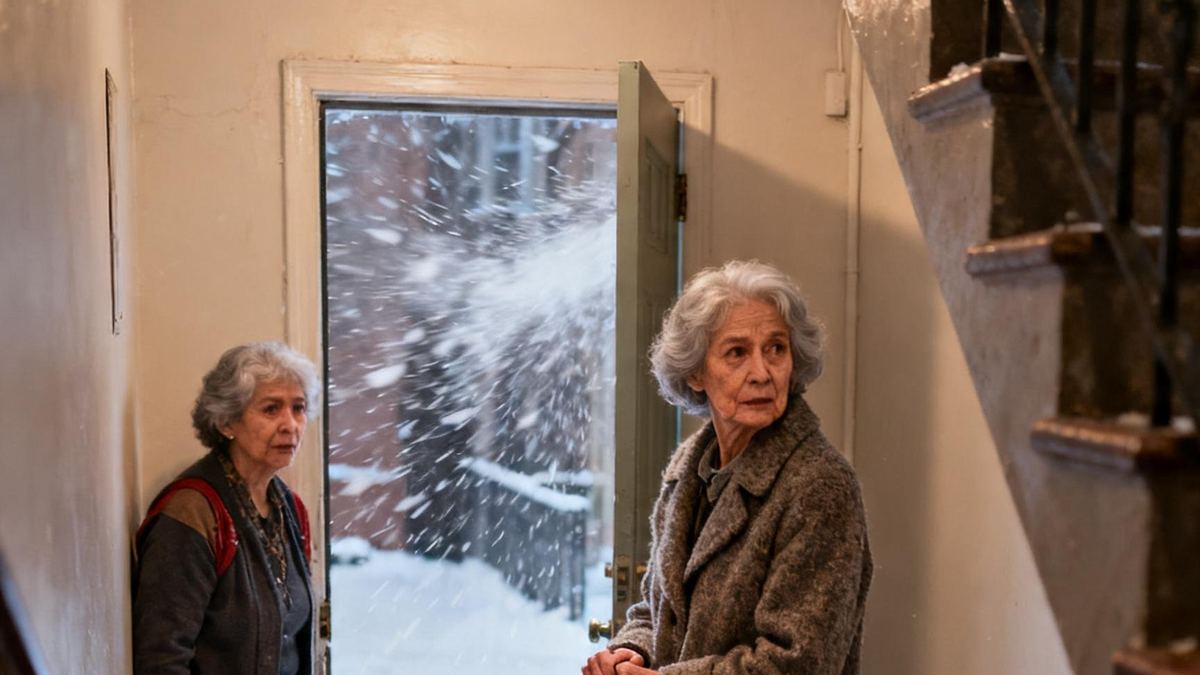
Ada Vass bent down, grabbed Arnie by the collar, and dragged him across the linoleum to the front door. The wind opened it for her. She put her boot on his back and shoved him over the threshold into the snow. Then she did the same to Tyler, then Brent. Brent was crying. She shut the door and wiped her hands on her coat. “The one in the middle needs a new phone,” she said. “I stepped on it.”
I asked if she was okay. She looked at me like I had asked if the post office was open. “Miss Benton,” she said, “I spent nine years as a drill sergeant at Fort Campbell. I used to throw bigger men than that out of helicopters.” She was not out of breath. She smelled like coffee and old wool, not a drop of whiskey. “I’ve been sober eight months,” she said, because she caught me looking at her hands. “Tell nobody.”
That was the first surprise. The second was that the animals followed Ada up the stairs to her apartment in 4B, not mine. She had left her door cracked. Squirrel took the stairs in three hops. Biscuit shot through the gap. The brindle with one back leg climbed step by step, and Ada reached down and scooped him up with her free arm.
I stood in the stairwell with the can-opener in my hand and the wind whistling through the mail slot. I didn’t feel safe. I felt like a woman who had just discovered the fire escape was made of sugar.
The next morning, I took the memory card from the camera behind the Scottie dog. I loaded the video onto an old USB stick. It showed all of it: the three of them surrounding me, the cane, the drag, the shove. The sound was terrible. You could hear Tyler asking his father, “Are we going to jail?” I didn’t answer him then. But I answered him at eleven o’clock that morning.
I walked to the property manager’s office on Glenway Avenue with the USB stick in my coat pocket and a printed timeline—three pages, single-spaced. I didn’t ask. I told them. “You have two options,” I said. “You file a 30-Day Notice to Quit for apartment 2A, and I don’t send this to the police.” I set the USB stick on the desk. “Or you don’t, and I walk across the street to the district station and also send it to the city’s department of health for the dog on the chain.” The property manager, a man named Don, watched the video without touching the mouse. When it got to Brent’s knee folding, he covered his mouth with his hand. “That’s assault,” he said. “I know,” I said. “I’m offering you the non-assault version.”
Don typed up the notice while I sat in the plastic chair by the window. He put it in a clear plastic sleeve and handed it to me. “Do you want me to serve it?” he asked. “No,” I said. “I’ll deliver it myself.”
Back at the Merriman Arms, I waited until the building was still. Then I took the service elevator to the second floor, the one the tenants use for moving. I slid the notice under Arnie’s door, then I knocked three times and walked back down the stairs. I had not waited for a process server. I had done it myself.
Two days later, Arnie came out of his apartment carrying a black garbage bag. He had to step around the notice, which was still on the floor, unrolled. His face was the color of uncooked dough. He didn’t look at me. He didn’t look at anyone. He just kept stepping, one hand on the rail, one hand holding the bag. Tyler and Brent didn’t come with him. They had left the night before. I knew because Brent had thrown a duffel bag out a second-floor window, and it had landed on the hood of Arnie’s tow truck. That part wasn’t on my camera. I heard it.
That evening, Ada came down to 1A with the brindle in her arms and a bottle of seltzer in her coat pocket. The two dogs and three cats had moved in with her permanently. She had even gotten them flea collars from the pet store on Glenway. “You know what the monthly fee is?” she said, pouring seltzer into two water glasses. “Less than what I used to spend on vodka. And nobody asks me for money.” She said this the way another woman might say she had gotten a good deal on a sofa.
We sat at my kitchen table. The window above the sink looked out at the fire escape, and the streetlight made a long white stripe across the table. Ada didn’t talk about the fight. She talked about the cat with the shredded ear, how he needed a particular brand of food because his stomach was touchy. I listened. I didn’t say anything about the camera.
The animals stayed with Ada. I still put down blankets in the stairwell because the cold didn’t end with Arnie Slocum. There were always more strays. But I also put a new sign on the wall above the radiator, printed in block letters: “Stairwell monitored by security camera. Be kind. This is not a suggestion.” It was the first time I had put up a sign since I retired.
The next time I saw Arnie was at the Kroger on Warsaw Avenue, about six weeks after the notice. He was in the produce section, holding a bag of oranges. I was in the canned goods aisle, deciding between two brands of tuna. Our eyes did not meet. He set the oranges down and walked out without them. That was the last I saw of him.
And Ada? Ada still lives in 4B. She works four mornings a week at the VFW post on Neeb Road, serving coffee. I see her every evening when the dogs come downstairs to sit by the radiator while I refill the food bowls. She doesn’t talk about Fort Campbell. But sometimes, when the wind comes off the Mill Creek and the stairwell door rattles, she sits on the bottom step and watches the front entrance. It’s not fear. It’s what she calls “territory.”
As for the camera, the one that cost one hundred ninety-three dollars with tax: I never had to send the footage to the police. I kept the USB stick in the ceramic Scottie dog’s hollow bottom, behind the left ear. If anyone ever asks, it’s there.