That door at the end of the building — seven entrances, mine was the last one, right up against a chain-link fence — was the only thing standing between a pack of strays and a Cleveland winter. The wind off Lake Erie came sideways in January, snow like ground glass, and those animals would huddle by the dumpster behind the old brewery across the street. I’m Art Green. Sixty-four, part-time bookkeeper at a garage on Detroit Avenue. Live alone in a two-bedroom walk-up with a radiator that clanks like a spoon in a garbage disposal.
Every night when the temperature dropped below fifteen, I’d unlock that last door and lay out two old quilts I got from a yard sale on Lorain Road. Then I’d fill a shallow pan with water and dump a bag of store-brand dog biscuits into a plastic bowl. The strays knew the routine. Two mutts — one with a chewed-up ear, one missing a back leg — and three cats, all ribs and matted fur. They’d slip inside, shake off the snow, and curl up on those quilts. I’d sit on the bottom step with my thermos of coffee and watch them eat.
The neighbors hated it. Apartment 3B, a guy named Bert Rodgers, big as a refrigerator, two sons just as wide. They cornered me in the stairwell more than once. Told me they’d call the city, call the landlord, call Animal Control. I’d apologize and keep doing it. The animals had nowhere else. You ever watch a cat try to survive a night on a Cleveland sidewalk in February? I have.
This one Thursday, the snow was coming down so thick the streetlights looked like cotton balls. I had the quilts spread, the water out, the biscuits poured. The one-eared mutt was already chewing, tail going like a windshield wiper. I heard boots on the landing behind me.
“We warned you, old man.” Bert’s voice bounced off the peeling walls. “I told you what would happen.”
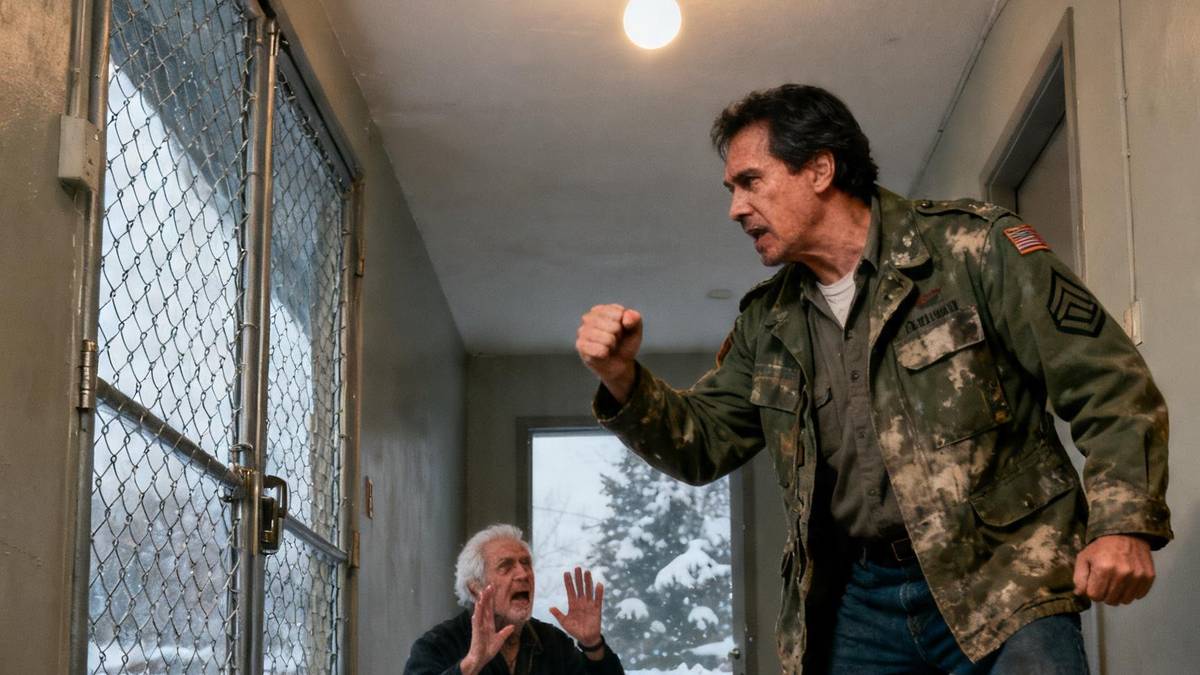
I turned. Bert and his two boys blocked the hallway. The younger one, Danny, held a length of pipe. I remember thinking: that’s for me. Not for the dogs, not for the cats — for me. My legs went numb. My hands came up in front of my face, and I closed my eyes so I wouldn’t see it coming.
Then the noise started — not on me, in front of me. Grunts, curses, the wet smack of fists on flesh. I opened my eyes. Bert was on the floor, one arm covering his head. Kevin, the older son, was trying to crawl toward the door, but something yanked him back by his jacket. Danny was making a sound like a stepped-on accordion.
Over them stood Wayne Caldwell from the fourth floor. Every tenant in the building called him the drunk. He wore a dirty green army jacket and a wool cap pulled down to his eyebrows. He hit Bert again — a short, chopping motion to the ribs — and Bert folded like a strip of duct tape.
Wayne stepped over him and got close to my face. I smelled cheap whiskey and stale cigarettes. “Don’t worry,” he said. “I’ve handled worse than this. Way worse.” He turned, grabbed Danny by the collar, dragged him to the door, and shoved him out into the snow. Then Kevin. Then Bert — Wayne threw him so hard the man’s boots left dents in the storm door.
Wayne walked back in, brushed snow off his sleeves. He looked down at the animals. They hadn’t moved. They were sitting at my feet, watching.
“They’ll call the cops,” I said. My voice cracked.
Wayne barked a laugh. “No they won’t. Those three got records longer than my discharge papers.” He pulled a crumpled pack of Marlboros from his jacket, thought better of it, put them away. “I was recon, man. Hunted men bigger than Bert Rodgers in places you can’t spell.” He tapped his temple. “They’ll be polite to me from now on. Hospital or no hospital.”
He held out his hand. “Twenty bucks says they never say a word.”
I dug into my pocket. Crumpled singles, a five, some quarters. I held it out. Wayne looked at the mess in my palm and grinned — not cruel, just tired. He pulled a wad of cash from his jacket. Tossed a fifty on top of my change.
“Fifty against your pocket lint,” he said. “If they squeal, it’s yours.”
He looked at the animals again. The one-eared mutt barked once, like he agreed.
“You got guts, you know that?” Wayne said. “You were scared — I saw you shaking. But you didn’t run.”
“I was terrified,” I said. “Still am.”
Wayne pointed at the dogs and cats. “But you didn’t leave them.”
He walked to the door, held it open. “Come upstairs. Got coffee. Got something to eat. Bring your pack.”
I froze. The animals looked at me. The one-legged dog limped forward, and I followed.
Wayne’s apartment was nothing like I expected. The floor was swept. The sink was empty. No stacks of empties, no smell of stale booze — just coffee perking on the stove and a couple of mismatched chairs. Near the radiator, on a folded blanket, were the same two dogs and three cats. My strays. They’d followed me up four flights.
“They moved in a week ago,” Wayne said, pouring coffee into a mug that said “World’s Okayest Veteran.” “I found them in the stairwell one night when you weren’t there. Brought them up.” He shook his head. “Didn’t plan it. They just stayed.”
We sat and ate — he’d made chili, thick and hot, with crackers. The animals curled around our feet. He told me about the Army, about a shrapnel scar on his hip that ached every time the barometer dropped, about six months in a VA hospital after his discharge. “They gave me pills instead of a job,” he said. “So I found my own medicine.” He tapped the edge of the table. “Bad choice. I know.”
I didn’t say anything. Just ate my chili.
That was November. By Christmas, Wayne had a job — an old buddy from his unit got him in at a warehouse in Brook Park, loading trucks. He cut his drinking down to one beer on Sundays. Bert Rodgers and his sons got out of the hospital two weeks after that night. I passed them in the hallway once. Bert looked away so fast he walked into a wall. His boys crossed the street when they saw me coming.
The other neighbors stopped complaining about the animals. They’d wait until I was out on the sidewalk, then nod. One lady in 5A left a bag of cat food outside my door with a note: “For the little ones.” No signature.
But I kept thinking about Wayne. About him standing over Bert, about him saying “I’ve handled worse.” About him sitting in that clean apartment, pouring coffee, while my strays slept on his blanket. So the first week of March, I went to see a lawyer over in Lakewood. Her name was Diane something. I told her I wanted to change my will.
“You have assets?” she asked.
“A 2008 Honda Accord, a checking account, and a life insurance policy from the garage,” I said. “Maybe forty-two thousand total. And the apartment.”
“Who do you want to leave it to?”
I wrote Wayne’s full name on a piece of paper. Wayne Anthony Caldwell. Last known address: 4401 West 25th, Apartment 4A, Cleveland.
Diane typed it up. It took twenty minutes and cost me $145. I told her to send a copy to Wayne.
Two days later, I heard a knock at my door. Wayne stood there with a manila envelope in his hand. He hadn’t opened it — the flap was still tucked under. He held it up.
“What the hell is this, Art?”
I turned and walked back inside. The animals were on the sofa, all five of them. I sat down, and the one-eared mutt rested his head on my knee.
“It’s a will,” I said. “You get the money. The car. The apartment. Everything.”
Wayne didn’t move. The envelope hung from his fingers like it was electrified.
“Why?” he said, and his voice was low. “I didn’t ask for this.”
“Because you took them in,” I said, nodding at the animals. “When I die, somebody has to keep that door open. Somebody has to put out the quilts and the biscuits.” I leaned forward. “And you’re the only person in this building who knows how to handle a Bert Rodgers if one ever comes back.”
Wayne stood in the doorway for a long time. The snow had started again outside — little specks against the window. Finally he stepped inside, closed the door behind him, and set the envelope on the kitchen table next to my thermos.
The one-legged dog got up and went to him. Wayne knelt down, scratched behind the dog’s good ear, and said, “Okay. But I’m buying the biscuits from now on.”
That was eleven years ago. Wayne runs a small dog rescue out of that old building now. He bought the whole property in 2019 with the money I left him — I’m still alive, still bookkeeping, still laying out quilts in the last doorway on West 25th. Bert Rodgers moved to Parma in 2017. Last I heard, he got bit by a Chihuahua. No joke.
The animals still come. Different ones now — the old ones crossed a long time ago. But every cold night, the door at the end of the building opens, and the strays walk in like they own the place. Because they do.