For forty-seven of our fifty years, Richard and I lived in a two-story colonial on a street lined with sugar maples in Madison. Every autumn the city smelled of wet leaves and bratwurst from the farmer’s market, and every evening Richard settled into his recliner with the *Wisconsin State Journal* and a glass of brandy while I carried plates to the kitchen.
Most people believed I’d won the husband lottery. Richard was the kind of man who held doors and remembered everyone’s birthdays. At barbecues he’d lift his beer and announce, “Joan is the reason this family hasn’t fallen apart. She’s the glue.” My sister-in-law once whispered that she wished her husband looked at her the way Richard looked at me. Our three kids grew up hearing those tributes and believed their father adored their mother. I suppose, in his own way, he did.
What they never witnessed was the moment the front door clicked shut. That’s when the other Richard appeared. He’d toss his jacket onto the banister, drop his loafers in the middle of the hallway, and ask why the mail hadn’t been sorted. If his favorite shirt wasn’t ironed by seven a.m., he’d stand in the bedroom doorway holding it with two fingers, as though it were a dead mouse, and say, “Any chance you got around to this today?” The phrase *any chance* became a running tally of my failures. He didn’t yell. He never struck me. He simply assumed I existed to keep his world frictionless.
For twenty-eight years I taught fifth grade at Randall Elementary. I graded papers on Sunday nights while Richard watched the Packers and reminded me to refill the chip bowl. When I retired, he treated my newfound free time like a software update that had finally installed the wife he’d ordered. “Now you can really take care of things,” he said. His own retirement had arrived three years earlier, but his calendar remained sacred: coffee at Collectivo with the old Lions Club crew, eighteen holes at Odana Hills, and a standing appointment with the recliner. My calendar, he believed, was his to fill.
“Joan, fetch my reading glasses.”
“Sweetheart, this soup needs more salt.”
“The car’s making a noise. Book an appointment.”
No please. No thank you. If I pushed back, he’d tilt his head and smile that same public smile and say, “You’re so sensitive lately. Maybe you should see someone.”
Our fiftieth anniversary approached. The kids rented the Sky Room at The Edgewater, all glass walls and Lake Mendota glittering below. Relatives flew in from Phoenix and Milwaukee. Our daughter, Maggie, compiled a slideshow of black-and-white wedding photos and grainy Super 8 footage. I bought a navy dress with a silver clasp at the neck and spent seventy dollars at a salon on Monroe Street, watching a stylist twist my gray hair into something that felt, for an hour, like armor.
I’d spent the entire week preparing: I scrubbed bathrooms for houseguests, ironed Richard’s dress shirts, baked two coffee cakes, and still found time to search the garage for his cufflinks because he’d left them in a tackle box. By the time we arrived at the restaurant, I was exhausted. But Richard glided through the room like a senator. He kissed my cheek for the cameras, refilled my wine, and delivered a toast that made my sister-in-law dab her eyes.
“Joan has dedicated her whole existence to my happiness,” he said, lifting his glass. “And the miracle is, she still does it with a smile.”
The applause felt like a door slamming. I looked down at my hands on the white tablecloth—knuckles swollen, a small scar from a kitchen burn twenty years ago—and I felt something detach. That morning I’d cleaned up after six people, located his tie behind the dryer, and listened to him complain that the scrambled eggs were too dry. I was the glue, all right. I was holding together a life I wasn’t even living.
Then Maggie asked if I’d like to say a few words.
Richard turned to me with his chin raised, ready. He was already nodding, already composing the follow-up anecdote about how lucky he was. I stood up without meeting his eyes.
“Fifty years is a long time,” I said. “And I haven’t been smiling the whole way through.” A few nervous chuckles. I pressed on. “I’ve been introduced tonight as a woman who dedicated her life to making her husband happy. The part nobody hears is that behind closed doors, I’m not the best woman in the world. I’m the person who’s given orders.”
The room stilled. Someone’s fork clinked against a plate. Richard’s face flushed the deep maroon of the brandy in his glass.
“In public, I’m a queen,” I said. “At home, I’m the staff.”
Maggie’s eyes darted to her father. My oldest son, Peter, cleared his throat and suggested I might just be tired. But Maggie was staring at her napkin, and I saw her chin tremble. Later she would tell me she’d watched Richard speak to me like a maid for years but assumed I’d made peace with it. That’s the trouble with glue: nobody notices it until it stops sticking.
Richard tried to laugh it off. “Well, now you’ve had your say,” he said, as if I were a child who’d interrupted adult conversation. Nobody laughed with him.
We rode home in a taxi without speaking. The tires hummed on the wet asphalt, and the radio played a soft jazz station Richard hated. I let it play.
The moment we stepped into the foyer, he shrugged off his sport coat and draped it over a chair. “My stomach’s burning,” he said. “Fix me a cup of chamomile tea.”
Something inside me—a circuit board that had been shorting out for decades—simply clicked off. I looked at his coat, then at him. “The kettle’s in the kitchen.”
He blinked. “I’m aware. I’m asking you.”
“And I’m telling you: the kettle’s in the kitchen.”
He stood there for a full five seconds, patented public smile nowhere in sight, then walked into the kitchen himself. I heard cupboard doors open and close, the clatter of a spoon. That tiny sound—Richard fumbling for a teabag—was the first honest thing I’d heard in our house in years.
The next several weeks were a study in frost. He accused me of humiliating him. I accused him of treating my silence like a standing ovation. I stopped searching for his glasses, stopped ironing his shirts, stopped inventorying the pantry so his preferred brand of whole-grain crackers never ran out. I joined a watercolor class at the senior center on Ingersoll Street. I bought a sketchbook and a set of sable brushes and started painting the chickadees that visited our feeder. I didn’t ask permission. I just walked out the door.
Richard, to his credit, slowly learned to operate the washing machine. He prepared his own lunch twice before asking—not telling—if I could show him how to use the George Foreman grill. I called that progress.
But old habits have deep roots. One Wednesday afternoon I came home from class to find him standing in the living room, holding the TV remote like a gavel. “Where’s my other pair of glasses?” he demanded. “I’ve been searching all over.”
Something about that tone—the imperial *I’ve been searching* as if I’d hidden them intentionally—made the circuit board not just click off but shatter.
I didn’t answer. I walked past him to the recliner. It was a tan leather beast, wide as a boat, with a heat-and-massage feature activated by a cord snaking to the wall. Richard had spent thousands of hours in that chair issuing small commands while I delivered coffee, mail, slippers, snacks, phone calls, scissors, stamps, and silence.
I bent down, gripped the electrical cord, and yanked it from the outlet. Then I tilted the chair back on its wheels and rolled it toward the front door.
“What are you doing?” Richard’s voice scaled up half an octave.
The front steps were tricky. The recliner weighed a hundred and thirty pounds, and the armrests kept jamming against the doorframe, but I wrestled it onto the porch without asking for help. Our neighbor’s yellow Lab watched from behind the fence, tail wagging uncertainly.
I pulled the chair across the driveway to the curb, right under the sugar maple, and went back inside for my phone. Richard trailed after me as I dialed the number for St. Vincent de Paul.
“I have a recliner for pickup,” I told the woman on the line. “Leather, good condition. The remote’s still in the pocket.”
Richard opened his mouth. I held up one finger. “Yes, this afternoon works fine,” I said. “No, I don’t want a receipt.”
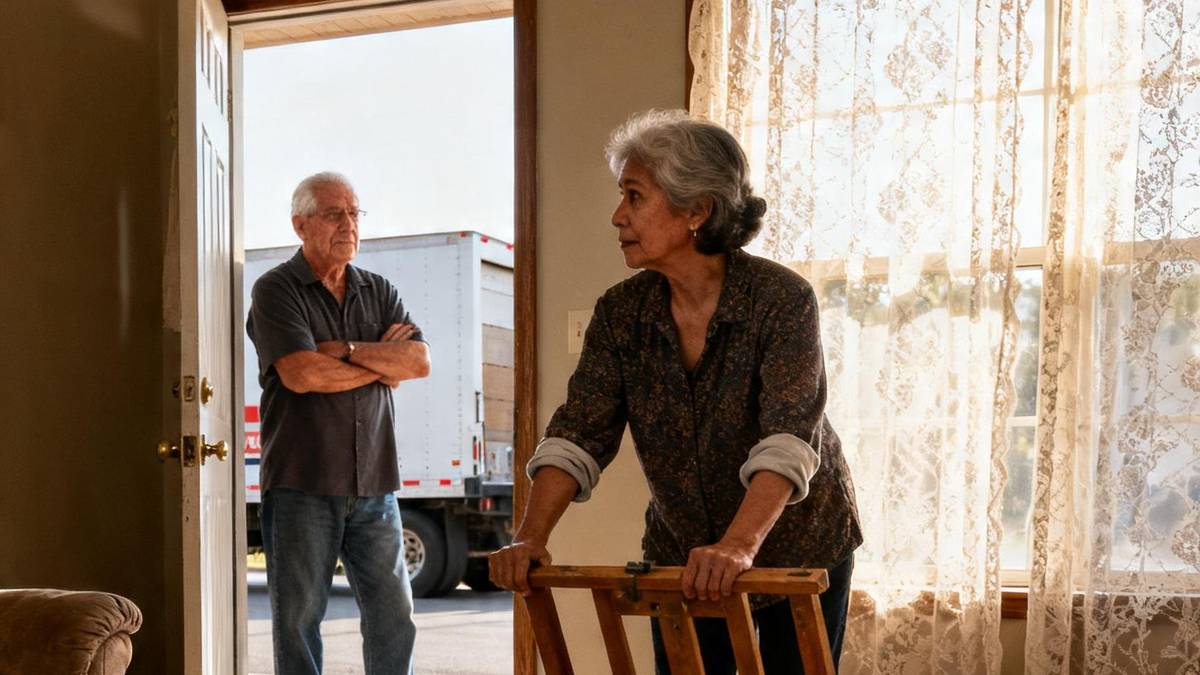
The truck arrived forty minutes later. Two men in fluorescent vests hoisted the chair into the back while Richard stood on the porch with his arms crossed, his brandy-colored complexion draining to a pasty white. He didn’t yell. He didn’t know how to yell without an audience.
I went inside and dragged my easel from the spare bedroom and set it exactly where the recliner had been. I positioned my stool, adjusted my lamp, and laid out a fresh palette: cadmium yellow, cerulean blue, a small dab of crimson. Outside, the truck rumbled away. Inside, our cat, Mr. Tibbs, circled the bare patch of floor with a confused meow. I scratched behind his ear and told him he’d adjust.
Forty minutes after that, Richard appeared in the doorway. The anger had drained out of him, replaced by something I hadn’t seen before—a kind of naked bewilderment, as if the house itself had been swapped for a foreign country.
“My chair,” he said. It was half question, half epitaph.
I didn’t look up from my mixing of grays. “I gave it away. You won’t be needing it to tell me where your glasses are.” I tapped the brush against the edge of the water jar. “The spare pair is in the drawer by the microwave. Where you put them.”
He stood there for a full minute. The furnace kicked on, humming behind the walls. Then he turned and walked down the hall. I heard the front door open and shut. I assumed he was going for a drive.
An hour later he came back carrying a brown paper grocery bag. He walked into the kitchen, and I heard the sound of vegetables being chopped. A skillet clanked onto the stove. The scent of onions and garlic drifted through the house—smells I had produced every evening for five decades while he reclined and waited for his plate.
At six thirty he called my name. Not a command. Just my name, from the kitchen, careful and a little hoarse. I set my brush down and walked in.
The table was set. Two plates, two napkins, a pitcher of water. A bowl of pasta with mushrooms and spinach sat in the center. Richard pulled out a chair—not his usual one at the head of the table, but the one nearest the window where I always sat. He didn’t smile. He didn’t make a speech. He just stood there holding the back of the chair, waiting.
I sat down. He pushed the chair in, then took his own seat and passed me the serving spoon. His hand trembled, a slight tremor I’d never noticed before, and I realized I’d been so busy fetching his glasses I’d never actually watched his hands.
We ate for a while in silence. The evening light came through the window and caught the silver clasp of my dress, still hanging over the laundry room door. I’d thought about throwing it out that morning. Instead I’d left it there, a small metallic anchor to the night everything began to change.
“The pasta’s good,” I said.
Richard put his fork down. He didn’t say *any chance*. He didn’t say *finally*. He just reached across the corner of the table and touched the back of my hand, his thumb brushing the scar from the kitchen burn. Then he picked up his fork again and kept eating, and somewhere outside, a chickadee landed on the feeder I’d filled myself.