The Overlook Lodge clung to a ridge above town, its pine-log walls creaking in the November wind. Inside, mason jars of dried sage and goldenrod lined two long tables, candles flickering off the windows that framed the Gore Range. Thirty family members had driven up from Denver, Boulder, even Grand Junction, to celebrate Harlan and Ada’s fiftieth anniversary. Ada wore a velvet dress the color of fir needles, something she’d bought at the mercantile after eyeing it for six months. Her knuckles were swollen from decades of kneading dough at her bakery, but that night she’d painted her nails a soft coral, a color she’d picked because it reminded her of the sunset over the Tenmile Range.
Harlan held court with a bourbon in hand, his white hair swept back, his laugh rumbling like a distant avalanche. He toasted her, voice carrying that folksy cadence that had made him the most trusted postman in Summit County for forty years. “Ada here has endured my fishing trips, my late nights, and my ornery disposition,” he said. “She’s the reason I’m the luckiest man in the high country.” Applause burst out. My sister-in-law leaned over and said, “You hit the jackpot, hon.” I traced the rim of my water glass and thought about the morning.
That morning, I’d scrubbed the guest-room toilets before the sun hit Quandary Peak. Harlan had left his thermal boots in the hallway, his flannel shirt dangling from a doorknob, his oatmeal bowl crusting in the den. I’d asked if he could sweep the porch before family arrived. “Saw a fox out by the woodpile,” he’d said, not looking up from his coffee. “Might go track it.” Then: “Find my wool socks. The thick ones.” I’d found them wadded in his tackle box, damp from some old trip. He’d patted my back and said, “Sharpest eye in the valley.”
Harlan never raised his voice. He never shattered a dish. He just fed me a thousand tiny erasures, day by day, until I felt like a ghost in bifocals. If supper wasn’t plated by six, he’d stand in the doorway and jingle his keys, a signal that meant “Get moving.” If I picked up a novel, he’d notice a burnt-out bulb in the pantry and suggest I “take care of that when you’ve got a free minute.” Over the years, I’d stopped mentioning the watercolor class in Leadville or the wildflower hikes I wanted to join. His reply never changed: “You got too much time on your hands, Ada? I could find you something to do.” And he’d mean something for him.
So when my daughter Lisa asked me to say a few words at the party, Harlan shot me that smug grin, the one that expected a recitation of his virtues. I stood. The chair legs snagged on the knotty pine floor. The grandkids hushed. I looked at my sons, my nieces, at the sister-in-law who believed my marriage was a postcard.
“Fifty years is a lot of mornings,” I said. “You all know Harlan the raconteur, the guy who memorizes the birthdays of half the county. At home, there’s another Harlan. The one who hasn’t made his own doctor’s appointment since Gerald Ford was president. Who asks me to hunt down his reading glasses while he stands right next to the nightstand where he set them. I’m not griping about work—I ran Ada’s Sourdough for twenty-seven years, raised three kids, and buried a stillborn daughter alone because he was on a fishing trip. But for half a century, I’ve been paraded as the happy wife who adores serving, while at home I’m the person who gets told to carry out the garbage before dawn, in her housecoat, in February.” I paused. The only sound was the wind rattling the lodge windows. “Tonight, I’m not a symbol. I’m Ada. Who likes to watch elk from her kitchen window and hasn’t ridden a horse since she was twenty-five because it wasn’t deemed a sensible hobby.”
Harlan’s face went from red to the color of old snow. He tried a chuckle: “She’s being theatrical. Must be the altitude.” No one joined. My son Dave muttered that I was probably exhausted from all the cooking. But Lisa set her jaw and stared at her napkin. Later, she told me she’d heard the jingling keys her whole childhood and never once thought to ask if I minded.
We didn’t ride home together. Harlan had to cadge a lift with my brother because I took the Subaru early. When he walked in around eleven, I was at the kitchen table with a mug of chamomile, the house smelling of pine from the candles I’d lit for myself. He tossed his sport coat onto a chair. “I need something to settle my stomach,” he said, not looking my way. “Fix me a tea, will you?”
I stayed still. “Kettle’s on the stove. Teabags are in the bear-shaped jar.”
He turned, the porch light catching the deep seams around his mouth. In fifty years, I’d never refused a single directive. “What’s crawled into you tonight?”
“Nothing,” I said. “I’m just not your waitress as of now.”
The following weeks were tight as a banjo string. Harlan grumbled about being humiliated in front of the family. I kept my voice flat: “I told them what I feel.” I quit ironing his shirts. He wore a wrinkled one to his retired carriers’ breakfast and came home furious, smelling of scorched cotton from his own attempt with the iron. I said nothing. I started driving to Buena Vista on Thursdays for a watercolor class and left a note on the counter: “Back by two. Tuna salad in the fridge.” One day I came home to find a bowl of cereal crusted in the sink, and a shopping list in his handwriting that just said “coffee creamer????” I didn’t add it to my own.
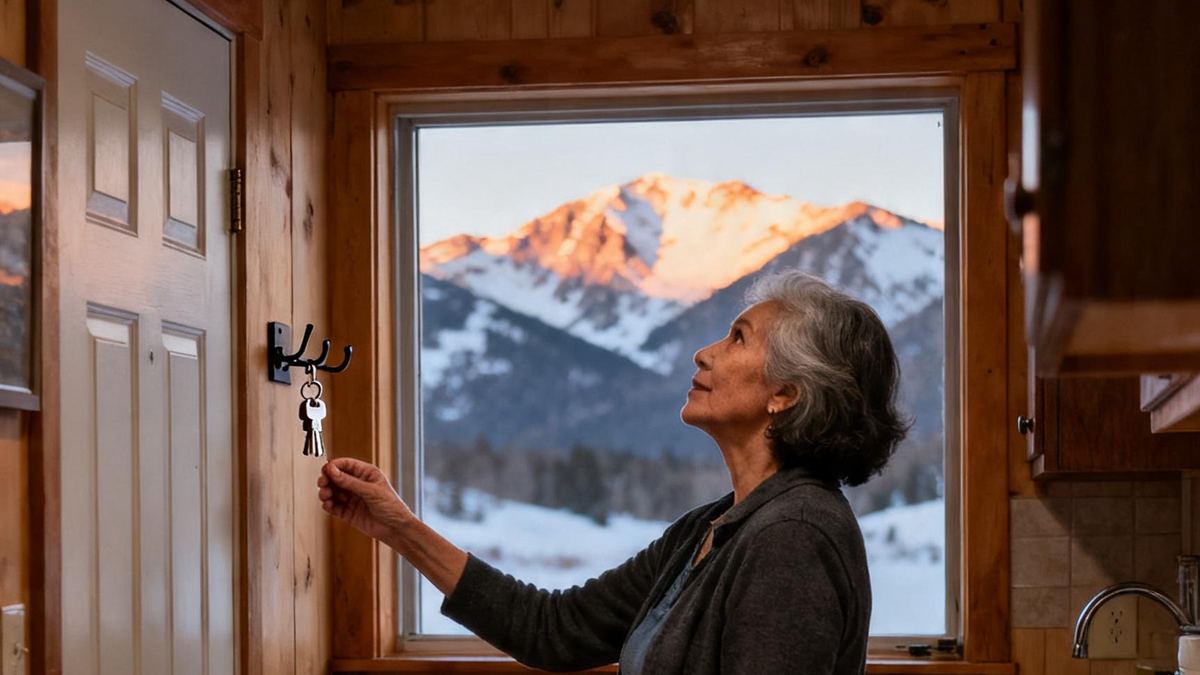
In December, I did what I’d been planning since my mother passed. She’d left me a little money, tucked away in a separate account at a credit union in Denver—something Harlan knew nothing about. I’d been eyeing a cabin near the Gunnison River, a place with a red metal roof and a porch aimed straight at the sunset over the West Elks. Two rooms, a woodstove, and a kitchen window that perfectly framed Mount Crested Butte, like a postcard someone had tacked up just for me. I closed on it the week before Christmas, and I told nobody.
On New Year’s Day, I packed a suitcase and my favorite enamel saucepan. I took my house key off the ring and hung it on the hook by the door—the same hook where Harlan used to sling his mailbag for four decades. I found him in the den, watching a bowl game with the volume too high. “Harlan,” I said, “I’ve bought a place out near Three Rivers. I’m moving there in the morning.”
He muted the TV. “You’ve what now?”
“Bought a cabin. I want my own space. You’re welcome to visit, but you’ll do your own cooking and sweeping, and you’ll speak to me like I’m the owner of the roof over my head.” I set a manila folder on the ottoman. Inside: a printed list of local meal services, a note about grocery delivery, and a spare key to the cabin. “House details are in there. Wi-Fi password’s on the bottom.”
He blinked at the folder, then at me. “Ada, you can’t just… drive off.”
“I’m not leaving you, Harlan. I’m just not living your script anymore. I’ll come back for the summer farmer’s market, and maybe you can sit on my porch sometime with a cup of coffee you brewed yourself.”
Next morning, I loaded the Subaru with my suitcase, my paintbrushes, and a bag of rye starter. The road unwound through snow-dusted canyons, past frozen waterfalls and a herd of mule deer nibbling the shoulder. The cabin smelled of cedar and cold river. I built a fire, made a pot of strong coffee, and wrapped myself in a wool blanket on the porch. An osprey sliced across the sky. My phone buzzed—a text from Harlan, the first he’d ever sent me: “Where is the iron kept?” I set the phone face-down.
A week later, gravel crunched in the drive. Harlan stood at the door, holding a grocery bag and a bundle of dried sage from our old garden, the one I’d left behind. He didn’t apologize with words. He just set the bag on the counter, looked around the little kitchen, and picked up a potato peeler. “You need help with supper?” he asked. His hands, for the first time in my memory, weren’t waiting to be filled. They were reaching. I pointed at the cutting board. “Peel four,” I said. He peeled six.
The mountains stood blue in the twilight, and I poured us both a splash of whiskey. Outside, the last light hit the ridge, gilding the snow. I sat there, my own key in my pocket, and breathed deep.