The sock under the gas pedal was what got me.
A pink sock. Tiny, with a grey dinosaur on the cuff. It had been there three weeks, ever since I picked up my granddaughter Nora from dance class and she kicked off one shoe to show me a scab on her heel.
Now I was parked behind the rehab clinic on South 27th Street, engine off, snow spitting against the windshield, and the burner phone in my hand said: Friday. Megabus to Minneapolis. Answer me.
I'd never been good at being sixty. Not the aches, not the reading glasses. I could handle those. It was the idea that the best parts were all in the rearview. My wife Carolyn didn't see it that way. She's fifty-eight, a school nurse for Milwaukee Public Schools, and she still makes fun of me for grunting when I get out of the truck. Thirty-nine years married. Three kids. Five grandkids. A house in Bay View with a front porch and a storm door that catches in the humidity.
Then I met Jade at the Aurora rehab clinic after my knee replacement. She was twenty-nine, worked the front desk, and she said my name like "Mar-tin," both syllables, soft. I started finding reasons to schedule appointments. The waiting room had one angelfish that swam tilted and a vending machine that only took exact change, a dollar seventy-five for a bottle of water. I brought her coffee from Colectivo. She never once called me sir.
The No. 27 bus stopped outside the clinic. The fare box had a hand-written sign taped to it that said EXACT CHANGE $2.25. I read that sign every time I walked in, mostly to avoid saying something stupid.
One afternoon I asked her to sit in the Silverado. I don't know what I expected. I told her I had a wife, kids, grandkids. That I wasn't going to lie to her. That being around her made me feel like I was thirty again, and I didn't want it to stop.
She didn't look at me. She fiddled with the zipper on her jacket.
"I'm not going to be your mistress," she said. "I'm not going to be the thing that keeps you awake in a recliner at a nursing home. Choose. Me or them."
The word nursing home did something to my stomach. I was sixty, not dead. But she said it like I was already parked in the driveway with the lights off.
I asked for time. She gave me three days.
By then I had already cosigned the loan on a 2018 Ford Fiesta for her. Three thousand one hundred down, three hundred twelve a month, and I paid her insurance on the fifth. One hundred ninety dollars. She had a job and bad credit after a divorce. I told myself I was helping. I told myself a lot of things.
That Thursday, I watched Nora, Miles, and Jacob while Eric picked up an extra shift at the beer distributor. I made mac and cheese from the blue box and cut up hot dogs. Nora dipped hers in ketchup the way Carolyn's mother used to. Miles asked me to draw a T. rex with chalk on the driveway. My hand cramped around the chalk. I did it anyway. A pink T. rex with too many teeth.
At nine, Eric came back and said, "Thanks, Dad. You look like hell."
I didn't answer. The burner phone buzzed in the front pocket of my flannel.
That night, I opened the glove box. The title to the Fiesta sat there under a pack of Huggies and a tire gauge. I flattened it on the center console and read both names. Martin Delano. Jade Workman. My signature, then hers. I'd watched her sign it outside the dealership with a purple pen.
I knew what I had to do. Not because I found some noble reason. Because the sock under my gas pedal felt heavier than the phone in my pocket.
Friday afternoon, I met Jade at the Culver's parking lot off I-94, by the airport. The wind off Lake Michigan cut through my coat. She got out of the Fiesta, the same car I'd cosigned. I had a manila folder under my arm.
"I made a choice," I said.
She looked at the folder.
"I closed the account at Landmark. The title's signed. It's yours. The payment comes out of your account starting Monday. Insurance too."
She shook her head. "You can't just —"
"I can." I tapped the folder against her door. "It's all in there. You keep the car. You keep the two thousand I put in the glove box. But you don't keep me. I'm not your nursing home, and I'm not your bank."
She said nothing. Then she laughed, but it didn't reach her eyes. "You'll be back. They always come back."
I didn't answer. I started walking toward the Silverado.
I didn't go straight home. I took the truck out to Bay View Park and sat with the engine running until the snow turned to rain. Then I drove to our house on Clement Avenue. The neighbor's beagle, Clyde, started barking at the mail truck even though it was nearly six and the mail truck was already gone.
Carolyn was in the kitchen, measuring coffee into the percolator. I set the burner phone and the Landmark statement on the counter next to the sugar bowl.
"What's this?" she asked.
"I almost did something I couldn't take back," I said. "I have to tell you."
She picked up the phone, then set it back down. Her hand went to the faucet and stayed there.
"Tell me now," she said.
So I did. I told her about the front desk and the angelfish that swam tilted, about the coffee from Colectivo, about the Silverado in the clinic parking lot and the word nursing home that had lodged itself under my ribs. I told her about the Fiesta, the three thousand one hundred down, the insurance on the fifth. I told her about the folder, the two thousand dollars, the purple pen outside the dealership. I did not leave anything out. I did not make myself sound better than I was.
Carolyn didn't cry. She turned off the tap, dried her hands on the dish towel hanging from the oven handle, and folded it in half, then in half again, the way she always did, edges matched up neat. She set it on the counter. She picked up the Landmark statement, read it front and back, and put it down exactly where it had been.
"Thirty-nine years," she said, "and you let a girl who calls you Mar-tin decide whether I get a husband or a story I tell our grandkids about the year you lost your mind."
"I didn't let her decide anything. That's why I'm standing here."
"You're standing here because it's Friday and the three days ran out." She said it flat, not a question. Her eyes went to the window, to Clyde sniffing along the fence line, and stayed there a moment before coming back to me. "I'm not going to pretend that doesn't matter."
"It matters," I said. "I know it does."
She picked the percolator up off the stove, set it back down without filling it, like her hands needed something to do and then didn't. "I watched my mother stay with a man who did less than this and call it loyalty. I'm not doing that. If I stay, it's not because I don't have anywhere else to go. I've got the house on my grandmother's side, I've got my own pension, I've got Linda in Sheboygan who's been asking me to move in with her since March. I could go tonight."
"I know."
"So don't stand there looking grateful. I haven't decided anything yet."
She walked past me, into the mudroom, and I heard her rooting through the coat closet. For a second I thought she was leaving, coat and car keys and gone, and my chest went hollow in a way the rehab clinic parking lot never had. Then she came back holding an old shoebox, the one where she kept photographs she hadn't gotten around to putting in albums. She set it on the table and took the lid off. On top was a Polaroid from our wedding, 1987, her in a dress her sister had altered twice, me with hair.
"You're going to sell the truck," she said, not looking up from the box. "Whatever the Silverado's worth, it goes to the emergency fund, and I don't want to hear about it again. You're going to tell Eric and the kids the truth, not some version where you come out looking like you found Jesus in a Culver's parking lot. And you're going to go to counseling with me, every other Tuesday, starting next week, because I am not interested in trusting your word alone for the next twenty years."
"Okay."
"That's not a yes to staying. That's the price of finding out."
I said okay again because it was the only word left in me that made any sense.
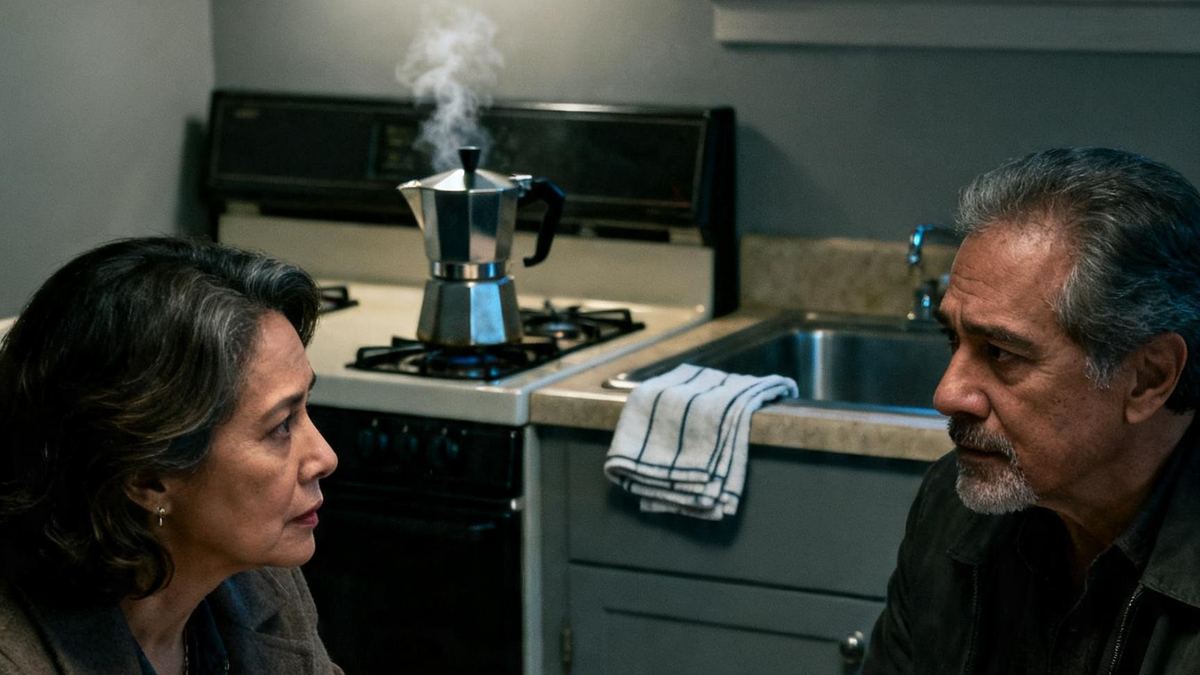
She closed the shoebox and set it back on the table between us, the Polaroid corner sticking out from under the lid. Then she filled the percolator with water from the tap, spooned in the coffee, and set it on the burner. The gas caught with a small blue ring of flame.
"Sit down, Martin," she said. "It's going to take a few minutes."
I pulled a chair up to the table across from her, and we sat there while the percolator started to knock and hiss, not talking, the smell of the coffee filling up the kitchen the way it had every morning for thirty-nine years, and neither one of us moved to turn on the light over the stove, so we just stayed there in the gray, waiting to see if it would boil over.