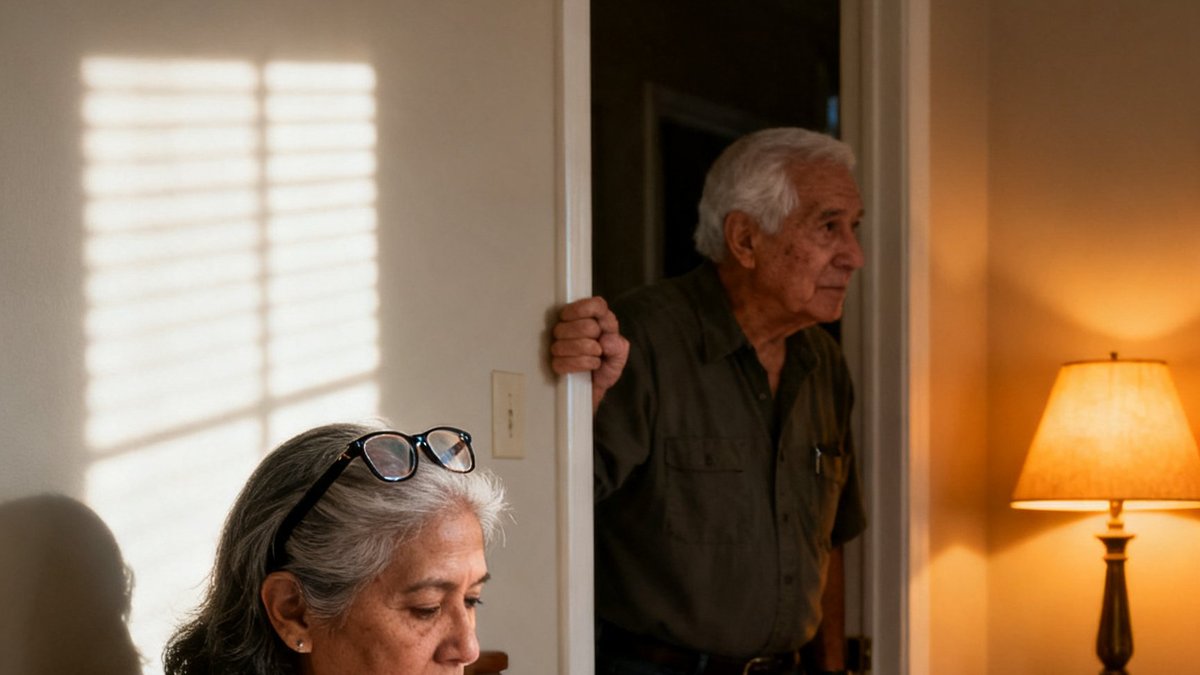
For a while, I told myself it was nothing but tiredness. My wife Carol had started slipping off to bed earlier and earlier, and I figured that was just what happened at sixty-nine — you get tired, you turn in early. It took me until a Tuesday in March, walking down our hallway in Dayton, Ohio, past the thermostat she keeps set at sixty-eight no matter what I say about the gas bill, to understand it wasn't sleep she was after at all.
My name's Walter. I'm seventy-one, retired from the machine shop out on Route 4 after thirty-eight years running a lathe. Carol and I have been married forty-one years. We raised two boys in this house — a brick ranch with a carport, half a mile from the Kroger, close enough that Carol still walks there most mornings for her coffee and the paper, even though everybody gets their news on a phone now. She likes the paper. Says the phone gives her a headache.
We were never the same kind of sleeper. I've always been a night owl — used to work third shift for a stretch in the eighties, and something in me never fully switched back. Carol's the opposite, up with the birds, usually has the coffee going before six. But for most of our marriage we still went to bed around the same time, ten thirty or eleven, her reading a few pages and me falling asleep with the lamp still on.
About eight months ago, that started changing. She'd say goodnight at ten. Then nine thirty. There was a stretch in January where she was gone from the living room by nine fifteen, and I'd sit there with the Reds pregame or some rerun of Wheel of Fortune, not thinking much of it. Winter does that to people. Dark by five thirty, cold out, nothing wrong with wanting to be under the covers.
Then one night I went looking for my phone charger — the good one, the fast kind, not the cheap one that takes all night — and I found it on her nightstand. She was sitting up in bed with her reading glasses on, wide awake, a library book open in her lap. Not sleepy in the least.
"Thought you'd be out cold," I said.
"Nope," she said, and turned a page.
I didn't think much of it that night. But it kept happening. She'd disappear from the couch, and I'd find her later, lamp on, perfectly alert, working through some paperback with a cracked spine from the library sale. That's when it clicked — she wasn't tired at all. She was leaving.
So I finally just asked her straight out, sitting at the kitchen table one Sunday with the dishes still in the sink. She set her book face-down on the placemat and said, "I'm tired of spending every evening watching whatever you want to watch."
That stopped me cold. We've got two TVs in this house — one in the den, a decent one Carol picked out herself two Christmases ago. I said as much. Why not just watch her own shows in there?
"Because then we eat dinner and disappear into separate rooms," she said. "That's not better."
That was the start of a conversation I hadn't seen coming. Carol laid it out plain: since I retired, our whole routine had shrunk down to almost nothing. I had my recliner, my ballgames, my Fox News at six and my westerns after. She'd sit next to me most nights even when none of it interested her, and somewhere along the way she just stopped bothering to say so. She'd pick up a book instead and quietly head for the bedroom.
"We haven't had a conversation longer than fifteen minutes in I don't know how many months," she said.
I wanted to argue with that. Instead I sat there trying to remember the last real conversation we'd had — not "did you take the trash out" or "the Hendersons are putting up a fence" — an actual conversation. I came up empty. We were under the same roof, eating the same meals, pushing the same cart through the same Kroger on Saturdays. But most of the time, we were just occupying the same square footage.
I asked her if she was tired of me.
"I'm tired of how we live," she said.
Those aren't the same thing, and it took me a couple of days to really sit with that difference. I'll admit I was sore about it at first — sore in that stubborn way where you know somebody's got a point but you don't want to hand them the satisfaction of saying so. What felt like peace to me, forty-one years settling into something comfortable, had apparently felt like something closer to loneliness to her. She admitted her part too — that pulling away quietly every night without a word wasn't fair to me either. Neither of us had done anything wrong on purpose. We'd just stopped noticing each other, one remote-control evening at a time.
We didn't fix it overnight, and there wasn't any single big moment where everything turned around. It was smaller than that. Two nights a week, we agreed, the TV goes off after dinner. Some nights we actually talk. Some nights we play gin rummy at the kitchen table, the same deck of cards we've had since our younger son moved out. Some nights, if the weather holds, we walk down to the cul-de-sac and back, past the Petersons' dog barking at us through the fence like he's never seen us before in his life, though we've lived four doors down from him for fifteen years.
We kept some things separate too. I still watch my games. Carol joined a book club that meets Thursday mornings at the library branch on Wilmington Pike, and she comes home from those talking faster than I've heard her talk in years. Funny thing is, once we started spending a little less time parked next to each other doing nothing, we actually started missing each other a bit during the hours apart.
A few weeks ago, Carol went to bed early again, right around nine. I asked if something was wrong.
She laughed. "No — tonight I'm actually just tired."
I clicked off the TV, sat there a minute in the dark listening to the furnace kick on, then walked back and checked that her lamp was off before I turned in myself.