Snow and frozen wind tore into the chamber, snuffing out half the torches in a single breath. The orchestra died mid-note. Hundreds of nobles stood frozen beneath crystal chandeliers, silk and jewels suddenly meaningless.
Standing in the heart of the storm was a girl of no more than eight years old.
Small.
Alone.
Her black hair was soaked and plastered against her pale face. Snow clung to the torn edges of a royal blue cloak. With every step she took, a wet print bloomed across the ancient stone floor, then vanished.
Twenty knights drew steel.
“Stay back from the throne!” Captain Roderic’s voice shook the rafters.
The girl kept walking.
What terrified the court — what made grown men step backward without meaning to — was the simple, impossible fact that no child survived the Frozen Lands alone. The cold out there didn’t negotiate. It didn’t spare the young or the innocent.
And yet here she was. Royal blue and all.
Lord Kael rose from his seat beside the empty throne. Five years had passed since King Alaric vanished. Five years during which no man in Eldoria had held more power, made more decisions, or slept more soundly on borrowed authority.
“Who are you?” Kael’s voice filled the hall.
The girl did not answer. She did not slow.
The knights blocking her path began to move aside — not on command, not on instinct, but as if something ancient and weightless was walking beside her, and they simply could not bring themselves to stand in its way.
When Kael finally stepped in front of her, she didn’t flinch at his sword. She didn’t look at the deep scars carved across his face.
Her eyes dropped lower.
To his wrist.
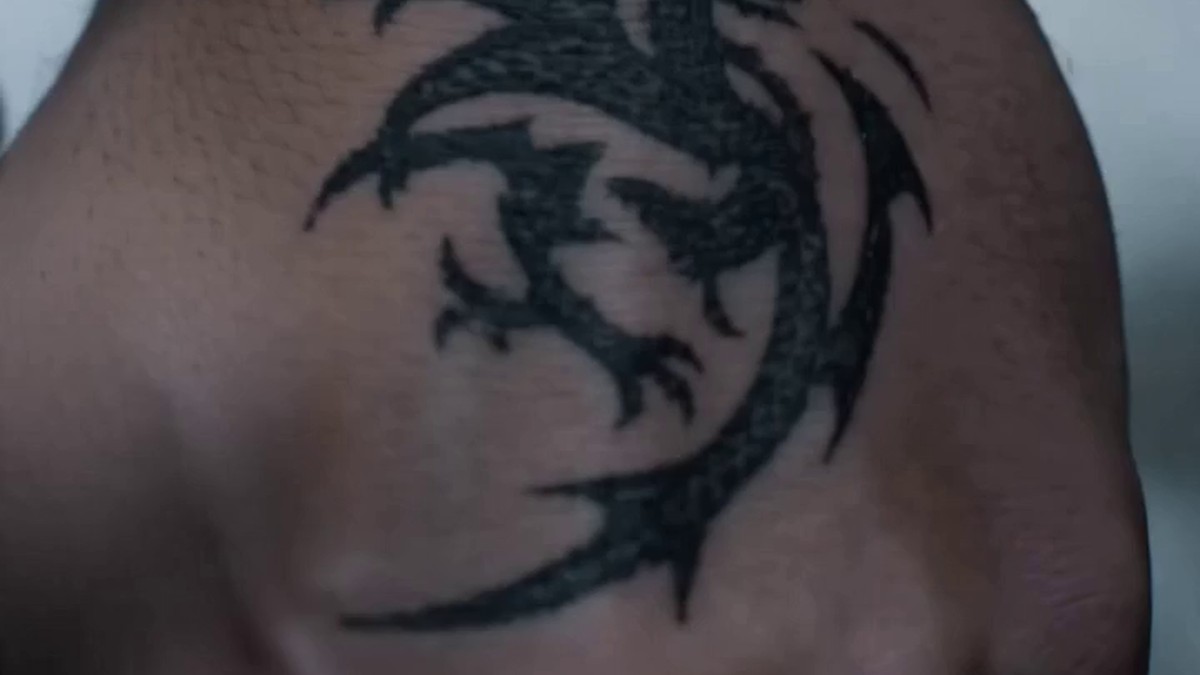
To the sacred dragon emblem of the royal legion, burned into his skin years before any of this began.
A small, trembling finger rose and pointed directly at the mark.
Kael’s jaw tightened. “How do you know that emblem?”
For the first time in five years of absolute composure, something behind his eyes cracked open.
The girl’s voice was barely a sound.
“My father…”
The entire hall held its breath.
“My father carried the same mark.”
The word detonated in the silence like a stone dropped into still water.
*Father.*
Rings spread outward — through the courtiers, through the knights, through the candlelight itself — and when the last echo died, the Great Hall was more quiet than it had ever been. More quiet than stone walls and winter wind should allow.
Kael did not move.
He was a man who had survived a dozen battles, three assassination attempts, and five years of governance sharp enough to cut glass. He had learned long ago that the safest response to surprise was stillness. Let the other person fill the silence. Let them show their hand.
But his hand — his wrist — had gone cold.
“Child.” His voice came out measured. Careful. “You are confused. Lost. The cold does terrible things to the mind.”
“I’m not confused.”
She said it without anger. Without fear. The way a person states a fact that has been true their entire life.
“I walked from the Frozen Lands because the men you sent stopped looking for me there.”
The sentence hit like a blade finding a gap in armour.
*The men you sent.*
A murmur moved through the hall — the kind that starts in the throat and dies before it reaches the lips. Lady Vorn, standing near the eastern pillar, pressed her fingers to her mouth. Old Brennan, the court historian, took one slow step forward and then thought better of it.
Kael’s composure held. He was very, very good at this.
“I sent no men to the Frozen Lands.”
“You sent them to make sure no one came back from them.” She looked up at him now, full in the face. Her eyes were the exact colour of iron in winter — grey, and cold, and absolutely certain. “My father came back anyway. Three years ago. He didn’t make it past the border.”
The hall stopped breathing.
“He sent me on ahead.” Her voice cracked for the first time — just once, the way ice cracks before it holds again. “He told me to memorise everything. The mark. The words. The name of the woman in the capital who would know the truth.”
“And what name is that?” Kael asked.
It was the wrong question to ask in a room full of witnesses, and the half-second after he said it — the half-second in which he understood that — was visible in his face. Just barely. But visible.
The girl turned.
She turned away from Kael entirely, which was either the bravest thing anyone had done in this court in five years or the most catastrophic. She turned toward the crowd, toward the silk and the jewels and the frozen, frightened faces, and she said the name loudly enough for every person in the hall to hear it.
“Maren Ashveil.”
—
No one moved.
Then, from the back of the hall, near the servants’ door, a woman in grey took one careful, deliberate step forward.
She was not young. She was not dressed for court. She had the hands of a woman who had spent years doing work that other people pretended didn’t need doing — hands that knew cold water and rough rope and the particular weight of secrets carried too long.
She had been there all evening. She was there most evenings. Seventeen years as the court’s head of household records, and no one looked at her anymore.
That was, Maren Ashveil understood, rather the point.
“My lord Kael.” Her voice carried without effort. “This child is telling the truth.”
The room lurched.
Kael moved first — and it was the movement that condemned him. Not his words. Not his face. The way his hand went to his sword with the speed of a man who had prepared for exactly this moment, who had rehearsed it, who had known for five years that one day the hall would fill with exactly this kind of silence.
“Seize the woman,” he said. “Seize the child.”
But something strange happened.
The knights looked at him.
And then they looked at the girl.
And the girl had drawn nothing, threatened nothing, raised no weapon and spoken no spell — she simply stood there in her soaked cloak with her wet footprints drying on the ancient floor, and the dragon mark on Kael’s wrist seemed to burn in the torchlight between them, and the twenty knights of Eldoria did not move.
“Captain Roderic.” Kael’s voice dropped to something dangerous. “I gave an order.”
Roderic was a broad man, scarred from the same wars that had built this kingdom. He had followed Kael’s orders for five years without hesitation. He was, by every measure, the wrong person to lose in this moment.
He took two steps forward — toward Kael — and stopped.
“My lord,” he said slowly. “The emblem she described. The wrist mark.” He paused. “That mark was given only to the king’s personal guard. Seven men. I knew three of them.”
“This child was told a story by a desperate man—”
“King Alaric had a daughter,” Roderic said. “She would be eight years old.”
It landed like an axe.
Kael turned. He was calculating — you could see it, the way you can see a fire deciding which direction to burn. The doors behind him were still open. Snow still curled through the entrance. The night beyond was very dark and very cold.
“You would take the word of a child over—”
“Tell me where the king is.”
The voice came from the girl.
Just that. No title, no deference, no softening. The question had been inside her for three years and it had worn all the edges smooth on the way out.
*Tell me where the king is.*
Kael’s jaw worked.
“Your father,” he said, “made choices. He discovered things that were not meant to be discovered. Men who find themselves in possession of dangerous knowledge have a way of—”
“Is he alive?”
The silence that followed was its own kind of answer.
She had known, probably. Children who walk alone through the Frozen Lands have already made peace with most of the terrible possibilities. But knowing and hearing are different countries, and the girl’s face crossed from one to the other in the span of a single breath — the chin dropping slightly, the eyes going very still, the way grief arrives not as collapse but as stillness, the body becoming suddenly, completely quiet.
Maren Ashveil crossed the hall in fifteen measured steps.
She placed herself beside the child. Her grey dress against the girl’s royal blue cloak. She did not speak. She did not need to.
Kael looked at the two of them.
He looked at the hall.
He had built five years of power on a single foundation: that King Alaric had vanished, and vanished men leave voids, and voids require filling. He had filled it carefully, efficiently, and without sentiment. He had made Eldoria run. He had kept the borders, fed the cities, adjudicated the disputes. He had done the work of kingship without the crown.
And he had done one other thing, one night at the border, in the cold and the dark, and that one thing was now standing in the centre of his hall in a blue cloak, and the hall was very quiet, and the knights had not moved.
He drew his sword.
—
It was Roderic who stepped forward.
Not the girl. Not Maren. Roderic, who had known three of the seven men who carried the dragon mark, Roderic who had served for twenty years and followed orders for five of them without asking the questions he should have asked, Roderic who understood that there are moments when a man must choose between the authority he serves and the thing that authority was supposed to protect.
“My lord Kael.” His blade cleared leather. “I would ask you to set it down.”
“You are making a fatal mistake—”
“I’ve made them before.” He took another step. “I’m still here.”
The two swords were between them now, one drawn in calculation and one drawn in decision, and the court of Eldoria pressed back against the walls and the snow kept coming through the open doors and the girl in the blue cloak stood and watched with those iron-grey eyes and did not look away.
Kael was the better fighter. Everyone in the room knew it.
He was also the man who had just admitted, without saying the words, that a king was dead and a child had walked alone through the winter to find out why.
He looked at his blade.
He looked at the girl.
Something in his face — not remorse, not quite, but something adjacent to it, the last cold chamber of a man who had once believed the ends would justify the means and was now watching them refuse to — collapsed inward, and he was just a man standing in a hall full of people who were no longer afraid of him.
He lowered the sword.
Roderic was on him in three steps — the blade stripped away, the arms held fast, the movement practised and clean and final.
—
The hall exhaled.
It took a long time. People do not realise how much they have been holding until they are allowed to stop.
Maren knelt — slowly, with the careful respect of a woman who had carried seventeen years of waiting — and looked the girl in the face.
“Your father was a good man,” she said. “He knew what he was carrying when he crossed back. He knew they would be waiting.” She paused. “He made sure the right things survived.”
“He made sure *I* survived,” the girl said.
“Yes.” Maren’s voice was very quiet. “That was always the more important thing.”
The girl looked past her, at the empty throne at the far end of the hall. It sat exactly where it had always sat, high and dark and draped in the blue standard of Eldoria — the same blue as her cloak. Someone had kept it polished. Someone, all these years, had kept the throne clean.
She looked at Maren.
Maren nodded.
The girl walked the length of the hall alone.
The wet footprints followed her, bloomed and faded, bloomed and faded, all the way to the dais. The knights parted. The nobles parted. The snow came through the open doors behind her in slow, aimless spirals, as if it had nowhere else to be.
She climbed three steps.
She turned and faced the court — hundreds of faces, silk and armour and candlelight, all of it tilted toward her like a field turning toward the sun.
She did not sit.
She was eight years old and her father was dead and she had walked through the dark alone and she was not ready to sit, not yet, possibly not for years.
But she stood in front of the throne of Eldoria, and she did not look small.
“My name,” she said, into the silence of the hall, into the hush of five years of held breath, “is Elara. Daughter of Alaric.”
She let it settle.
“And I have come home.”
The last torch that the wind had snuffed guttered back to life somewhere in the dark above her.
The snow kept falling outside.
And in the Great Hall of Eldoria, very slowly, one by one and then all at once, every person in the room went to their knees.