The first time, I blamed the weather. The second time, a sick kid. By the time we hit the fifth of July last summer, I had stopped making excuses for them and started keeping receipts.
I sat at the kitchen table at six in the morning, the window open, the air already thick as broth. Our neighbor’s hound was running the fence line with the same question he asks every day. I had a calculator, a stack of Kroger receipts, and a legal pad with two columns. One column said what I’d spent. The other said what they’d brought. That second column was blank on purpose.
Three years. Four cookouts a summer. Brisket, ribs, pulled pork. Charcoal, hickory chunks, aluminum pans. Potato salad, slaw, cornbread, four kinds of sauce. Beer, soda, ice. My husband Sean’s sister, Colleen, and her husband, Dan, and their two boys—they’d roll up around one, eat until four, then load paper plates with leftovers and wave from the driveway. Every damn time, empty-handed. Every time, Sean’s mother would say, “They’re family, you don’t nickle-and-dime family.”
So I didn’t. For a while.
This year, I did the math. Three years times four cookouts times roughly two hundred dollars a pop. I rounded down to be fair. Two thousand three hundred dollars. And in all that time, Colleen had once brought a bag of ice. I know because I watched Dan make a show of pulling it from the trunk like it was a bottle of champagne.
The envelope was my idea, but it didn’t feel like mine by the time I was finished. It felt like something the kitchen finally said. I typed it on the computer in forty-point font because I didn’t want any squinting, and I slipped it into a plain white envelope along with a copy of the receipt from last year’s biggest cookout. Two hundred and eighty-one dollars and sixty-two cents. I underlined the total in red pen.
At noon, Sean was in the backyard fiddling with his new smoker—a barrel-style rig he’d bought off Facebook Marketplace in April—and I was inside setting the table when Colleen’s minivan crunched up the gravel driveway. I heard the sliding door open before the engine died. I heard the boys yelling about the dog.
Colleen came through the back gate with a Tupperware bowl of watermelon. Pre-cut, store-bought, maybe six cups. She set it on the table and said, “Don’t say I never give you anything.”
I counted to ten by pressing my thumb into each knuckle. Then I went inside, took the envelope off the counter, and carried it out to the yard with the same hand I’d have used to carry a hot dish.
“Before anyone makes a plate,” I said, “we’re going to settle last year.”
Colleen laughed, thinking it was some kind of bit. Her laugh is a honk, short and sharp. Then she saw I wasn’t laughing back. Her hand stopped halfway to the chips.
I held out the envelope. She took it, opened it, read it. Her face went from tan to tomato in about three seconds. That’s the thing about a bloated carbon monoxide reading—it doesn’t care how you feel inside.
“Are you serious?”
“Two hundred and eighty-one sixty-two,” I said. “That’s what I spent. I’m not asking for half. I’m asking you to show up with something that isn’t a bag of ice or a story about how busy your week was.”
Dan stepped in then, palm up, voice low, the way he probably talks to his golf buddies when a putt goes wide. “So this is what it’s come to? We’re handing out bills at a family cookout?”
“No,” I said. “This is what it’s come to. I’m the one who bought the meat, made the sides, cleaned the deck, and stayed up until one in the morning so the brisket would rest. You’re the ones who ate it and left me the dishes. The bill is the proof of who did what.”
Sean came over from the smoker with the temperature probe in his hand. He stood next to me, not in front of me. That was new. “She’s been up since Thursday,” he said quietly. I did not need the backup, but the sound of it made something in my chest drop a half-inch.
Colleen folded the envelope and put it on the picnic table. She and Dan exchanged a look that could’ve cut the screen door off its hinges.
Then Dan said, “We’re not paying for a party nobody invited us to on paper.”
“Fine,” I said. “Then you can watch the party from the porch.”
I walked to the smoker, pulled the brisket, wrapped it in butcher paper, and set it in the passenger seat of my sister’s Honda. Then I went back and took the potato salad, the slaw, the ribs, and the two racks of beer. I left the watermelon, the chips, and a loaf of white bread on the table. My sister Eileen, her wife, and their daughter started gathering their things, laughing—not at Colleen, the way family sometimes laughs when danger passes close, but at the absurdity of me loading a two-gallon pitcher of sweet tea into a car with both hands and a hip check.
We drove to the lake at the end of our road. Ten people, two cars, a trunk full of food. The minivan stayed in the driveway. I didn’t look back.
That night, Sean called. I was sitting on the dock with my feet in the water, watching the last of the light get swallowed by the trees. I thought he might tell me I’d gone too far. Instead he said, “I was so used to their version of things that I stopped noticing the math. You didn’t ruin the cookout. You ruined the trick.”
A week later, I got a Venmo alert. Two hundred and eighty-one dollars and sixty-two cents. The note attached read only, “Fine.” No apology, no please, no thank-you. That was fine with me. I didn’t spend it. I put it in a jar on top of the fridge with a piece of blue painter’s tape and a label: “Next time they touch the smoker.”
The first Saturday in August, I sent out a new list. Smaller. My sister’s family. Two neighbors who’d brought more than opinions all summer. A guy from Sean’s work who once fixed our gutters without being asked. Colleen and Dan were not on the list. Sean’s mother called twice. I let the machine get it both times.
At that August cookout, we ate brisket and ribs with no envelopes and no receipts. One of the neighbors brought homemade cornbread in a cast-iron skillet. Eileen’s wife brought a watermelon sliced into wedges, not chunks from a plastic container. The guy from Sean’s work brought a growler of beer from a local brewery and his own bottle opener because he’d heard the story and thought it was the funniest thing he’d ever heard.
I didn’t think it was funny. I thought it was a long time coming.
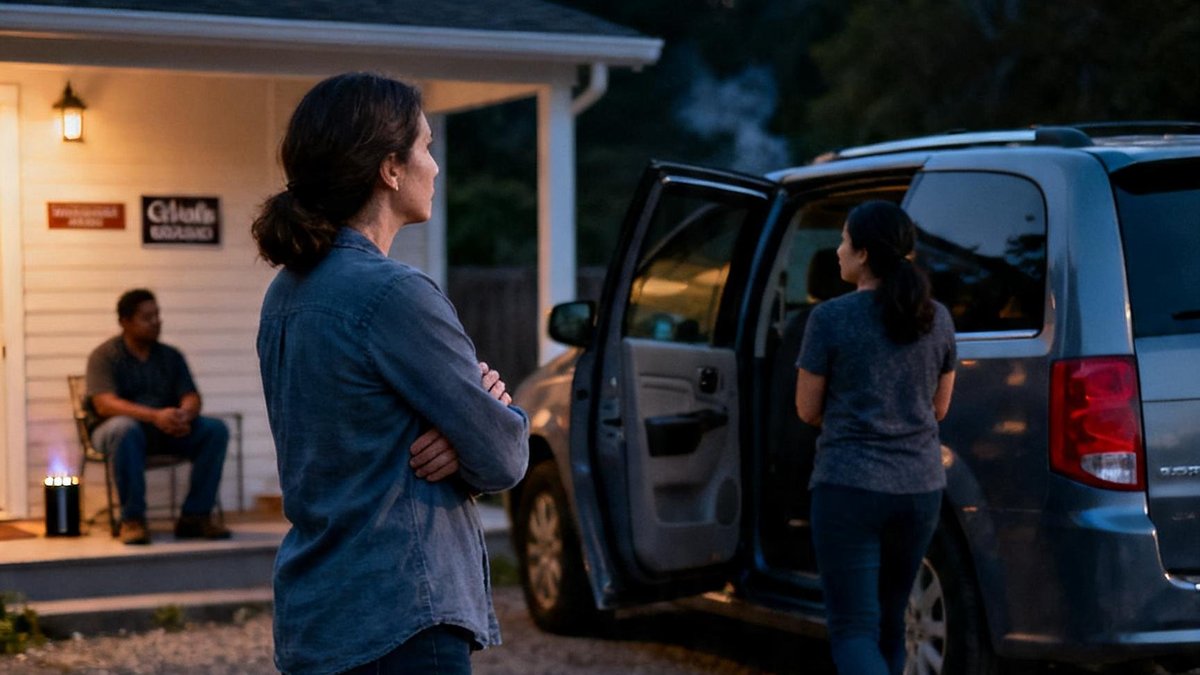
Colleen showed up once more, in September, to pick up a table she’d left at our house from some church event. She stood in the driveway with the sliding door open. The hound next door went still, watching her like he knew. I carried the table out, set it by her van, and went back inside.
Halfway to the porch, she said, “You know, you could’ve just asked me to bring something.”
I turned around. The words were already out before I could stop them.
“I did,” I said. “Every year for three years. You just never heard it because you were too busy being the guest.”
She opened her mouth, then closed it. The sliding door of that minivan shut with a sound like a receipt being torn from a register.
I went inside, locked the screen door, and checked the smoker. It was still warm.