David said it right over the Wednesday meatloaf — just laid it out like a weather report.
“That beach house was paid for with *my* salary, Claire. For forty-seven years, you haven’t put a single dollar into this marriage.”
The peas on my fork stopped halfway to my mouth. Outside the kitchen window, the November rain hammered our little Portland bungalow, the same rain that had been rotting the windowsill for three winters now. I’d asked him to fix it. He’d said we didn’t have the money. But that morning he’d brought home a brochure for a sport-fishing boat, and when I said no, he’d brought up selling the Cannon Beach cottage. That’s how we got to the meatloaf.
I set the fork down. “I raised our kids. I took care of your mother for eleven years.”
David didn’t even lift his eyes from his plate. “Mom lived here. You were her daughter-in-law. That was just family.”
Just family. As if the words cancelled out the bedpans, the three-a.m. wandering when the dementia got bad, the feeding tubes toward the end, the fact that I’d learned how to change an IV bag at fifty-six years old because the home health aide didn’t show up on Christmas Eve. All of that sat on the table between us, cold and invisible as the mashed potatoes I was about to scrape into the trash.
We met in 1976, right out of college. I was Claire Harper then — worked as a loan officer at First Interstate Bank downtown, wore heels, had a 401(k) and a beige file cabinet that was all mine. After we got married, we bought this house on a tree-lined street in Montavilla. The market was different then. You could buy a whole bungalow for sixty-eight thousand dollars, and we did, with both our signatures on the deed.
When the twins came, day care was going to eat ninety percent of my paycheck. David sat at this same table and held my hands. “Just until kindergarten,” he said. “Then you go back.”
Kindergarten came. And then Emma was born, two years later, a surprise. We kept saying “next year.” Then David’s mother, Margaret, slipped on her back porch in Beaverton, broke a hip, and never really came back from the anesthesia — her memory started unraveling in chunks. His two brothers lived in Florida, sent Christmas checks. So I packed up the boys’ bunk bed and moved Margaret into the office. That was 1998. She died in my guest room in 2009. Eleven years.
I didn’t begrudge her. She’d been a stern woman, all Presbyterian and pressed napkins, but toward the end she’d grab my wrist and whisper, “You’re still here.” The problem wasn’t Margaret. The problem was that somewhere along the way, David’s bookkeeping had turned me into a dependent.
I tried to bring in money. For three years I baked banana bread — seventy loaves a week — and sold them at the church coffee hour and the farmer’s market. Made four hundred and thirty dollars a month on a good run. It always disappeared: sneakers for the twins, a co-pay for Emma’s ear tubes, a new alternator for the minivan. David never asked where the extra came from. He just filled the tank and assumed the car ran on his paycheck.
By the time of the meatloaf, we were both seventy-one. The kids were grown. The house was paid off, and we had a little over three hundred and twenty thousand in a joint brokerage account. And the Cannon Beach cottage — a two-bedroom cedar shake place we’d bought for a song in ’92 with *both* our names on the original contract, though David had long since “forgotten” that detail. He’d always handled the finances after I left the bank. I’d let him, because I was tired, and because the world teaches you that if you don’t earn the paycheck, you don’t get a vote.
That Wednesday, I loaded the dishwasher, went into the guest room — now my room — and pulled out the deed I’d dug up from the safe deposit box six months earlier. The cottage was still in both our names. I hadn’t been erased after all.
The next morning, I took the number 75 bus to a law office in Lloyd District. A family law attorney named Priya Kapoor looked over our paperwork for an hour and handed me a single sheet of paper.
“Mrs. Leary, you were married under Oregon community property law. Your domestic labor and caregiving have full legal standing. That cottage is half yours. The brokerage account is half yours. He can’t sell a potted plant without your signature.”
I didn’t want a divorce. I wanted a ledger that told the truth.
Two Fridays later, we had an intervention — not with a therapist, but at our own dinner table. Emma drove up from Eugene. Lucas took the train from Seattle, and Noah came over from his condo in the Pearl. I said nothing. The kids said everything.
Emma: “Who stayed up with me when I had mono in high school, Dad? You were in Austin for three weeks.”
Lucas: “Remember when the transmission blew on the old Dodge? Mom sold her grandmother’s opal ring. We all got to school that semester.”
Noah didn’t speak much. Just set a printout on the table. He’d looked up the median cost of a full-time home caregiver in Multnomah County for eleven years — twenty-four-hour care like I’d done — and circled the number. Two hundred and thirty-eight thousand dollars.
David stared at the circle. Then he stood up, chair scraping hardwood, and walked out to the garage. We heard the door slam.
I gave him a week. Then I did what Priya told me I had every right to do.
On a gray Monday, I walked into our credit union branch on Glisan Street and asked for a certified check in my name alone. One hundred and sixty thousand dollars — exactly fifty percent of the brokerage balance, rounded down. The teller blinked twice, checked my ID, and filled out the form. The printer hummed. She slid the check across the counter, and I tucked it into the front pocket of my raincoat.
Down the street, at a different bank, I opened a high-yield savings account under “Claire M. Harper.” No Leary. I deposited the check. Then I used part of it to write another check — thirty thousand — to a licensed contractor who’d been giving me estimates on the new bathroom and the rotted windows for two years.
I came home and put the deposit receipt on the kitchen counter, along with a copy of the cottage deed and a note: *The windows get ordered Thursday. The beach house stays in both our names. Your half is still yours. Mine is finally mine.*
David found the receipt around seven. I was in the den, sorting through old photo albums, which is what I’d done every night for the past seven days. He stood in the doorway, holding the little slip of paper. His thumb kept tracing the bank logo. He didn’t shout. He didn’t sit. He just stood there, and I kept my hands on the album.
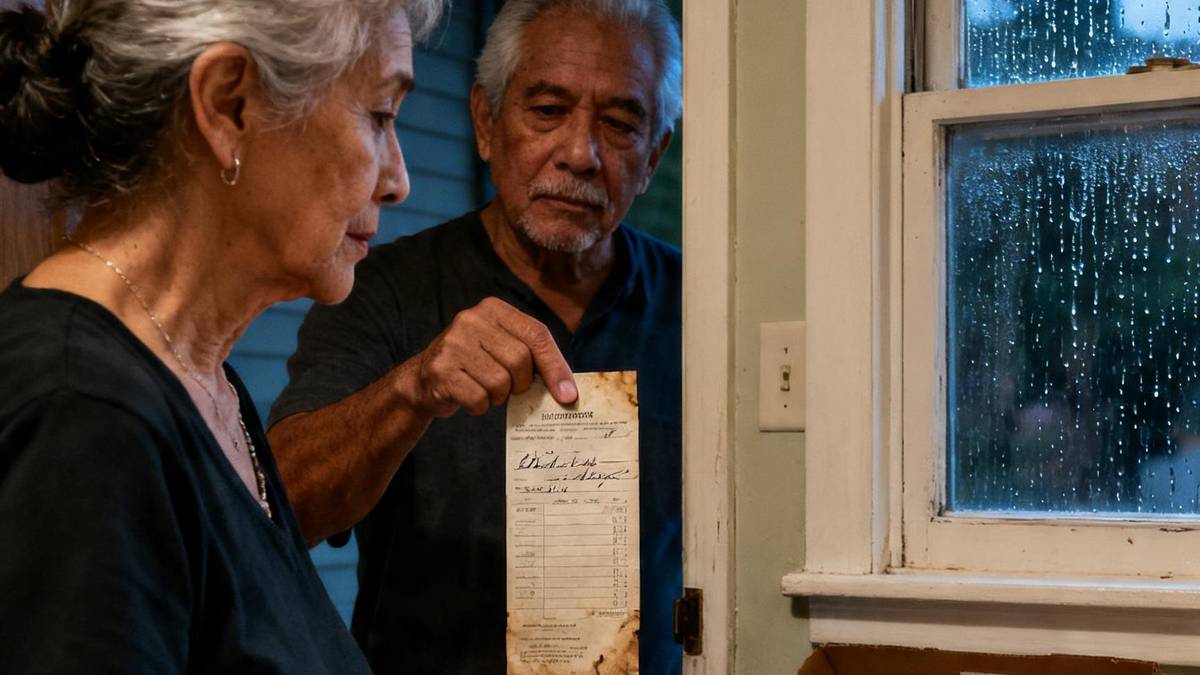
Three days later, he placed a shoebox on the kitchen table. Inside were pharmacy receipts — Margaret’s name, David’s name, and mine, scribbled in blue ink. Co-pays for Aricept, for blood thinner injections, for the hospital bed rental when her lungs filled up. Hundreds of them, rubber-banded together in chunks. He’d kept them in his filing cabinet all this time. I’d never known.
He had no speech. He just lifted a faded receipt from 2005, the one where I’d signed for the emergency oxygen tank delivery, and tapped my signature.
“You signed for everything,” he said.
I lifted the tea kettle, filled it, set it on the burner. The gas clicked three times before catching.
“Yes,” I said. “I did.”
The contractor finished the windows in mid-January. The bathroom got a walk-in shower and a grab bar that doesn’t look like it belongs in a hospital. On the day they put the last pane in, the mail came with a notice from the county assessor’s office — the Cannon Beach property had been re-recorded. The deed now showed a joint tenancy with an explicit right of survivorship for both spouses, filed by my lawyer, signed by David in front of a notary a week after the shoebox incident. He’d gone downtown and done it without telling me.
I still have my separate account. I add to it monthly, from the rent we collect on the cottage now. We don’t talk about “his” and “mine” anymore — not since the shoebox, not since the check.
But every year, on the anniversary of the Wednesday meatloaf, I take a twenty-dollar bill from my wallet and set it on top of that shoebox in the attic. It’s not for David. It’s for Margaret. For eleven years of alarm clocks and sponge baths. For a number that never appeared on a W-2.
And if you ever wonder whether a life of unpaid labor adds up, I can tell you exactly what it equals — down to the dollar.