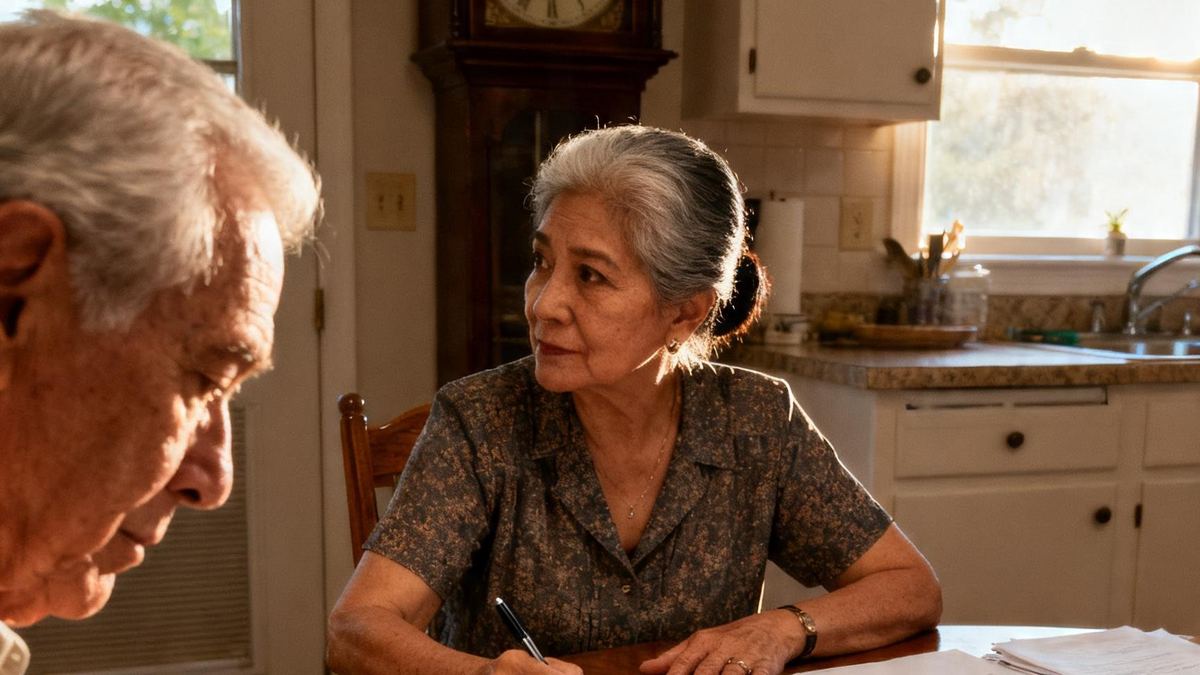
I married Ray in the fall of ’81. I was twenty-three, had a decent head for numbers, and worked the front desk at a dental supply office in Winston-Salem. The pay wasn’t spectacular, but it was mine. Direct deposit every other Friday, a drawer full of my own pens, a coffee mug with my name on it in the breakroom. Little things that added up to a person who existed outside her living room.
Our daughter came first. Two years later, the twins. By the time the youngest was out of diapers, we ran the numbers. Full-time daycare for three kids in North Carolina? I would’ve been working just to hand my paycheck to the daycare center. Ray sat at the kitchen table with a yellow legal pad and said, “It makes more sense for you to stay home. When they’re all in school, you go back.”
I held him to that promise for exactly two years.
The summer before the twins started kindergarten, Ray’s mother slipped on a wet floor at the Food Lion and fractured her hip. She lived alone in a split-level out in Kernersville, stubborn as a mule and twice as ornery. Ray’s brother was stationed overseas with the Navy. His sister had a high-rise condo in Chicago and visited once a year if we were lucky. So the math did itself again. I was already home. I was already the one who knew which pediatrician took our insurance, which pharmacy had the best price on asthma inhalers, which brand of compression socks didn’t cut off her circulation. Picking up one more set of prescriptions and driving an extra twenty minutes each way felt like the path of least resistance.
I want to be clear: I don’t resent his mother. She was proud and prickly, and she called my meatloaf “adequate” for fourteen years like it was a compliment she rationed. But she also taught me how to can peaches and told me once, when Ray wasn’t in the room, that I was the only one in the family who showed up. That mattered.
What ate at me was the way the rest of them stopped seeing it as *showing up*. It became the weather. It became wallpaper. Ray would come home from the tool-and-die plant, drop his lunch cooler on the counter, and ask what was for dinner while I was on the phone arguing with his mother’s Medicare supplement provider. He’d tell people at cookouts, “I support five people on one salary,” and everyone would clap him on the back. Nobody asked who bathed his mother after her second hip surgery. Nobody asked who sat in the parent-teacher conference when the twins’ English teacher flagged a reading delay. Nobody asked because I was there, and when you’re always there, you’re invisible.
I found ways to scrape together a little cash. I altered prom dresses for the neighbor girls, hemmed pants for the guys at Ray’s plant, sold banana bread and lemon bars at the church bazaar. Two hundred dollars here, eighty there. It went straight into school shoes, a new water heater when the old one rusted through, the copay on Carol’s—that’s our daughter’s—braces. Ray never saw those receipts because I never handed them to him. He saw the braces on her teeth and figured they came from his overtime.
Fourteen years. That’s how long I cared for his mother. Fourteen years of morning medication trays with the little compartments labeled Tuesday-Wednesday-Thursday, of driving her to the dialysis center and sitting in a plastic chair with a paperback while the machines hummed, of pureeing her meals after the second stroke when she couldn’t swallow solids anymore. She passed in her sleep in 2019. I was the one who found her. I was the one who called the funeral home while Ray was in the middle of a shift and couldn’t get to his phone.
After the funeral, Ray said, “Well, that chapter’s closed,” and went back to work.
When he retired at seventy, we sat down at the dining room table to go over the finances. Paid-off house in Clemmons. Two used cars in the garage, both Toyotas. A modest 401(k) Ray had built over forty-two years at the plant. And a cabin up near Boone—a little two-bedroom A-frame we’d bought back in ’98 and hadn’t visited in three years. The roof needed work. The deck was starting to rot.
I said, “Let’s sell the cabin. Use part of the money to make the house work for us as we get older—widen the doorways, put in a walk-in shower. Save the rest for whatever comes.”
Ray didn’t even look up from the stack of statements. “That cabin’s mine. I paid for it.”
I laughed. I actually laughed, because I thought he was joking. Forty-seven years of marriage—you think you know a man.
He wasn’t joking.
“Let’s not get confused, Dina,” he said. He has this way of using my name like it’s a reminder of my place. “The money came from my paycheck. Every dime. You haven’t contributed.”
The room went very still. I could hear the refrigerator hum. The clock on the mantel—the one his mother gave us—ticked five times before I spoke.
“What would it have cost,” I said, “to hire a home health aide for your mother? Fourteen years. Twelve hours a day, some days more. What’s the hourly rate for that?”
He frowned. “That’s different. That’s family.”
“What would it have cost for a housekeeper? A cook? Childcare for three kids?”
“You were their mother,” he said. “It was your job.”
Not *ours*. Mine.
I slept in Carol’s old room that night. The twin bed still had the lavender comforter from when she was in high school. I lay there staring at the ceiling and added it up in my head, very quietly, very precisely. Fourteen years of elder care, at even a conservative fifteen dollars an hour—and that’s not what agencies charge, that’s bargain-basement, under-the-table cash—came out to something north of three hundred thousand dollars. That’s before the housework. Before the children. Before I sold my grandmother’s opal ring in 1993 to replace the transmission in the family sedan.
I didn’t sleep. At eight the next morning, I called a lawyer. Not a divorce attorney—I wasn’t sure yet what I wanted. Just someone who could tell me what I was worth.
Her name was Patricia Okonkwo, and her office was in a brick building downtown with a view of the courthouse. I brought the deed to the cabin, the 401(k) statements, the tax returns, our marriage certificate. She looked at everything and said, very calmly, “North Carolina is an equitable distribution state. All assets acquired during the marriage are marital property. It doesn’t matter whose name is on the paycheck. Your unpaid labor doesn’t show up on a W-2, but the law doesn’t see it as worthless.”
I asked her to put that in writing. She did.
I brought the letter home and laid it on the dining room table next to his yellow legal pad. Ray read it twice. His face went a shade of red I’d never seen on him—not anger, exactly, more like the color of something collapsing inward.
“You went behind my back,” he said. “To a lawyer. You’re trying to take what I built.”
“I’m trying,” I said, “to have my name on what we both built.”
He didn’t speak to me for three days.
The fight spilled over into Sunday dinner. Carol came with her husband and the baby. The twins drove in from Charlotte. We were all sitting around the table with a roast I’d put in the oven at six that morning, and Ray—stubborn, cornered, defensive—brought it up himself. I think he expected the kids to take his side. He’d always been the provider; they’d always seen him that way.
“Your mother wants half of everything,” he said. “Even though she never earned a paycheck in her life.”
Carol set down her fork. “Dad, who took care of me when I had pneumonia in fourth grade and you were at a trade show in Atlanta?”
One of the twins—Marcus, the one who never minces words—said, “Who sold Grandma’s jewelry to fix the transmission on the Corolla?”
The other twin, Andre, said, “Who took care of Grandma for fourteen years while you were at work and Aunt Lisa was in Chicago taking meetings?”
Ray just sat there. The roast got cold. The baby started fussing, and Carol took her into the other room.
He didn’t apologize. Not that night. But something shifted. A crack.
We started seeing a financial mediator—a neutral third party Patricia recommended. It took six sessions. I didn’t want a divorce; I wanted a correction. I wanted the paperwork to match the reality. By the end of it, we had a postnuptial agreement. All assets—the house, the cabin, the retirement accounts—were legally designated as joint marital property. Neither of us could sell anything without the other’s written consent. We also restructured the accounts. A portion of the monthly retirement disbursement now went into a separate account in my name only. Not an allowance. Not a gift. A legal recognition of deferred compensation for forty-seven years of labor that the IRS had never seen fit to tax.
The amount was two thousand dollars a month. Patricia helped me calculate it based on what a full-time caregiver and household manager would have earned over those decades, prorated across our remaining life expectancy. It wasn’t even close to what I was owed. But the number existed. It was on paper. It had my name on it.
A week after everything was signed, Ray came home from the hardware store with a small cardboard box. Inside were old receipts—his mother’s prescription copays, invoices from the physical therapist, a yellowed care log I’d kept in a spiral notebook in 2005. He’d found them in a filing cabinet in the garage.
He set the box on the kitchen island and stood there for a long time, just looking at my handwriting. Finally he said, “Fourteen years of this. I didn’t know there was a notebook.”
“There were six notebooks,” I said.
He nodded slowly. He didn’t cry—I’ve seen Ray cry exactly once, when his father died—but he put his hand on top of mine and left it there. “I don’t know how you did it,” he said.
I didn’t say, “I did it because nobody else would.” He already knew.
We’re still together. I’m seventy-three now. The cabin near Boone got sold last spring; we agreed on it together, both signatures on the closing documents. With part of the money, we put in the walk-in shower and widened the doorways like I’d wanted. The rest sits in a joint high-yield account at the credit union.
Ray has started doing the grocery shopping. He’s terrible at it—last week he bought three jars of capers because he couldn’t remember if we already had any—but he goes. He loads the dishwasher without being asked. He tells people, sometimes, that I “ran the whole operation,” and he says it without flinching.
I don’t ask for permission anymore. Not for new shoes, not for lunch with my sister in Greensboro, not for the monthly transfer that lands in my personal account on the third of every month. I don’t check with anyone before I spend my own money.
Last Tuesday I drove to the bank, withdrew four hundred dollars in cash, and walked two blocks to the jeweler’s. I bought myself a ring—a small opal set in silver, like the one I sold in 1993 to keep the car running. It wasn’t expensive. But I paid for it from my account, with my debit card, and I put it on my finger before I started the car.
I sat in the parking lot for a minute with the engine running, just looking at the stone catch the light. Then I pulled out onto the road and drove home.