The call came just as she merged onto I-40, rain hammering the roof of her Honda CR-V so hard she could barely hear the ringtone. Ellie didn’t recognize the number, but her gut told her to pull over at the next exit. She swerved into a gas station off Charlotte Pike, killed the engine, and answered.
“Mrs. Danielle Thompson?” A man’s voice, crisp and overly polite. “My name is Alan Kirby, I’m a closing attorney with Cumberland Title here in Nashville. I’m calling because we received a signed quitclaim deed this morning transferring your property on Richland Avenue to your husband. I just need to verify the notary block—something looks a little off, and I wanted to confirm you personally appeared before the notary.”
The wipers had stopped mid-swipe, leaving the windshield a blur of brake lights and wet oak leaves. Ellie felt the plastic steering wheel bite into her palms.
“I haven’t signed anything,” she said. “I’ve never even spoken to a notary about my house.”
A pause. “Ma’am, your signature is right here on the copy your mother-in-law dropped off. She said you and David wanted the house in his name for estate planning purposes. She brought a copy of your passport, too.”
Ellie’s throat closed. Margaret. Margaret, who’d shown up at their door four days early “just to help with the fall cleaning”—and who had, on day two, asked with the offhand air of someone commenting on the weather where the deed to the house was kept.
“Mr. Kirby,” Ellie managed, “that house was mine before I ever met David. I bought it eight years ago. I made every mortgage payment. No one has my permission to transfer anything.”
The attorney’s keyboard clacked. “Then I’m stopping the recording right now. I won’t file this deed. But, Mrs. Thompson—you should know the signature on here is a very good match.”
“It’s not mine.”
“I believe you. I’m going to send you a scanned copy right now and flag the file for fraud.”
Ellie set the phone on the passenger seat the second the call ended. She sat there, engine off, rain turning the world outside to silver streaks, and thought about the night Margaret arrived. How she’d walked into the kitchen without knocking, found Ellie at the laptop paying the last of the property tax bill, and had stood right behind her reading the screen. *“You really should put David on the title someday. A man needs to feel rooted.”* Ellie had laughed, said something about rootless men and IKEA furniture, and let it go. She had done that—let things go—for seven years.
She scrolled through her texts from David. The most recent one was from that morning: *“Mom’s just trying to help. Stop looking for trouble.”* It was the same song he’d been singing since the wedding. When Margaret rearranged Ellie’s entire home office because the feng shui was “offensive.” When Margaret took Ellie’s grandmother’s silver tea set to a consignment shop because “nobody under seventy uses that stuff.” When Margaret told David, within earshot, that a real wife wouldn’t keep her own bank account. Every time, David’s only reply was a shrug and *“She means well.”*
The scanned image pinged her inbox. Ellie opened it. There, in grainy black and white, was a quitclaim deed listing the Richland Avenue house—the little 1930s bungalow with the magnolia in the front yard, the house she’d bought for $267,000 when she was twenty-nine and stupidly proud—as being transferred to David Curtis Thompson for “love and affection.” And there was her signature, a near-perfect loop on the “D” that she had never made with her own hand.
The thing that cracked something open in her chest wasn’t even the forgery. It was the line the attorney had almost said as an aside: *Your mother-in-law dropped it off.* Margaret hadn’t just snooped through Ellie’s dresser and found the passport tucked between insurance forms and a college diploma. She had then taken that passport copy, along with a deed she must have photographed with her phone while Ellie was in the shower, and driven to a title company and handed it over like a birthday present.
Ellie pulled back onto the highway, but instead of heading toward the clinic where she managed patient intake, she aimed the car toward Richland Avenue. She needed to see the house before anything else happened to it.
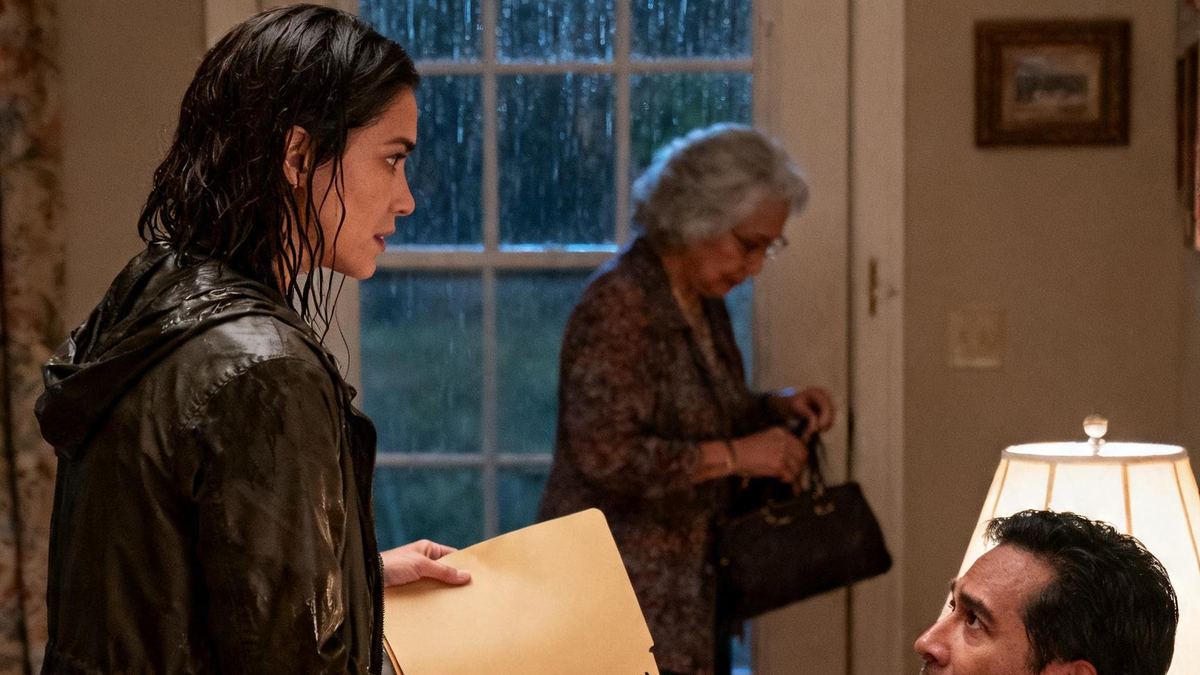
The bungalow sat under a canopy of dripping oaks, the porch light still on from the morning. Inside, the kitchen smelled of cinnamon and something acrid—furniture polish? Margaret’s work. Margaret herself was on the sofa, a cup of tea balanced on the armrest, David’s ancient tabby Rutherford curled at her feet. David was in the recliner, scrolling on his phone. On the coffee table between them, a crisp manila folder.
Ellie didn’t bother taking off her wet coat.
“The title company called,” she said.
Margaret’s teacup paused halfway to her lips. David looked up, forehead creased. “What?”
“An attorney named Alan Kirby. He wanted to verify the deed you tried to record today.” Ellie’s voice came out flat, almost conversational. “The one with my forged signature.”
Rutherford flicked his tail. David’s feet came off the recliner. “Forged? What are you talking about?”
Ellie walked to the coffee table, opened the folder without asking. Inside: a photocopy of her passport, the deed she kept in a fire safe in the hall closet, and what looked like a draft of the quitclaim form filled out in blue pen. The handwriting on the form was Margaret’s—the same cramped cursive that had once labeled all the spice jars in Ellie’s kitchen without permission.
Margaret set the teacup down. “Ellie, you’re being dramatic. I was simply organizing some paperwork. David and I discussed it, and we agreed it makes sense for the house to be in both names.”
“We discussed it,” David said, but his voice had gone thin. “We didn’t agree she’d go file things.”
Ellie pulled the scanned copy up on her phone and held it in front of his face. “Look at the signature, David.” He stared at the screen. His jaw went slack. Margaret stood, her hand outstretched. “Give me that.” Ellie moved the phone out of reach.
“Who forged my name?” she asked.
Margaret’s mouth opened and shut. The mask of the helpful mother-in-law slipped for just a second, and underneath was the same stone-cold certainty Ellie had glimpsed a hundred times over seven years: a woman who believed that anything her son touched automatically became his, and anything his wife owned he was simply being cheated out of.
David was on his feet now. “Mom, tell me you didn’t.”
“I was protecting you,” Margaret snapped. “This house is too big for one person. You’re the man of this family, and you need to have a stake. She’s kept it all to herself since before you even met. What kind of marriage is that?”
Ellie didn’t raise her voice. “The kind where I bought the house with my own savings, paid the mortgage with my own salary, and never once asked you for a dime. The kind where your son lived here for seven years without paying a cent of principal or interest and I didn’t complain. Not once.” She turned to David. “Did you know she had my passport copy? Did you help her get into the safe?”
He was pale, his eyes locked on the deed. “I told her where the key was. She said she needed it for… an insurance form.” His voice cracked. “Ellie, I had no idea she would do this.”
“But you wanted it to happen,” Ellie said. “You wanted the house in your name. You’ve been listening to her talk about ‘rooting’ you for years, and you liked the sound of it.”
He didn’t argue. That silence was the truest thing in the room.
Margaret gathered her purse, chin high. “If you’re going to stand there accusing the only mother who ever loved you, I’ll just go pack.”
“No,” Ellie said. “You’re not packing. You’re leaving right now with whatever is in your hands. I’ll have the rest of your things sent to your condo in Chattanooga by courier. You aren’t spending another night under my roof.”
Margaret’s expression flickered. “You can’t throw me out.”
“I’m not throwing you out. I’m denying entry to a person who attempted to commit real estate fraud in my home.” Ellie walked to the front door and opened it. Rain blew in, pocking the hardwood. “The attorney is holding the forged deed as evidence. I haven’t decided yet whether I’m pressing charges.”
That word—charges—landed like a slap. Margaret’s lips pressed white. She looked at David. He didn’t meet her eyes. She grabbed her raincoat and swept out with a hiss of “you’ll regret this” that the wind swallowed whole.
The door clicked shut. For a long moment, David just stood there by the recliner, Rutherford weaving around his ankles.
“Ellie,” he said finally, “I’ll fix this.”
“You can’t. You didn’t just stand by while she invaded my privacy. You handed her the key to the safe. You gave her access to the paperwork that gives me the only security I have in this world, and you didn’t warn me.” She picked up the manila folder from the table. “You knew what she was capable of, and you let her do it anyway. I’m done.”
She didn’t yell. She just walked back to the kitchen and called the locksmith.
The next two weeks were a blur of motions: a consultation with a divorce attorney named Deborah Okonkwo whose office smelled of peppermint and whose retainer Ellie paid from the very savings account Margaret had once called “selfish.” A formal letter to Cumberland Title demanding they retain the fraudulent deed indefinitely. A visit to the county register of deeds to put a fraud alert on her property. Locks changed: deadbolts, knob locks, a keypad on the back door with a code only she knew.
David tried. He came by the house three times. The first time, he stood on the porch while Ellie spoke through the Ring doorbell and told him to leave. The second time, he left a letter and a Tupperware of his mother’s banana bread on the mat; Ellie threw the bread out and shredded the letter. The third time, he was just sitting in his car at the curb when she got home from work, headlights cutting through the dusk. He rolled down his window and said, “I still love you.”
“I know you do,” she said. “That’s not the problem.” She walked inside and didn’t look back.
The divorce was finalized on a Tuesday in November, in a downtown courtroom with fluorescent lights and a judge who signed the decree after three minutes. David didn’t contest. He knew he had no ground to stand on.
That evening, Ellie sat on her back porch in the dark, wrapped in the cashmere sweater that had survived Margaret’s attempted purge of her closet three years ago. She held a mug of Earl Grey—her grandmother’s mug, the one with the chipped rim that Margaret had tried to throw away twice. The rain had stopped hours ago, and the clouds were parting over the magnolia, letting through a strip of cold silver moon.
Her phone buzzed. A message from David: *“I understand now. I’m sorry.”*
She read it. She set the phone face-down on the arm of the chair. The porch boards creaked with a gust of wind, and from three houses over, someone’s beagle bayed at the moon.
The house was quiet in a way it had never been during seven years of marriage. No television murmuring from the living room. No mother-in-law stirring pots in a kitchen she didn’t own. No husband padding down the hall to ask if she’d seen his keys. Just the old floor settling, a copy of the quitclaim deed still locked in her fire safe where it belonged now—not as a threat, but as a record. A reminder that she had almost lost a thing that was hers and hadn’t.
Ellie’s thumb traced the chip in her mug. Then she unlocked the phone, blocked David’s number, and opened the contractor’s contact. She’d been thinking about repainting the front door a deep navy blue. The house was hers. Not the bank’s—she’d paid off the last $4,100 of the mortgage three days after Margaret left, just to feel the weight of it gone. And certainly not her ex-husband’s. Hers. The door, the walls, the roots.
For the first time in a long time, she didn’t wonder if someone was about to walk in without knocking.