My second wife Kate calls it the “Ellie Situation,” like it’s a weather pattern that parked itself over our house. I’d say it with a straight face too, back when we first drove up to Ohio to get her. “Temporary,” I told Kate on the way back, Eleanor silent in the back seat with a cardboard suitcase. “Just until we find something more suitable.”
Kate nodded. We both knew what “suitable” meant. A nursing home up in Asheville, the kind with a view of the mountains and a monthly rate I hadn’t yet figured out how to afford.
Eleanor — “Granny Elle,” she said, the second she got out of the car — was my first wife’s mother. Sarah died of ovarian cancer a year earlier, and Granny Elle had been alone ever since in a clapboard house in Defiance. She was seventy-nine and walked with a hitch from a hip replacement, but her eyes missed nothing. The evening we arrived at our place outside Banner Elk, North Carolina, she carried her suitcase past the welcome mat, straight into the kitchen. Inspected the stovetop, the fridge, the window above the sink that looked out onto Grandfather Mountain.
Our five-year-old Lily tailed her, dragging a stuffed rabbit by one ear.
Granny Elle ran a finger over the cast-iron skillet hanging on the wall. Sarah’s skillet. I hadn’t touched it since the funeral.
“This yours now?” she asked.
“Ours,” I said.
“Good. This is a good skillet.”
She didn’t mention Sarah again that night. She just took the skillet down, washed it, and set it on the stove.
I woke before sunrise to a smell I couldn’t place at first — yeast and butter and something hot. My brain fumbled through old files until it landed: pancakes. The kind Sarah used to make on weekends, thin and lacy at the edges, soaking up maple syrup until they nearly fell apart.
I found Granny Elle at the stove in a flannel robe, the skillet already sizzling. Lily sat on a step stool beside her, rabbit forgotten.
“Blueberry or plain?” Granny Elle asked me, not turning around.
“Blueberry,” I said, because that’s what Sarah would have made.
I ate four before Kate came down. By then Lily had a smudge of batter across her nose, and Granny Elle was humming something that sounded like a musical — the one about the orphan girl, I think, but I can’t be sure.
In October, I toured a private nursing home outside Asheville. The brochure showed a gazebo and a resident holding a cat. The administrator, a woman with a ring on every finger, walked me through the dayroom, the dining hall, the “memory care wing” with its coded doors.
“We have one bed opening November second,” she said. “Mr. O’Brien passed last Thursday. Very peaceful.”
I took the paperwork. Left a check for $3,500 to hold the spot.
I drove home along the Blue Ridge Parkway with the sun low and golden through the pines, and I didn’t tell Kate I’d put money down. The checkbook sat in the glovebox for six days. On the seventh, I tossed the whole folder — brochures, contract, receipt — into the bottom drawer of my desk.
Then Lily got sick.
Strep throat that turned into something uglier — a fever that hit 104 and stuck there for three days. Kate and I traded shifts, but Granny Elle wouldn’t leave the room. She camped in my reading chair, a quilt over her knees, a bottle of children’s Tylenol on the nightstand. I’d come in at two in the morning and find her leaning toward the bed, crooning a song from *Annie* that Lily loved.
On the third night, Lily’s voice came out dry and cracked. “Granny? You sang the whole time.”
“Well, I only know the one song, sweet pea,” Granny Elle said. “So you better get better before I wear it out.”
I was standing in the hall. Lily didn’t see me. Granny Elle didn’t, either. She was busy wiping the kid’s forehead with a cloth that had a faded strawberry print — one of Sarah’s old dish towels, I realized. She must’ve found it in a drawer.
I went back to the kitchen and stood over the sink. The moon was out, sharp on the ridge, and the thermometer outside read twenty-three degrees. I thought about the nursing home in Asheville, that November second opening, the $3,500 I’d never tell Kate about.
Then I pulled the bottom drawer open.
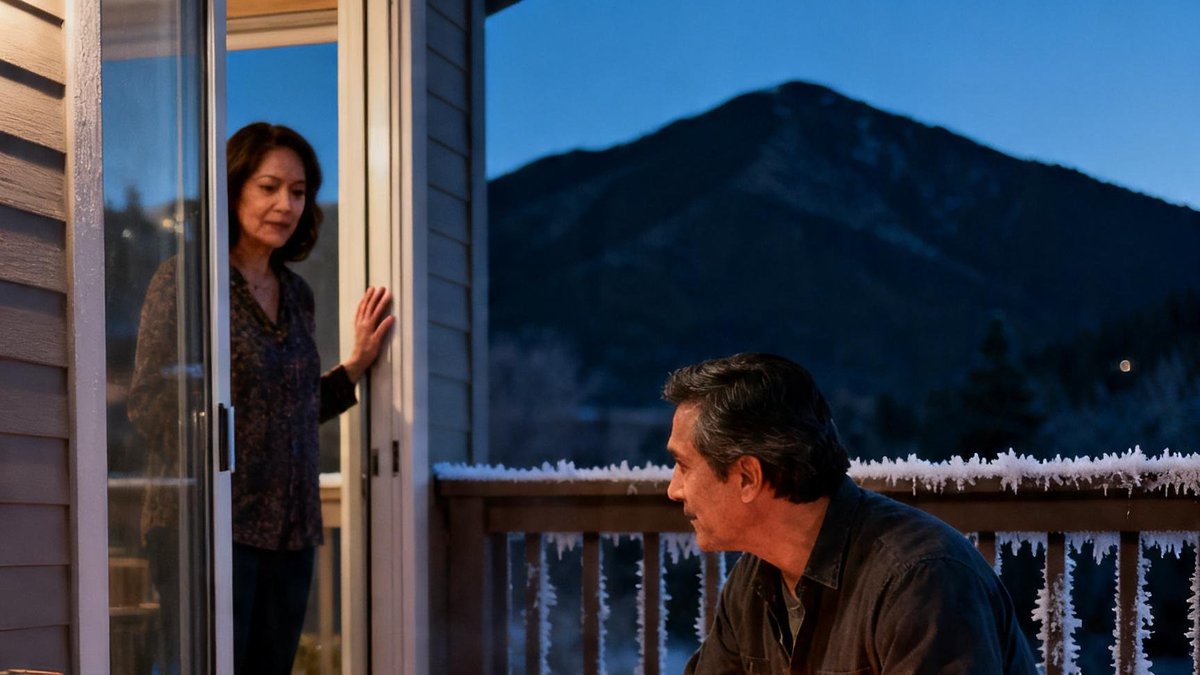
Kate found me out on the deck with the fire pit going. I’d crumpled the contract first, then the brochures, one page at a time. The flames took them fast, orange and black, the glossy photos puckering.
She closed the sliding door behind her. “So we’re not looking for anything ‘more suitable’ anymore.”
“Figured that out in November,” I said.
“I knew it in October,” she said, and she didn’t mean anything by it except that she’d been waiting for me to get there.
Granny Elle stayed with us for seven more years. Every morning of those seven years, the house woke to the smell of pancakes. Even on Christmas, even on the morning of Lily’s middle school graduation, even on the Tuesday when we got eight inches of snow and the power went out — she lit the gas burner with a match and poured batter.
We lost her three days before Lily turned thirteen. Quiet, in her sleep, the quilt still over her. Kate and I were wrecked for weeks. Lily didn’t speak for two days, and then on the third, she went into the kitchen and took the skillet off the wall.
I found the syrup jar when we were cleaning out the room. A glass bottle, the label from a sugarhouse down in Hendersonville. Inside, a scrap of paper in Granny Elle’s handwriting:
*For Lily’s Sunday pancakes. XXX.*
No date. No lesson. Just the syrup.
It’s still in the pantry. Lily’s fourteen now. Some Sundays, she pulls the jar down and sets it on the counter, next to the same skillet, and I’ll hear her humming that old show tune under her breath.
The pancakes come out exactly like Sarah’s used to. Almost exactly.