The nursing home brochures were in my glove compartment for eleven weeks. Glossy. Full of sunshine and octogenarians laughing over checkerboards. I picked the best one — Maplewood Glen, up in Skokie, with a memory-care wing and a registered nurse on-call. It cost $4,200 a month. I was ready to pay it.
Anna Vasilievna arrived in a Greyhound bus with a suitcase held together by a leather belt. My wife’s mother. Seventy-nine years old, a widow from Kenosha, and the last living relative of my late wife, Liza. Liza died of a pulmonary embolism at thirty-four, and I was left with a five-year-old, a mortgage in Oak Park, and a mother-in-law I’d met exactly four times.
“Just for a while,” I told my second wife, Catherine, when we picked her up at the station. “Until we figure out something more permanent.”
Catherine nodded. She’s practical. She understood that “permanent” meant Maplewood Glen.
Anna Vasilievna — she insisted on “Nonna” the moment she walked in, said “Mrs. Volkov” made her feel like a corpse — walked into our condo, disregarded the guest bedroom entirely, and went straight to the kitchen. She opened my refrigerator. Sniffed a carton of half-and-half. Examined the stovetop like a forensic investigator.
“This hood vent,” she said, in that heavy, rolling accent I still associate with rye bread and church basements. “You ever clean the filter?”
I hadn’t. I didn’t know it had one.
Our daughter Ella, my kid with Liza, watched from the hallway. Five years old, clutching a stuffed fox. She’d stopped talking much after the funeral.
Nonna knelt down — slowly, one hand on the counter — and looked at the fox.
“This is a serious animal,” she said. “What does he eat?”
Ella blinked. “Pancakes, I guess.”
“Okay. Then we make pancakes.”
The next morning I woke up at 6:15 to a smell that didn’t belong in my kitchen. Butter. Yeast. Something sweet blooming in a cast-iron pan. I walked out in my boxers, hair standing up, and found Nonna in a flour-dusted apron, Ella on a stepstool beside her, pouring batter from a measuring cup with the focus of a bomb-disposal technician.
“You sit,” Nonna said. Didn’t look at me. “These ones come off the pan in twenty seconds. I’m counting in my head.”
I sat. Ate five. The pancakes were thin at the edges — blintzes, technically, she corrected me later — with a dollop of sour cream and a spoonful of raspberry jam she’d made from a bush behind her old house in Kenosha, the jar wrapped in a dish towel for the bus ride.
That was October.
In November I drove up to Skokie. Alone. Toured Maplewood Glen. The administrator, a woman named Deb with a cardigan and a practiced smile, showed me the dining hall, the activity calendar, the room with a view of a drainage pond they called “Sunset Terrace.” I nodded a lot. Asked about the staff ratio. Took the paperwork.
On the drive back, I pulled off at a rest stop and sat in the car with the engine off for forty minutes. The brochures sat on the passenger seat. I didn’t touch them. I was trying to picture telling Nonna about Maplewood Glen, and every time I tried, I saw the top of Ella’s head bent over the mixing bowl, and I could smell the blintzes.
I never mentioned the tour to Catherine.
In December, Ella got scarlet fever. A bad case. The pediatrician on Harlem Avenue used the word “vigilance” three times. Her fever hit 104.1. She was delirious, talking to people who weren’t there, crying about the fox being lost.
Nonna didn’t sleep for three nights.
I’d come into Ella’s room at two in the morning and find Nonna in the chair by the bed, changing the cold compress on Ella’s forehead with the mechanical regularity of a metronome. She’d sing something low and tuneless — a folk song from Volgograd, she told me later, about a river and a willow tree. She didn’t check her phone. She didn’t complain. One night I saw her adjust Ella’s blanket, then pause and touch her own chest, right over the sternum, pressing hard with two fingers. The gesture of someone swallowing pain so a child won’t see it.
On the fourth morning, the fever broke. Ella opened her eyes, saw Nonna, and said, “You’re still here.”
“I got nowhere else,” Nonna said, and smoothed the hair off Ella’s forehead.
I was standing in the doorway. I turned around, walked to the kitchen, and sat at the table with a mug of coffee I didn’t drink. The guest bedroom I’d prepared for Nonna was still pristine — comforter smooth, pillows fluffed. She’d never slept in it. She’d been in with Ella since the first night of the fever.
Catherine found me there an hour later.
“You look like hell,” she said.
“I drove up to Skokie in November.”
“I know.”
“To look at the place.”
“I know that too.” She poured herself coffee. Sat across from me. “You left the mileage log in the glove compartment. With the brochures.”
I stared at her.
“I figured you’d tell me when you were ready,” she said. “And then you didn’t. And then she taught Ella to roll pierogi dough, and I realized you’d decided.”
“Decided what?”
“That we’re not looking for anything more permanent.”
We weren’t.
Seven years.
Nonna outlasted two administrations in Washington, a Cubs World Series win, and my marriage to Catherine, which crumbled for reasons that had nothing to do with a mother-in-law in the guest room. When we separated, Catherine didn’t fight me on it. “She’s yours,” she said. Not cruelly. It was just the truth. Nonna was mine.
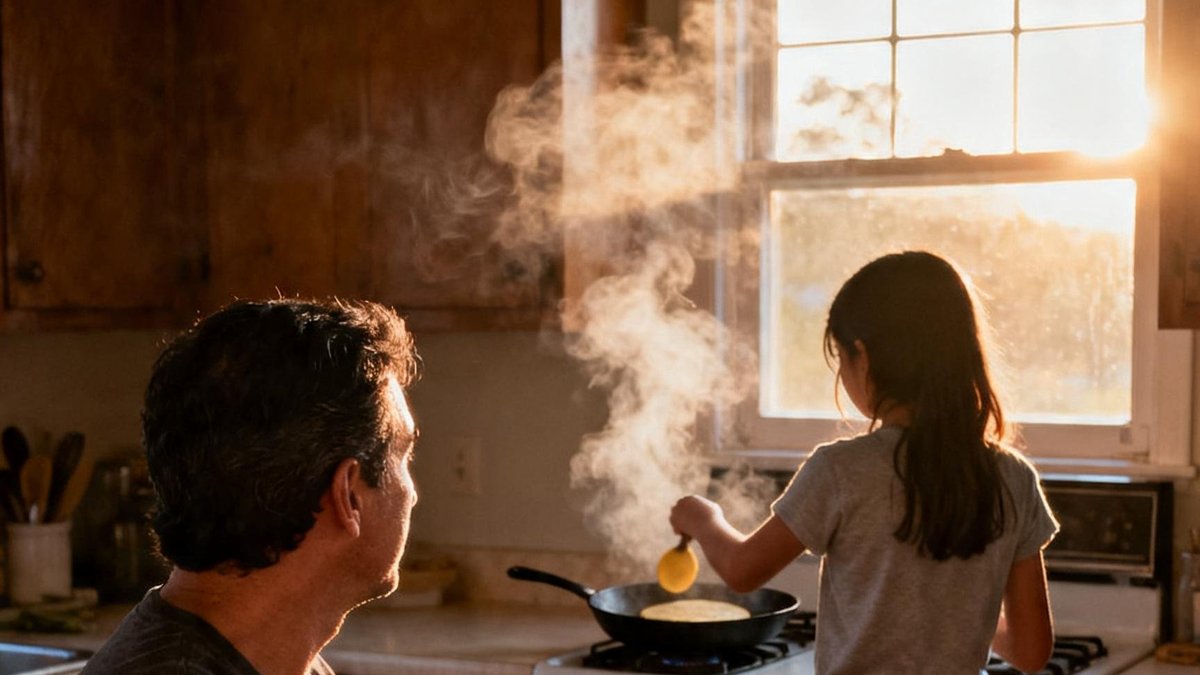
Toward the end, Nonna’s hands shook. She couldn’t manage the measuring cup anymore. So Ella — twelve years old now, all elbows and sarcasm — became the one at the stove. Nonna sat on her walker-seat beside her, giving instructions in a voice that had grown thin as wax paper: “Lower the flame. Not that low. Okay — now. Now, flip.”
And Ella, who once couldn’t speak after losing her mother, flipped the blintz perfectly.
The last blintz Nonna ever ate was one Ella made. I know this because of the date. It was a Tuesday. I remember because the hospice nurse came at noon, and Nonna waved her off and said, “After breakfast,” and breakfast took forty minutes because Ella insisted on getting the edges exactly right.
A Tuesday.
After she died, we found a stack of papers in her room — her expired Pennsylvania driver’s license, her green card, a letter from the Social Security office, and an envelope with our address on Oak Park written in her handwriting, as if she’d been preparing to mail it and never had to. Inside: a will. She’d left her savings — $24,700 from forty-one years of working the register at a dry cleaner’s — to Ella. For college.
Which was when I sat down at my laptop, opened my bank’s wire-transfer page, and sent $24,700 to the University of Illinois-Chicago’s prepaid tuition program for one beneficiary: Ella Grace Morrison.
Not matching it. Replacing it. So Nonna’s money would stay in an account Ella couldn’t touch until she turned twenty-five, and by then she’d know what to do with it. Add to it. Give it away. Name a daughter after a woman she only got seven years with.
Catherine called me that evening. We still talk. She handles my life admin like she’s a caseworker and I’m a moderately competent client.
“You did what?” she said.
“Transferred the exact amount. You can check the account.”
A pause. Not Catherine’s style, pauses.
“She would’ve hated that,” Catherine said finally.
“I know. She’d say I wasted money she already gave. But it’s not her decision anymore. It’s mine.”
The kitchen still smells like blintzes some mornings. Not because I burn butter — because Ella’s making them. She’s got the recipe down to muscle memory. And sometimes, at six-fifteen in the morning, I sit at that same table and I watch my daughter stand exactly where Nonna stood, her back to me, the pan hissing, and I think: some things you can’t fix with a glossy brochure and a check.
Some things you just hold onto, until they’ve held onto you long enough that paying them back feels like paying for air.