The gasp that gave him away came from the woman who had spent two decades insisting my daughter didn’t exist.
I was wedged into a folding chair in the back row of the Riverton High gym, Sophie pressed tight against my chest beneath an open cardigan. Eleven days old, warm and weightless as a loaf of bread. Her father, Danny, leaned near the fire exit in jeans dark with motor oil from the transmission shop. Maya, my daughter, sat with the other seniors in the front row, the gold honor cord I had ironed that morning bright against the royal blue gown she had let out herself two days before giving birth.
The principal tapped the mic. “And now, the Ashford Family Promise Scholarship. Please welcome Senator Charles Ashford.”
The man who walked on stage wore a gray suit and a smile that had been practiced in front of mirrors since he was seventeen. The scar beside his left eyebrow was still there, small and pale. His thumb pressed against his forefinger the way it always had when he was cornered.
I had not seen him in eighteen years.
I had not expected to see him handing my daughter an envelope with his name embossed in gold.
I was seventeen when I got pregnant. Charles was eighteen, captain of the baseball team, son of the family that owned half the commercial real estate in Fairview County. He promised me forever in the parking lot behind the Dairy Queen. Forever lasted until October, when his father moved the family to Maryland and their phone number stopped working. My letters came back unopened. I gave birth alone with my mother gripping my left hand and an empty chair on my right.
Afterward, my life shrank to the Belmont Arms Hotel—cleaning rooms by day, working the front desk by night, stretching a bus pass until the magnetic strip went smooth. Maya learned to read from receipts and to measure time in shift changes.
She also learned not to ask about her father.
By senior year, I thought we had outrun the worst of it. Maya had a 3.8 GPA, a spot in the nursing program at Westbrook Community College, and an essay that had landed her among the finalists for the Ashford scholarship. Then, last January, she started throwing up every morning. She blamed cafeteria food. Then stress. Then a stomach bug that refused to quit.
She was seven months along before she told me.
I couldn’t be angry. I saw my own reflection in her—terrified, stubborn, bracing for disappointment. She wasn’t afraid I would stop loving her. She was afraid my sacrifices had become a weight she could never put down.
Danny didn’t bolt. He picked up extra shifts at the garage, showed up to every ultrasound he could, and assembled the crib with the instructions upside down. They named their daughter Sophie.
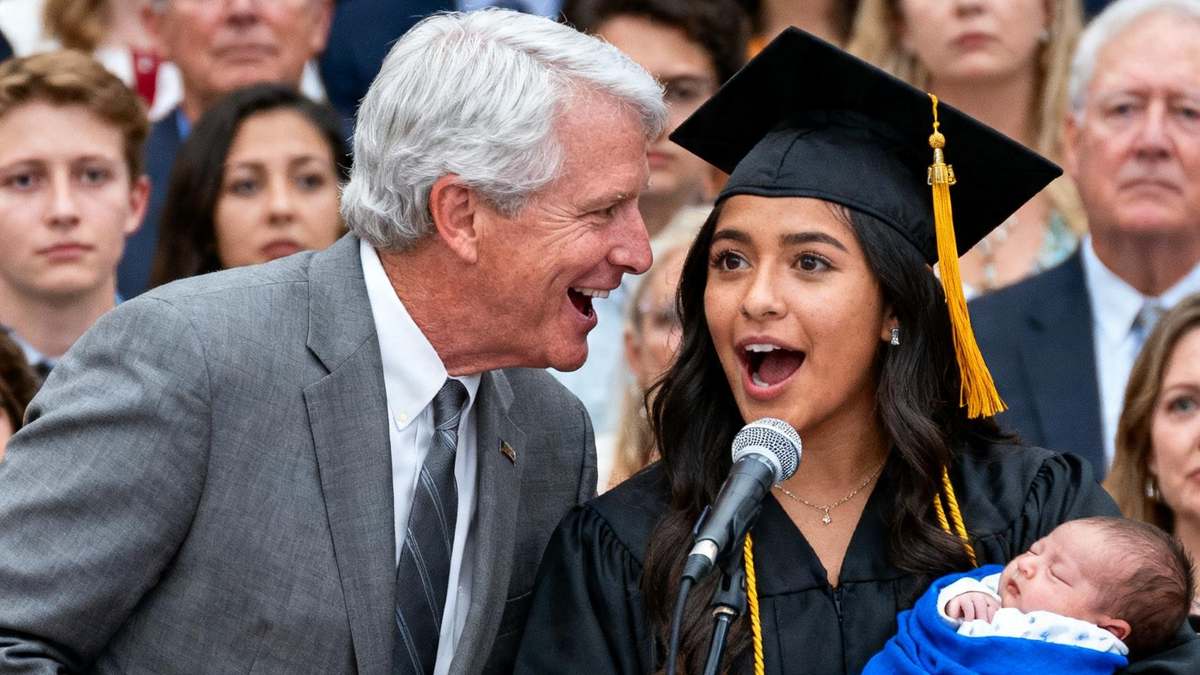
Onstage, the senator was praising resilience. “No young person should be defined by the circumstances of their birth,” he said, his voice slick with sincerity. Every sentence landed like a fishhook in my chest.
“This year’s Ashford Family Promise Scholarship,” he announced, “goes to a student whose courage and commitment embody everything this award represents. Maya Barrett.”
Maya didn’t stand right away. She turned and walked up the aisle toward me, her gown swishing against the scuffed floor. The woman two rows back—the one who had gasped—pressed a hand to her throat.
“Mom,” Maya said, bending close. “Give me Sophie.”
I tucked the baby against her shoulder. Maya kissed Sophie’s forehead, covered her with the edge of the blue gown, and walked toward the stage while the crowd’s confusion swelled.
Someone behind me muttered, “Well, the apple doesn’t fall far.”
My face went hot, but Maya never dropped her chin.
Charles smiled as she approached, holding out the scholarship envelope with both hands, the cameras from the local news catching every angle.
Instead of taking it, Maya stepped around him, adjusted the microphone down, and faced the audience.
“My mother taught me never to humiliate someone in public,” she said, her voice shaking exactly once. “She also taught me that silence protects the wrong person.”
Maya turned toward the senator, my granddaughter breathing softly between them.
“Before you hand me that envelope, tell everyone why my birth certificate says ‘father unknown.’”
The applause died in jagged pieces. The principal took a half-step forward. “Maya, perhaps we could—”
“No,” Charles said, the word cutting sharp because the microphone was still live.
Maya shifted Sophie higher. “Do you know who I am?”
Charles glanced toward the cameras. Everyone in that gym knew he was expected to announce his run for Congress before the end of summer.
“I know your application,” he said, voice careful as a tightrope walker. “You are an exceptional young woman.”
“I’m your daughter.”
The gym went so still I could hear the air-conditioning hum.
Three weeks earlier, a woman named Patricia Vance had cornered me in the hotel laundry room during my midnight shift. She wore a cream blazer and carried a leather folder stamped with the Ashford campaign logo. She said the senator’s office had received “sensitive information” after a background review of scholarship finalists.
Inside was Maya’s application photo, her birth certificate, and an agreement offering ninety thousand dollars toward college and childcare—provided we never identified Charles as her father.
I laughed because the alternative was crying.
Patricia warned that public accusations could become “complicated,” especially for a young single mother applying to nursing school.
I didn’t know Maya had found the unsigned agreement in my locker the next morning.
On stage, she looked at Charles with the same steady expression she’d used when telling me she was pregnant.
“My mother wrote to you. She sent pictures. Hospital records.” Maya’s voice cracked, and she had to stop, swallow. “Every single one came back. ‘Return to sender.’ Big red stamp. I’ve seen them.” She tilted her head toward the envelope in his hand. “And then your office offered us ninety thousand dollars to hush up. Ninety thousand. You even put a date on it—June tenth. We still have the paper.”
Patricia was seated beside the superintendent. Her face went the color of old milk.
Charles stepped toward the mic. “I did not authorize a threat.”
Sophie stirred and let out a thin cry. Maya rocked her and kept going, voice lower now.
“I’ve been trying to figure out, my whole life, why the blank space on my birth certificate felt like—like I was already a secret before I could even talk. And then I had her.” She touched Sophie’s cheek with one finger. “And I thought, no. I’m not gonna teach her that love is something you have to buy, or beg for, or hide.”
At the back of the gym, Danny covered his mouth with one grease-blackened hand.
“I don’t want your hush money. I don’t want a scholarship with your name on it. I want—” She paused, looked down at Sophie, then back at the senator. “I want you to say it. Right here. Who I am.”
Charles’s jaw tightened. He looked less like a polished public figure and more like the boy I once knew—cornered, ashamed, desperate for an exit.
“My parents told me the baby had been placed for adoption,” he said.
The words hit me so hard I nearly sat down.
Charles looked at me. “Joanne, I swear. They said you left town. That the child was gone.”
“That explains one year,” I said, my voice carrying across the rows of folding chairs. “What about the other seventeen?”
And in that silence, everyone heard the answer.
One kid in the senior section started clapping. Then another stood. Within moments, the whole class rose—not cheering, but applauding with a slow, heavy force that felt less like celebration than a verdict.
Maya stepped away from the microphone, walked past the untouched scholarship envelope still sitting on the podium, and came down the stairs toward me.
Before she reached the aisle, Charles called her name.
She didn’t turn. “Good. This time, don’t disappear before the results come back.”
By morning, the video had been watched over two million times. Reporters camped outside our duplex. Strangers called Maya brave, reckless, inspiring, cruel, attention-seeking, and heroic—sometimes inside the same comment. Charles’s campaign released a statement claiming he welcomed “a respectful private process.” Patricia Vance claimed she had acted without his full knowledge.
The hotel manager moved me off the front desk because guests kept asking to take selfies with me.
Viral attention doesn’t warm bottles at three a.m. Public courage still has to wake up exhausted and wash spit-up from its only clean blouse.
A week after graduation, Maya sat on our couch with Sophie asleep against her shoulder, reading almost none of the coverage. She was waiting to find out whether her delayed start date would cost her spot in the nursing program.
I was waiting for her to regret everything.
“You could have warned me,” I said one afternoon, folding onesies at the kitchen table.
“You would have talked me out of it.”
“Exactly.”
Maya looked at me. “You spent eighteen years swallowing anger so I wouldn’t have to. That worked, Mom. I grew up knowing I was loved. But I also grew up thinking we weren’t allowed to tell the truth about what happened to us.”
She reached for the remote and clicked the TV off. The screen went dark, reflecting the two of us on the couch. I set down the onesie, the cotton still warm from my hands.
The woman on our porch that evening was tall, silver-haired, and dressed too carefully for a neighborhood with cracked sidewalks. I recognized her from campaign photos. Evelyn Ashford. Charles’s wife.
Maya came to the door with Sophie in her arms.
Evelyn’s eyes moved from Maya’s face to the baby’s, and something inside her seemed to splinter.
“I’m not here to defend him,” she said. “I’m here because there are things you should see.”
Inside the leather bag she carried were twenty-three letters I had mailed between 2007 and 2009. My handwriting on every envelope: Charles’s old Maryland address, then his college dorm, then his parents’ home near Annapolis. Each stamped RETURN TO SENDER in heavy red ink.
Evelyn placed a second stack beside them. These envelopes were newer.
The earliest was dated the year Maya turned eight.
Evelyn sat at our kitchen table while a pigeon tapped at the window—it had been trying to nest on the sill for three days. She explained that Charles had discovered the truth after his mother died. While clearing the house, he’d found my letters locked inside a desk, along with a private investigator’s report confirming I had never left town and that Maya was alive and well.
“He wrote to Maya,” Evelyn said. “He wrote every year on her birthday. Then he put the letters in a drawer.”
She said Charles had told her long ago that a girl got pregnant in high school but that the baby had been adopted. When he learned Maya existed, their son Spencer was five, Charles’s real estate firm had just gone regional, and he was terrified the truth would detonate everything.
“So he chose to know about me privately,” Maya said, “and pretend I didn’t exist publicly.”
Evelyn’s eyes were wet. “Yes.”
The DNA results came back two days later—99.998 percent probability.
Charles requested a meeting without lawyers or cameras. Maya refused until he agreed that Danny and I could attend.
We met in a small conference room at the Riverton Public Library. Charles looked smaller without a podium. He admitted he had authorized the money but denied ordering Patricia to threaten Maya’s education. He said the scholarship foundation had begun partly because he couldn’t stop thinking about the daughter he had abandoned.
Maya slid the unopened scholarship envelope across the table.
“You built a charity so strangers could thank you for helping girls like me. That isn’t the same as helping me.”
“I know that now.”
“No. You know it now because everybody else knows.”
I traced the rim of a coffee ring on the table with my fingernail, the wood scratched deep from years of use. Charles had been lied to, and then he’d stacked eighteen years of his own choices on top. I didn’t need to say it.
“Tell me what I can do,” he said.
Maya glanced at Sophie, asleep in Danny’s arms.
“You can tell the truth without making yourself the victim. Start there.”
Charles held a press conference on the courthouse steps that Monday.
He didn’t call what happened a misunderstanding. He didn’t blame his parents, his staff, or the fear of losing his career. He said he was Maya’s biological father, that he had known she was alive for a decade, and that he had chosen secrecy over responsibility.
Then he withdrew from the congressional race.
The political pundits treated that as the end of the story.
The actual work began later, once the cameras were gone.
Charles offered enough money for any college Maya wanted. She accepted only what a court would reasonably have required in unpaid child support, and she placed most of it into a trust for Sophie. She asked him to redirect the rest into a childcare fund at Westbrook Community College for student parents.
“No building with your name on it,” she said. “No press release about redemption.”
The nursing program held Maya’s place for the spring semester. Until then, she planned to take two online courses, work weekends at the pharmacy, and learn how to be Sophie’s mother without pretending love erased exhaustion.
Danny’s parents didn’t take the scandal well. His father told him to choose between the garage apartment above their house and “that circus.” Danny packed everything he owned into two duffel bags and moved onto our living room floor. By October, he and Maya had found a small one-bedroom near the community college. He wasn’t perfect—he forgot pediatrician appointments, once bought the wrong formula, and panicked the first time Sophie spiked a fever. But he kept showing up. That meant more to me than any polished promise.
One evening in late August, Charles appeared at the Belmont Arms while I was wiping down the coffee station in the lobby.
He had no aide with him. No suit. Just jeans, a faded navy shirt, and that old nervous habit with his thumb.
“I owe you an apology that is eighteen years too late,” he said.
“And then I used that lie as an excuse long after I knew better.”
I wrung out the rag into the bucket, watched the brown water drip.
He told me he had started therapy. Evelyn had moved into a separate apartment for a while. Spencer, now fourteen, knew about Maya and wanted to meet her, but Charles said he wouldn’t ask until Maya was ready.
I picked up the coffee pot and poured the dregs down the drain. “I’m not giving you a speech, Charles. You know what you did.”
When I got home, Maya was on the porch steps with Sophie. The baby was three months old by then, cheeks round and eyes tracking the streetlight.
“I don’t hate him,” Maya said. “I just don’t know him.”
I sat down on the step next to her, the old wood groaning. Sophie’s fingers closed around my thumb. The pigeon was still cooing on the window ledge, and neither of us said anything else for a while.
The childcare center opened the following January in two renovated classrooms next to Westbrook’s nursing building.
A small plaque near the entrance read: FOR STUDENTS BUILDING A FUTURE WHILE RAISING ONE.
On her first day of classes, Maya wore navy scrubs and a backpack stuffed with anatomy notes, bottles, and diapers. Her knuckles stood out white on the strap. Danny dropped Sophie at the center before heading to the shop. I waited in the parking lot because Maya had asked me not to walk her inside.
“You already took me to my first day of kindergarten,” she said. “You don’t have to do every first day.”
She came back after two minutes and hugged me through the car window.
Charles started writing letters. Not apologies—those had already been spoken. He wrote about ordinary things: his first job pumping gas at sixteen, the songs he used to play on a beat-up guitar, the grandmother Maya never knew, the mistakes he was still trying not to hide behind.
Maya kept the letters in a kitchen drawer. For six months, she left them unopened. Then one Sunday, she read the first one.
She didn’t forgive him that day. She didn’t call him Dad. She did agree, a few weeks later, to meet Spencer at the Pancake House off the highway. The two of them discovered they had the same crooked smile and the same habit of arranging sugar packets by color. They laughed awkwardly for twenty minutes, then naturally for another hour.
Charles waited outside and did not come in.
When Maya walked out, she paused right next to him.
“Coffee next Sunday,” she said. “One hour.”
His face shifted, but he didn’t make the moment larger than she offered.
Maya took my hand. Sophie stretched her arms toward Danny. Spencer fell into step beside us.