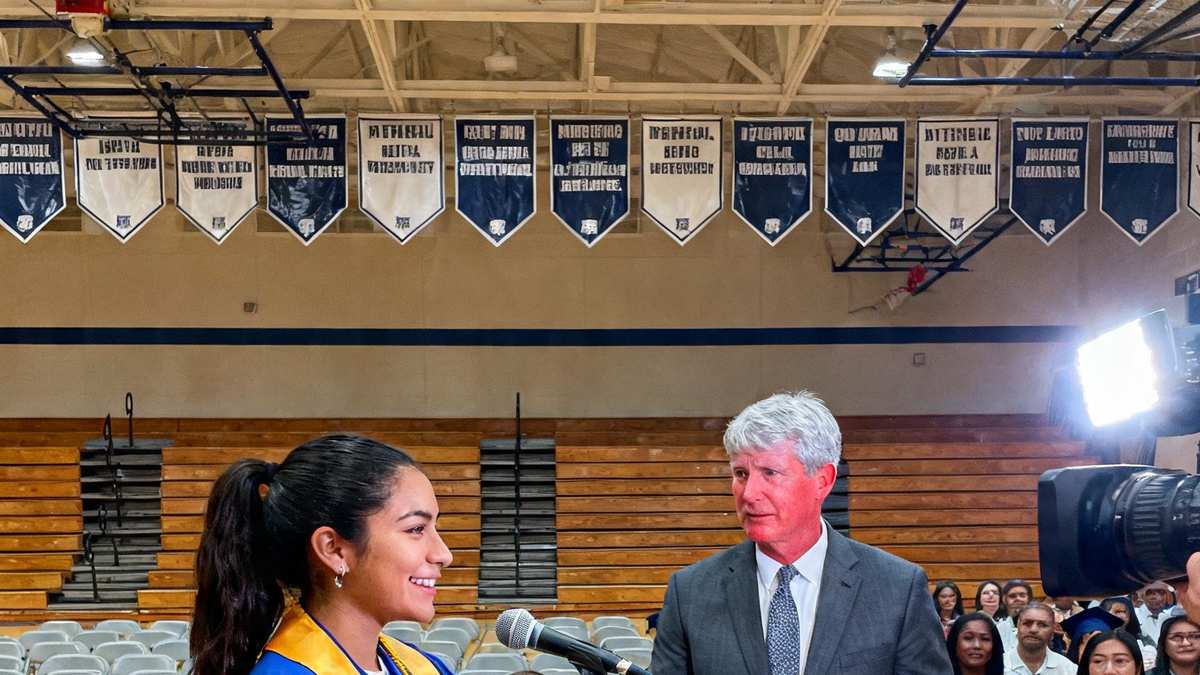
The man who got my daughter pregnant at seventeen was the boy who’d sworn he’d love me forever. I hadn’t seen him since he climbed into his parents’ black Escalade and vanished the week before my first ultrasound. But there he was, striding onto the graduation stage in a charcoal suit, flashing the same easy grin that had once made me believe the world was built of promises.
“Ladies and gentlemen, please welcome our surprise guest—Mr. David Calloway, founder of the Calloway Opportunity Foundation and candidate for North Carolina’s 11th congressional district.”
My granddaughter stirred against my chest. Her name was Lily, she was nine days old, and she was wrapped in a faded quilt I’d sewn from old hotel towels. Too young for a gym packed with sweaty families and squeaking folding chairs, but there was nobody to watch her. Her father, Joe, stood by the fire exit in coveralls streaked with transmission fluid, smelling of the Quick Lube where he worked sixty hours a week at $14.25 an hour. My daughter, Mia, sat three rows ahead with the other graduates, her honor cord resting over a gown she’d taken in herself after the birth because the rental shop charged extra for alterations.
For eighteen years, I’d pictured Mia crossing a stage while I cried happy tears. I had not pictured David Calloway handing her a scholarship with my name on it.
I was sixteen the summer I fell for him. He was seventeen, quarterback, son of the county’s biggest real estate developer, and a master at saying “always” when always still had a return policy. He promised we’d tell his parents together. He promised he’d be there when I went into labor. He promised his family’s money wouldn’t change him.
Then his father announced they were moving to Atlanta for a “business opportunity.” The house went dark overnight. His number was disconnected. The letters I sent came back unopened, month after month, until I stopped writing.
My daughter entered the world with my mother gripping my hand and an empty chair beside the bed. After that, my life shrank to one thing: keeping us afloat. I cleaned rooms at the Mountain Laurel Inn off Tunnel Road. I mopped floors, scrubbed toilets, and folded corners of toilet paper into little triangles for guests who never once looked at my face. Mia learned to read from the pizza coupons I brought home and patience from the nights I came home too tired to talk.
By senior year, she had a 4.0, a spot in the nursing program at Blue Ridge Community College, and an essay that landed her as a finalist for the Calloway Promise Scholarship. Then, right before Christmas, she started throwing up every morning. She blamed the cafeteria chili. Then stress. Then a stomach bug that just wouldn’t quit.
When she finally told me she was seven months pregnant, I saw myself at sixteen—terrified, stubborn, already in love with the weight she was carrying. So I didn’t yell. I pulled out my old maternity clothes from a box in the attic and helped her let out the seams.
Joe didn’t run. He showed up at every ultrasound with a greasy cap in his hands, and he assembled the crib in our living room while watching a YouTube tutorial three times because the instructions were missing. They named her Lily, after the scraggly daylilies that refused to die beside our porch.
Still, when Mia asked if she could bring the baby to graduation, I hesitated. People already whispered. The cashier at Ingles had stopped hiding her stares.
Mia looked at me with that calm, level gaze she’d inherited from nobody I could name. “They already do.”
Now David Calloway stood under the gym’s state championship banner, talking about resilience and “breaking the cycle of poverty.” Every sentence landed like a slap.
“This year’s Calloway Promise Scholarship goes to a student whose courage, academic achievement, and commitment to service embody the very spirit of this foundation. Mia Harper.”
Mia didn’t walk toward the stage at first. She turned, came down the aisle, and bent close to me. The noise of the crowd flattened.
“Mom, give me Lily.”
I lifted the baby into her arms. Mia tucked the quilt beneath her gown, kissed Lily’s fuzzy head, and walked toward the stage while whispers rolled through the bleachers like a wave.
Someone behind me muttered, “Guess history repeats itself.”
My face burned. Mia’s shoulders stayed square.
David beamed as she approached, holding the scholarship envelope with both hands, cameras clicking. Mia stepped around him, reached for the microphone, and faced the crowd. Her voice wobbled only once.
“My mother taught me never to humiliate someone in public. But she also taught me that silence can protect the wrong person.”
She turned toward him. Lily slept on, a tiny fist pressed against her cheek.
“Before you hand me money, tell everyone here why my birth certificate has no father’s name on it.”
The applause died. A few people laughed nervously, then stopped. I watched recognition crawl across his face in layers: confusion, calculation, then the cold panic of a man watching his campaign implode. The principal half-rose from his seat. “Mia, perhaps we could handle this privately—”
“No,” David said, the word cracking into the microphone.
Mia adjusted Lily. “Do you know who I am?”
He glanced toward the local news crew. Everybody knew he was polling well for the primary. “I know your application. You’re a remarkable young woman.”
“Don’t,” she said, and that one word hung in the air like a slammed door.
Three weeks earlier, a woman named Patricia Vance had approached me during my shift at the inn. She wore a cream pantsuit and carried a leather folder stamped with David’s campaign logo. Inside was Mia’s graduation photo, her birth certificate, and an agreement offering a hundred and twenty thousand dollars—for college, for childcare, for “expenses”—if we never identified David as Mia’s father. Patricia Vance explained that David had been a scared teenager, that he’d built a good life, that “public accusations could become complicated” for a young mother applying to nursing school. I got the message: take the money or risk Mia’s spot.
I laughed in her face because the alternative was throwing the folder at her head.
I didn’t know Mia had found the unsigned agreement next to my timecard the following morning. She’d come to bring me lunch—a cold biscuit wrapped in a paper towel—and seen the folder poking out of my locker.
Onstage, she didn’t launch into a speech about fear. She just told the crowd what the folder had inside.
“One twenty. That’s what they offered for us to stay quiet. A hundred and twenty thousand dollars. You know how many hours my mom would have to scrub toilets at $11 an hour to make that? Ten thousand, nine hundred and nine. She’d need about ten years with no days off.”
She adjusted Lily on her hip, her voice flattening out. “I did the math the night after I found it. Couldn’t sleep, so I sat on the bathroom floor with my phone calculator. Lily kicked inside me the whole time.”
David’s face went slack.
“That woman from your campaign told my mom that our silence would make things ‘less complicated’ for my nursing school application. That’s not a scholarship. That’s a bribe with a threat inside.”
Patricia Vance sat beside the superintendent, her face the color of old milk. She started to stand, but the superintendent put a hand on her arm, his jaw tight.
Mia kept talking, not to David now, but to the audience. “I’m not standing up here to teach anybody a lesson about love or courage. I’m here because I have a daughter, and she’s going to grow up, and when she asks me why she doesn’t have a grandfather’s name on any forms, I need to be able to say I didn’t hide the truth to make some politician comfortable.”
Joe covered his mouth with one hand at the back of the gym.
“I don’t want your hush money. I don’t want a scholarship with your name on it.”
She took the envelope from David’s frozen hand and set it on the floor at his feet. Then she walked down the stairs, passed me without a word, and headed for the exit, Lily still asleep.
David’s voice cracked through the mic. “My parents told me the baby had been given up for adoption.”
The words hit me so hard I nearly dropped my purse.
David looked at me then, across the rows of folding chairs, his eyes reddening. “Patty, I swear. They said you’d left town. They said the child was gone.”
“That explains one year,” I said, and my voice carried. “What about the other seventeen?”
The silence that followed was so thick I could hear the buzz of the overhead lights.
One student stood up and started clapping. Then another. Then the whole senior class rose, not cheering, but applauding with a slow, heavy force that felt less like support than judgment.
Mia was already at the gym doors, but she didn’t turn around.
By midnight, the video had been shared everywhere. By morning, it had over two million views. Strangers called Mia brave, reckless, inspiring, cruel, attention-seeking, heroic—sometimes in the same tweet. Reporters parked outside our duplex on Haywood Road. My manager moved me off the front desk because guests kept asking to take selfies with “the mom from the video.”
At 3 a.m., I was still warming bottles and scrubbing spit-up off my only clean shirt while my phone buzzed with notifications I didn’t read.
Mia spent the week after graduation on our couch with Lily napping on her chest, ignoring almost all of it. She was waiting to hear whether the nursing program would hold her spot. I was waiting for her to regret everything.
“You could’ve warned me,” I said one afternoon, folding baby onesies at the kitchen table.
“You could’ve told me who he was years ago.”
We looked at each other. Neither of us had an answer that didn’t hurt.
For eighteen years, I’d called my silence dignity. Some days it was. Other days it was just shame wearing lipstick.
The woman on our porch three days later was tall, dark-haired, and dressed too well for our neighborhood. I recognized her from campaign photos—Lydia Calloway, David’s wife.
Mia came to the door with Lily on her hip. Lydia’s eyes traveled from Mia’s face to the baby’s, and something in her expression cracked.
“I’m not here to defend him,” she said. “I’m here because there are things you should see.”
Inside her bag were twenty-seven letters I’d mailed between 2006 and 2008. My handwriting covered the envelopes: David’s new address in Atlanta, then his college dorm, then his parents’ house again. Each one stamped RETURN TO SENDER.
Lydia placed a second stack beside them. Newer envelopes. The earliest dated the year Mia turned nine.
She sat at our kitchen table—the one with the wobbly leg I’d propped up with a folded takeout menu—and told us the rest. David had learned the truth after his mother died. While clearing out her house, he’d found my letters hidden in a locked desk, along with a private investigator’s report confirming I’d stayed in Asheville and raised our daughter.
“He wrote to Mia,” Lydia said. “Every year on her birthday. Then he put the letters in a drawer.”
She pulled out one envelope, unsealed, and read a line. “‘I know you don’t know me, but I know you like mac and cheese, because your third-grade teacher mentioned it in the school newsletter.’ He kept that newsletter, too. In the same drawer.”
David had told her only that he’d once gotten a girl pregnant but the baby had been adopted. When he discovered Mia was alive, their son was six, his real estate firm was taking off, and he was terrified the truth would wreck everything.
“So he chose to know about me privately,” Mia said, “and ignore me publicly.”
Lydia nodded, tears sliding down her cheeks. “Yes. And I found out about the foundation—he started it the same year he learned about you. A way to help girls ‘in your situation’ without ever having to face you.”
The DNA results arrived two days later: 99.998 percent.
David requested a meeting—no lawyers, no cameras. Mia refused unless Joe and I could both be there. We met in a closed study room at the Pack Memorial Library. David looked smaller without a podium. He admitted he’d authorized the money but swore he didn’t tell Patricia Vance to threaten Mia’s nursing school spot. He said he’d had no idea she’d implied that, and that she’d been fired from the campaign that morning—the campaign itself was suspending operations.
Mia listened without expression. Then she pushed the unopened scholarship envelope across the table.
“You built a charity so strangers could thank you for helping daughters like me. That’s not the same as helping me.”
“I know that now.”
“No. You know it because everyone else knows.”
He didn’t argue. He looked at Mia. “Tell me what I can do.”
She glanced at Lily, dozing in Joe’s arms, her tiny mouth pursed like she was dreaming of milk. “You can tell the truth without making yourself the victim. Start there.”
David’s press conference took place on the courthouse steps the next Monday. He didn’t call it a misunderstanding. He didn’t blame his parents, his staff, or the fear of losing his career. He said he was Mia’s biological father, that he’d known she was alive for nine years, and that he’d chosen secrecy over responsibility. Then he withdrew from the congressional race.
The commentators treated that as the end. The harder work began when the cameras left.
David offered Mia enough money for any college she wanted. She accepted only what unpaid child support would have added up to—she’d done the math with Joe on the back of a gas station receipt: $74,316—and put most of it into a trust for Lily. She told him to redirect the rest into an on-campus childcare program at Blue Ridge for student parents.
“No building with your name on it,” she said. “No press release about redemption.”
The nursing program held Mia’s place for the spring semester. Until then, she took online courses, worked weekends at the CVS on Merrimon Avenue for $15 an hour, and learned to be a mother without pretending love erased exhaustion.
Joe’s parents were furious. They believed Mia had humiliated a powerful man and dragged their son into a scandal. Joe’s father told him to choose between the apartment above their garage and “that mess.” Joe packed his things into two duffel bags and moved onto our living room floor. He forgot pediatrician appointments—missed the two-month checkup entirely and had to reschedule—once bought formula for sensitive stomachs when Lily was on regular, and panicked when she had her first fever, calling me from the CVS checkout line with the wrong fever reducer in his hand. But he kept showing up. That mattered more to me than any polished promise ever could.
One evening in August, David came to the Mountain Laurel Inn while I was refilling the coffee station in the lobby. He had no aide, no suit—just jeans, a faded polo, and the old nervous habit of rubbing his thumb against his knuckle.
“I owe you an apology that’s eighteen years late,” he said.
I set down the coffee carafe. “You already gave that speech.”
“That was for the cameras. This is for you.”
He told me he used the lie his parents fed him as a shield long after he knew better. He’d started therapy. Lydia had moved into a separate apartment. Their son, Caleb, now fifteen, knew about Mia and wanted to meet her, but David wouldn’t ask until Mia was ready.
I studied the man I’d once loved. For years, I’d imagined this moment as a courtroom in my head—him confessing, me delivering the perfect speech, him understanding exactly what he’d cost us. But standing there, I felt nothing so clean as satisfaction.
David had missed Mia’s first steps, her first fever, her first day of kindergarten. He hadn’t been there when I worked through pneumonia because rent was due, or when Mia won the district science fair and searched the crowd before pretending she hadn’t looked for him. No apology could enter those memories.
“I don’t know what you want me to say,” I told him. “The past is done. Just… don’t make the next part worse.”
He nodded. Left without asking for forgiveness.
When I got home, Mia sat on the porch steps with Lily. The baby was three months old, round-cheeked and alert, staring at the scraggly daylilies I’d been trying to revive for a decade. Our neighbor’s hound dog, Rufus, thumped his tail against the fence.
“I don’t hate him,” Mia said. “I just don’t know him.”
I sat down beside her, and Lily grabbed my finger.
The childcare center opened that January, two bright rooms beside the nursing wing at Blue Ridge. A small plaque near the entrance read: FOR STUDENTS RAISING A FUTURE WHILE BUILDING ONE.
On her first day of classes, Mia wore navy scrubs and carried a backpack stuffed with textbooks, bottles, diapers, and more fear than she’d admit. Joe dropped Lily at the center before heading to the shop. I waited in the parking lot because Mia had asked me not to walk her inside.
“You already took me to my first day of kindergarten,” she said. “You don’t have to do every first day.”
I smiled as if that sentence didn’t break me open in the best possible way.
She came back two minutes later and hugged me through the car window.
David wrote letters—not long ones, not dramatic. He wrote about ordinary things: his first job bussing tables at a Waffle House, the dog he had as a kid, the grandmother Mia never knew, the mistakes he was trying not to hide behind anymore. Mia kept them in a kitchen drawer. For six months, she left them unopened. Then one rainy Sunday, she read the first one. She didn’t forgive him that day. She didn’t call him Dad. She did agree, a few weeks later, to meet Caleb at a coffee shop downtown. The two of them discovered they had the same crooked smile and the same habit of organizing sugar packets by color. David waited outside and didn’t come in. That restraint was the first thing Mia trusted about him.
Lydia eventually moved back home, though things between them were still awkward—she told me over coffee one day that she’d started sleeping in the guest room. “It’s not fixed,” she said. “But we’re not pretending anymore.” Their marriage was quieter and, maybe, healthier.
As for me, I left the night desk at the inn. Mia found an application for a licensed practical nursing program folded inside a brochure and left it beside my coffee mug. “You wanted this before you had me,” she said.
“That was decades ago.”
“You were eighteen. That wasn’t decades, that was just life getting in the way.”
I enrolled. The first evening I came home in scrubs, Lily was smearing sweet potato across her face. Mia clapped, Joe whistled, and I laughed until I had to grip the counter.
A year later, the high school invited Mia back to speak to the next graduating class. She almost said no. Then she agreed, on one condition: no dramatic introduction and no cameras.
Lily toddled beside her onto the same gym floor where she’d once been carried beneath a gown. This time, the seat beside me wasn’t empty. Joe sat there, smelling faintly of oil. Caleb sat on my other side. David stayed near the back wall, exactly where Mia had asked.
She didn’t give a speech about love or resilience. She told them about the paper towel biscuit.
“My mom used to work at the Mountain Laurel Inn cleaning rooms. I’d bring her lunch sometimes—whatever I could wrap in a paper towel. One day I found a folder in her locker. Inside was an offer to buy my silence. And right then I realized my mom had been offered more money than she’d ever make in ten years, and she’d laughed in their face. I’d spent my whole life thinking I came from half a family. But that day I understood I came from someone who knew my worth without a dollar sign on it.”
She stopped and scooped up Lily, who was tugging at her leg. “Anyway. That’s all. You don’t need to change the world. Just remember the people who loved you before you were impressive.”
Afterward, as we filed out into the warm May evening, David held the door but didn’t reach for her. Mia paused beside him.
“Coffee next Sunday. One hour.”
His throat moved. He didn’t make the moment bigger than she’d offered. “I’ll be there.”
She took my hand. Lily reached for Joe. Caleb fell into step beside us, and from down the block we could hear Rufus start barking because the postal truck had pulled up. The daylilies by the porch were still struggling—a few new shoots, maybe, but nothing blooming yet. We’d see by fall.